





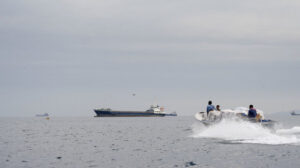
The bitter cup that Iran “drank” to the global economy by using the Strait of Hormuz as leverage to get the United States to back down in its campaign against it is now being drunk by Iran itself. Since Donald Trump’s blockade of Iran’s key ports of entry and exit took effect, he has reversed the conditions Tehran had previously set. “It seems perfect, but it’s actually dangerous gambling,” analysts say.
The issue for Trump is not just the economic hanging. Although he will certainly inflict pain on Tehran by stopping its key exports overnight (oil makes up 50% of Iran’s exports and hugely funds the regime’s needs, armaments, and the state budget), he may be looking forward more to the pressure that depriving Iran of oil will put on the Chinese economy. And to anticipate – since the Chinese economy depends on Iranian oil for its growth in large part – Beijing’s reaction and influence (to put it politely) on Tehran to make concessions and agree with Washington.
Typical is Vance’s description of this situation as “additional economic leverage” by the US in response to “the economic terrorism that the Iranians are trying to engage in, which as the President of the United States has shown, we can play that game too.”
With just nine days left in the – anyway fragile – ceasefire, Trump believes that a diplomatic intervention from Chi Jinping towards China’s key trading partner, Iran, will come very soon. As the world’s second largest economy imports about a third of its oil to meet its domestic needs from Tehran even today, amid war and blockade of the Strait of Hormuz, being cut off from this oil will come as a sudden shock to the Chinese economy, first and foremost, and will cause it a mini energy crisis – in the sense that it will be forced to switch suppliers to maintain a steady flow of oil.
Trump’s logic is that the pressure this situation will put on China will mean pressure from China on Iran and the enlistment of all the persuasion and “charm” available to Beijing to force Tehran to return to the negotiating table ready to accept the basic US terms. And most importantly, to commit to renounce any attempt and any aspirations to acquire nuclear weapons in the near or distant future.
The backfire on Trump
There is, of course, the backfire, the reverse firing of the weapon that Trump is proposing to Tehran. Because the blockade of the Straits and Iran’s ports is causing a huge risk factor for the world’s second largest economy, which could be seen as a finger to the first largest economy to prevent it from growing further.
Inevitably, it could therefore lead to tension between Beijing and Washington and bring about countermeasures from the Chinese, as we have seen in the trade war with tariffs and the blocking of technology exports (in the form of microchips) that led to a blocking of rare earth exports from China.
As China is by far the largest buyer of Iran’s oil and has continued to receive shipments through the Straits since the war began, this blockade will be very bad for Beijing, analysts say.
A blanket ban on tankers carrying Iranian crude threatens to cut off that supply, risking to reignite US tensions with Beijing ahead of Trump’s planned visit to China next month. “I doubt Trump is ready for such an escalation,” analysts predict, adding that “it would not be surprising” if Trump backtracked on his previous threats.
But it’s not just Beijing, but also Washington’s allies from whom the … backfire could come. See, for example, that the first to react to the blockade of the Strait of Hormuz by the United States is Saudi Arabia. The kingdom is, as reported by the Wall Street Journal, pressuring Washington to lift the blockade of the Strait of Hormuz and return to the negotiating table, fearing that this move by President Trump will have the opposite effect, namely that it could lead Iran to escalate its military actions and disruption of the global oil supply chain by blocking other important shipping routes. For example, Saudi Arabia is concerned that Iran, in “response,” will choose to close Bab al-Mandeb, a Red Sea passage critical to the kingdom’s oil exports.
This Saudi reaction not only echoes the nervousness that the US blockade of the Straits has caused in global markets (the return of oil to $100 and the downward trend in markets is typical), but also the shock that the realisation, after the barrage of missile attacks by Iran, that there is no longer that “security blanket” that these countries thought they enjoyed from the US.
In any case, however, Donald Trump is sending Tehran a message of determination, showing that he is determined to cause the serious disruption to the global economy that Tehran has threatened or attempted, deepening the oil shock already underway in the global economy. Based on Lloyd’s List Intelligence, oil tanker traffic through the Strait, which had begun to gradually increase after President Trump announced a two-week ceasefire last week, stopped again hours after he announced the blockade. At least two ships that appeared to be heading for the exit turned around.
At the same time, and as investors rushed to discount a further contraction in supply in the Persian Gulf, crude oil was rising again. U.S. WTI futures for May delivery rose more than 8 percent to $104.40 a barrel, while Brent rose more than 7 percent to $101.86.
President Trump’s order came after the collapse of 21 hours of weekend negotiations between Washington and Tehran, with no agreement reached on Iran’s nuclear program, control of the sea route and Israel’s ongoing attacks on Iran-backed Hezbollah in Lebanon.
The risk is there, of course, for the global economy. Until the region surrendered to the flames of war, about a fifth of the world’s oil passed through the Strait of Hormuz. Since then, this flow has been reduced to a minimum, upsetting the supply chains for oil, fertilisers, clothing and industrial products. Analysts have warned that clearing the build-up could take weeks, even after the crisis is resolved.
A complete blockade would further exacerbate the pressure. “Removing more oil from the market – particularly the only oil now leaving the Persian Gulf – will drive oil prices up further… to about $150 per barrel,” says Quincy Institute for Responsible Government executive vice president Trita Parsi.
In addition to crude oil, commodity prices for fertilizer and helium – critical inputs for food production and semiconductor manufacturing – are likely to continue to rise, fueling already accelerating inflation, other analysts explain. Not coincidentally, IMF and World Bank officials warned last week that they would downgrade their global growth forecasts and raise their inflation forecasts, warning that emerging markets would be hit hardest.
“The economic impact of attacks on energy facilities and ports in Iran and other Gulf countries may continue to put pressure on supply in emerging markets in Asia,” Barclays said. “It remains to be seen how quickly oil and gas extraction, refining and loading can normalise.”
Ask me anything
Explore related questions




