





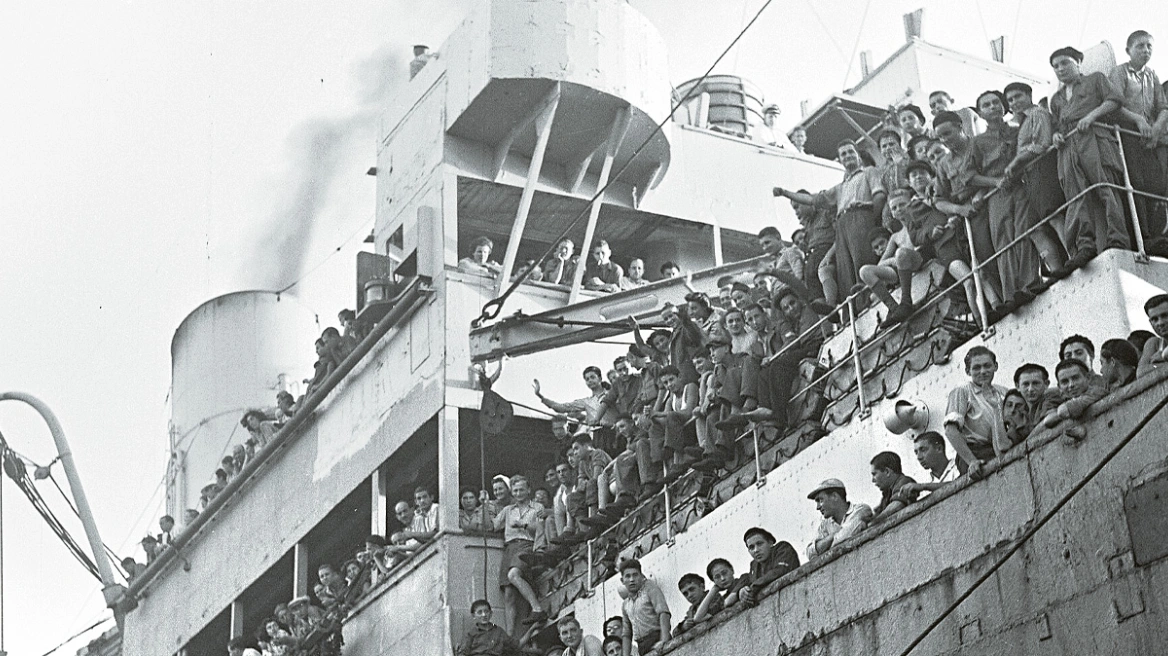
On the eve of Christmas 1945, it sailed from Piraeus carrying, among others, scholarship recipients of the French government: the philosophers Cornelius Castoriadis, Kostas Axelos and Mimika Kranaki, the architects Aristomenis Provelengios and Takis Zenetos, the painter Dikos Vyzantios, the writer Elli Alexiou and the poet Matsy Hadjilazarou, companion of fellow passenger-poet Andreas Embirikos, as well as the philologists and historians Emmanouil Kriaras and Stamatis Karatzas, and finally the musician Iannis Xenakis and the Byzantinist Eleni Glykatzi-Arveler—although it was later argued that the last two arrived in Paris at a later time.
The “missing” passenger
Among all those considered worthy of receiving the scholarship and representing the hope of Greek letters and arts, the name of a painter also appears. He was later mentioned posthumously by the New York Times: Nikos Balogiannis, who appears to have distinguished himself as a visual artist in America.
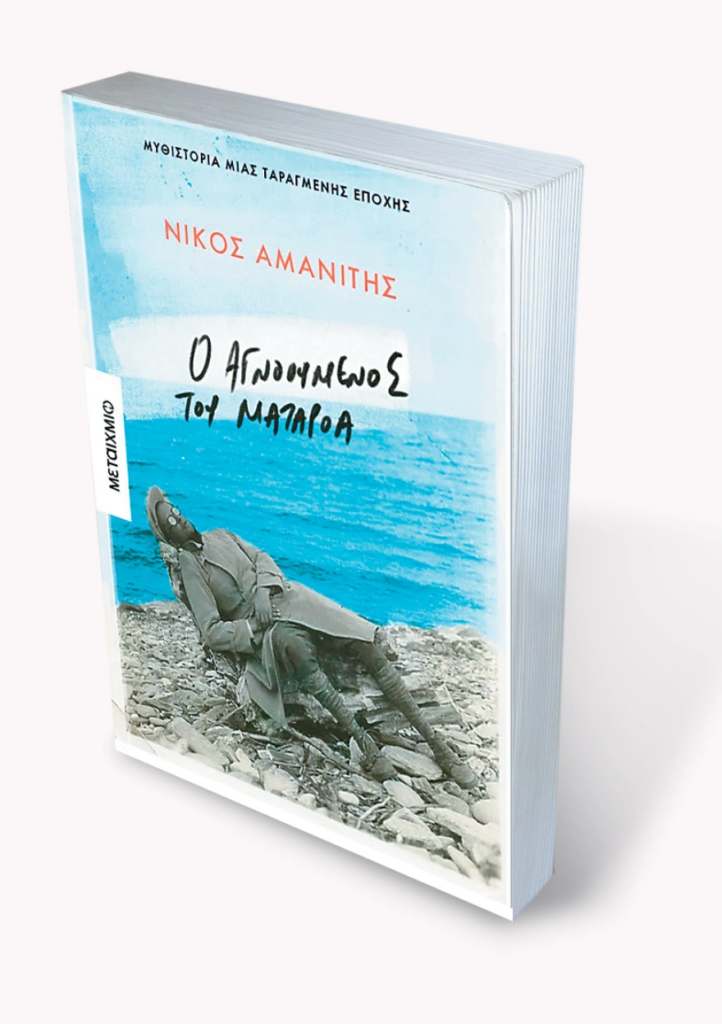
His traces, long lost, and his remarkable life story were later explored by journalist and writer Nikos Amanitis in his book The Missing Man of Mataroa, published by Metaixmio with the subtitle “A novel-history of a turbulent era.”
A love letter 27 meters long
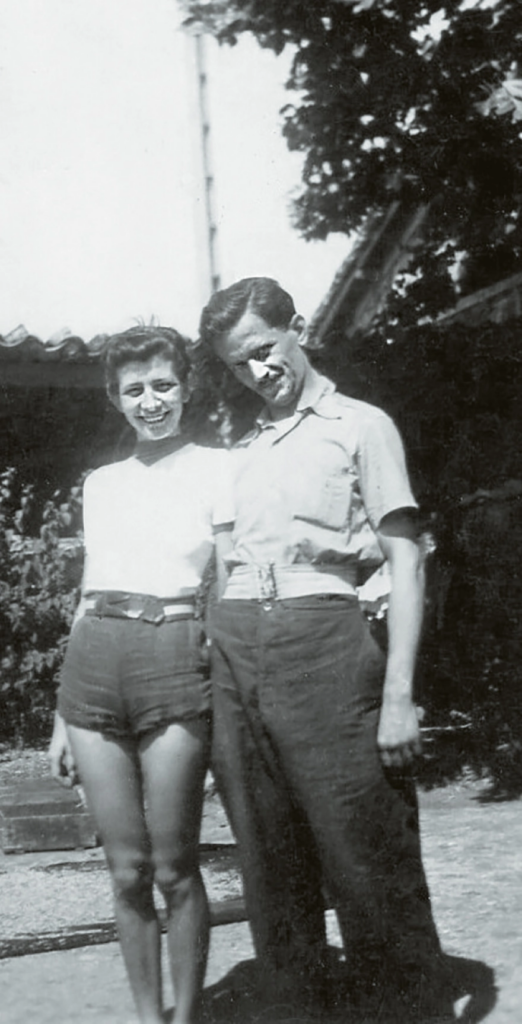
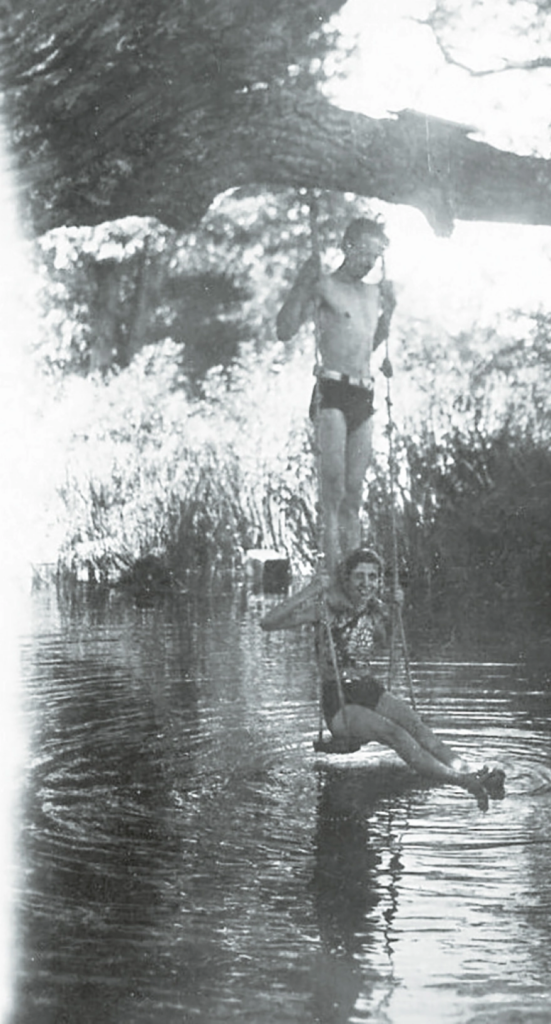
The Greek painter Nikos Balogiannis appears in photographs with his French lover “Moon,” a passion reflected in a love letter 27 meters long, written in continuous sheets forming a scroll.
It is no exaggeration to say that the ship that carried these prominent representatives of intellectual life resembles a living fantasy in itself—a mirror of a country that, due to circumstances, seemed to be losing its cultural capital.
This highly capable intellectual force found itself traveling together, embodying all the potential and aspirations of the country from different origins and backgrounds. More precisely, they were selected as recipients of a prestigious scholarship by Octave Merlier, then director of the French Institute.
Although for years this major historical event—repeatedly referenced by French scholars such as historian Pascal Ory—was absent from Greek bibliography, it was only with the important studies of Nelly Andrikopoulou (The Voyage of Mataroa, 2007, Estia Publications) and, more recently, Nikos Manitakis (From Myth to History, Asini Publications) that a fuller picture emerged.
Even more detailed is the approach of Nikos Amanitis, who not only presents the historical facts accurately but also brings the era vividly to life through literary narrative skill.
The departure from Piraeus
As Amanitis describes:
“It was the early hours of a sunny Friday, 21 December, when Mataroa sailed between Aegina and Faliro, anchoring offshore in the port of Piraeus, which had not yet been cleared of bomb damage. Passengers were informed before dawn, but neither military buses for transport nor trucks for luggage—assembled for days—ever appeared. They made their way to Piraeus alone, by whatever means they could find.”
A newspaper of 15 November 1945, just a month before that morning, published a diagram of the port with the caption: “The Port of Piraeus as it is today, with its destroyed sections and shipwrecks.”
Chaos prevailed at the port: customs, passport control, and one last humiliating ordeal—extensive baggage inspections, supposedly for currency control. The luggage created an unbelievable sight.
Nikos Svoronos, in a series of broadcasts on France Culture, estimated that it occupied 16 square meters and reached over 2 meters in height.
The travelers carried with them “everything they believed they would need in exile—everything they had and did not have: manuscripts, books, typewriters, tools, clothes, rugs, objects of every kind, vinyl records, medicines, photographs, their fetishes, boots for distant mud, hats and umbrellas.”
Everything was crammed into old cardboard suitcases, wooden crates, sacks, and improvised bundles.
One person brought 30 kilos of canned food. Sculptors carried their heavy tools. Kostas Koulentianos brought his bicycle. Nikos carried a long manuscript rolled up.
The boat that was supposed to transfer them never arrived. Eventually, around 7 p.m., the last passengers boarded, along with their belongings, after military cargo and supplies had been loaded.
Friends and relatives had long since left.
The unknown painter
In particular, the case of Nikos Balogiannis—who was among the first to board the New Zealand ship in pursuit of his fortune and ultimately a second life in America rather than Paris—raises questions.
What led this prominent artist, a former member of the EAM resistance, to be included in the list of Merlier’s scholarship recipients and the Mataroa passengers? And what is the unknown love story that followed him throughout his life?
A 27-meter letter
The story of the “Missing Man of Mataroa” begins with an unsigned painting of colorful tree trunks found in the author’s parents’ home, which leads him to the man who once stayed there.
“He was called Balogiannis, had left on the Mataroa and ended up in America, where he changed his name to Bel-John, started a family, worked, and died there many years ago.”
The narrative unfolds alongside a 27-meter-long love letter and is based on verified historical data and an extensive bibliography.
It also reconstructs the atmosphere of both Athens and Paris during the prewar and occupation years, moving between real history and literary storytelling.
Paris, war, and exile
From the Luxembourg Gardens, the cafés of the Latin Quarter, bookstores, and romantic walks of interwar Paris, we move to wartime Greece, the Occupation, and the Dekemvriana.
Everything described in Balogiannis’ letters is carefully cross-checked with historical sources, creating a hybrid of research and narrative reconstruction.
The book becomes a living document of an era—between Athens and Paris, war and art, memory and imagination.
A life between myth and history
The narrative also reconstructs the war experience of Balogiannis, an EAM fighter, who wrote passionate letters to his beloved “Moon,” filled with longing, imagination, and survival instinct.
His correspondence reveals both bravery and narcissism: during one attack, what concerns him most is not his injury, but whether his newly acquired coat has been ruined.
His Parisian life of 1939 appears vivid, bohemian, and deeply artistic, surrounded by painters, writers, and musicians.
The power of myth
As time passes, the passengers of Mataroa come to represent something larger than history itself. Their voyage becomes a symbol of intellectual exile, cultural rebirth, and postwar transformation.
As Amanitis writes, none of the passengers could have imagined that decades later, merely being on that passenger list would become a mark of identity and distinction.
Over time, Mataroa became one of the legendary ships of history—a mythical vessel of Greek intellectual life, even encompassing figures who were never actually aboard.
It became a symbol, a story, and eventually a myth that continues to shape how we understand an entire generation.
Ask me anything
Explore related questions




