





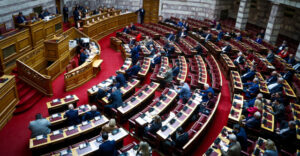
In an atmosphere of intense tension, today’s meeting of the Plenary Session of the Parliament for the discussion and decision on the requests for waiver of immunity of 13 members of the Southwestern Party who are referred to the two new files of the European Prosecutor’s Office on the case of OPEKEPE.
The debate is scheduled to begin at 12 noon, and the MEPs will reportedly ask to speak and reiterate what they argued in the Ethics Committee.
They will talk about the substance of the case that concerns them, present the facts and argue that the European Public Prosecutor’s Office indictment is flawed as it is based on fallacious conclusions about both their criminal involvement and the assessment of financial loss.
At the same time, they will call on the other MEPs to vote in favour of the withdrawal to claim their innocence before the natural judge, as otherwise there is a risk that a message of cover-up will be sent out, regardless of whether the indictment against them is, as they claim, patently perforated.
What prevented the mass guerrilla
The spontaneous request of the 13 referred to in the two separate indictments appears to have played a catalytic role in turning the tide within the blue CO and averting a mass guerrilla action by dozens of MPs who were gearing up to vote against all or most of the prosecution’s requests.
The contacts made in the last hours by Deputy Prime Minister Kostis Hatzidakis and the secretary of the blue party’s CO Maximos Charakopoulos with persons who were considered “suspected” of differentiation also had a fire-fighting effect.
However, sources from the majority camp argue that what would completely balance the climate in the internal party would be a public statement by the government that none of the people involved – current or future – will be excluded from the ballot papers without a final conviction, especially if the alleged offences are of a misdemeanour nature. This issue, however, appears to be deferred to the upcoming crucial meeting of the CO at the end of the month.
The suspects
However, there are cases of ND MPs, such as that of Makis Voridis, who are considering differentiating themselves based on their legal disagreement with the logic of the European Public Prosecutor’s Office, although at the crucial time, they will take into account the wishes of their 13 colleagues. Based on the wishes of the persons mentioned, who will finally vote, Mr Adonis Georgiades insists, however, that the evidence is not sufficient.
At the same time, George Vlachos and Stratos Simopoulos note that they want to hear the positions of colleagues and then will formulate an overall opinion while some disagree with the legal rationale but do not want to come to a break with the Prime Minister, such as Stelios Petsas, the path of abstention is opened for some of them. Finally, it should be noted that many of the 13 MPs mentioned are also oriented to abstain from voting altogether.
The procedure
Today’s procedure provides for two rounds of debate on as many as the files requesting the waiver of immunity of 11+2 MPs.
In the first phase, the following will take the floor: K. Papakosta, K. Karamanlis, I. Kefalogiannis, K. Skrekas, L. Vassiliadis, K. Tsiaras, D. Varztopoulos, M. Senetakis, Th. Leontaridis, Chr. Boukoros and N. Mitarakis, and then parliamentary representatives or political leaders from all the parties will take the floor to follow a similar procedure for the removal of the X. Athanasiou and T. Hadjivassiliou. The final decision on each of the 13 cases will be taken by the members of the national delegation by electronic, roll-call, and open vote. A simple majority of the Members present is sufficient to lift immunity.
Background
The second phase of the OPEKEPE case (the first was in June 2025 with the case against Voridis – Avgenakis) emerged in the public sphere 22 days ago with the announcement by the European Public Prosecutor’s Office 22 days ago that it is forwarding new case files to the Parliament.
A total of 14 sitting members of the government majority and another “blue” former minister (Sp. Livanos) were at the centre of the case, with the number of those involved reinforcing the sense of a wider scandal that threatens to overturn the established political correlations and creates the need for deeper institutional breakthroughs.
However, today, following the sending of the files to parliament and a thorough examination of their contents, a clearer picture is emerging. The information included allows for calm but meaningful assessments of both the legal background and the real, political implications of the case.
As is clear from the finding report, which runs to more than 120 pages, the European Public Prosecutor’s Office did not choose the route of simply recording and documenting the facts. It mainly proceeds to assessments, interpretations and conclusions about conversations between MPs or their associates with the OPEKEPE administration. These conversations date back to 2021 but were only processed in the last few months. Early reports claimed that this material was originally filed as having low criminal value.
In recent days, however, prosecution sources have attempted to throw the ball of blame at the Internal Affairs department of the ELAS, which carries out the legal link-ups, claiming that it had forgotten in its cabinets about 120-140 CDs with recorded conversations or that it was sorting through cases.
Vartzopoulos’ “Can it be done?” and the no-fault file on Athanasiou – Hadjivassiliou
In any case, the manipulations of the Greek branch of the European Public Prosecutor’s Office refer to a “salamization” of the overall file, as 4 files have already been transmitted to the Parliament, while a continuation is announced. At the same time, legal experts with knowledge of the documentation speak of a “bagging” of disparate cases that present huge discrepancies in terms of their criminal background and actual financial damage. They say that the case of Katerina Papakosta seems indeed aggravating in terms of substance (i.e. forgery) and the amount of damage caused (142,000 euros).
On the opposite side is the case of Dimitris Vartzopoulos as the prosecution “criminalizes” the phrase “whatever documents you need at your disposal. Can it be done?” written by the former minister, accompanying the forwarding of a producer’s request. According to the audit authority, the phrase demonstrates “that they knew that the file was empty/illegal and were requesting its extra-institutional, ‘after-the-fact’ regularisation”, however, the study of the file does not provide any substantiation of the claim. The cases of Tasos Hadjivassiliou and Charalambos Athanasiou are also characteristic, and this is because the European Public Prosecutor’s Office referred them to the European Court of Justice without attributing an offence to them, as the request they had forwarded was never implemented.
The considerations and the pattern
However, experienced legal experts estimate that most of the cases will not even go to the courtroom as the files will be dismissed as unfounded during the pre-trial proceedings. However, for that to happen, the plenary session would have to approve today’s 13 prosecution requests. The other case file on former Rural Development Minister Spilios Livanos and Deputy Minister Fotini Arabatzi follows the procedure of Article 86 of the Constitution and the Law on the Responsibility of Ministers, which means that they can only be examined by a preliminary investigation committee. According to reports, if there is a request from the opposition, the government majority will approve it so that, through fast-track procedures, the two officials can be referred for further proceedings to the Judicial Council.
In any case, the sequence of events as recorded in the multi-page material of the case file outlines a familiar, long-standing, and distorted practice that characterizes many aspects of the Greek state. Producers believe that they have been wronged in the calculation of the amount of the subsidy to which they are entitled for various reasons, either because the competent services did not correctly count their land or livestock (i.e. satellite and digital recording systems are not at least fully operational), or because of the poor processing of their applications by private centres for the reception of declarations (RRCs), or because checks have indeed revealed irregularities.
However, instead of going to a local law firm, they resort to the local MP to solve their problem. For their part, the MPs appear to directly forward the citizens’ requests as they are a potential electoral clientele without being sure whether they know that satisfying them is illegal or not.
The oxen of Papakosta
There are for example cases such as Katerina Papakosta where it is clearly evident that she not only knew but pressured to alter the file of a producer who while claiming to own 70 oxen was found to have 58 during an on-site inspection. In order to prevent the farmer from being excluded from the subsidy system and charged the relevant fine, the Member of Parliament appears to be coordinating an operation of illegal intervention in the computerised veterinary database so that the annual declaration could be ‘corrected’.
“Mr. Z. (a veterinary surgeon) went in and corrected the date so that it would appear that the reduction of animals was done before the audit. So if it was indeed done, that means there was no reason to object. I just point out to you that because he is a very important person, and we have assured him 99.9%,” appears to say to D. Mela. But while Papakosta’s case seems strongly aggravating as to the possible commission of an offence, the prosecution appears “inflationary” in its calculation of damages.
While the MP’s intervention concerns only one specific annual application for a subsidy, the auditing authorities, without apparent documentation, add up all the amounts received by the producer and the following years until 2024, turning the offence into a felony.
“Malliaras case” for Karamanlis – Lebanon
The case involving Kostas Ach. Karamanlis and the former Minister of Rural Development Spilios Livanos in the files of the European Prosecutor’s Office and even with offences of a felony nature is known in the Serres region as the “Malliaras file”.
George Malliaras, is an agronomist designer who operates a Declaration Reception Centre (RRC) in the region of northern Greece. RRCs are private offices that undertake on behalf of clients – farmers and livestock farmers – to collect the necessary documents and submit applications to OPEKEPE for the collection of subsidies. 37 producers turned to this centre asking to be included in “Measure 11” concerning organic livestock farming in order to receive subsidies ranging from 1,186.75 euros to 20,882.79 euros each.
However, their applications were rejected by the agency not as incomplete but as out of time, although the applicants appear to have submitted their documents on time. In searching to find the reason for rejection they found that the CID had temporarily suspended operations due to an exceptional and serious problem faced by the owner. Mr Malliaras himself recently stated that “this late submission and the consequent rejection of the payments was due to true and proven in writing force majeure, due to a serious health problem of my own, with urgent surgery and unavoidable treatments that occurred during the minimum delayed period of a few days in question, which I did not wish, but am forced under the circumstances, to make public.”
At that time, the 37 producers, seeking a solution to a problem they felt they had not caused themselves but which would have caused them financial loss, appear to have gone to the office of their local MP and from there their request was forwarded to the relevant ministry. According to the evidence in the file, there was no conversation between Mr Karamanlis or his associate. What does exist are communications between the then Minister’s seconded associates Spilios Livanos and officials of the OPEKEPE in which there is talk of the ‘Malliaras case’ which they link to the Karamanlis office. However, no immediate solution to the problem was found and the 37 were suggested to submit a hierarchical appeal, pointing out the reason of “force majeure” that made their initial declarations out of time.
Eventually, the appeal was granted, and the producers were paid as had happened in the previous two years. On the other hand, however, prosecutors focusing on the conversations recorded by the legal “bug” give a different interpretation of the events. They attribute “persuasive inducements”, “unprecedented institutional collusion” and “onerous political orders” that forced the then president of OPEKEPE, Dimitris Melas, to approve the hierarchical appeal and the illegal payments which cumulatively amount to 224,686.58 euros, elevating the offence for the two political figures to a felony.
The “greening” of Tsiaras
Another case where the immunity of an MP is being requested to be lifted not because of his personal conversations but of his associates, is that of Kostas Tsiaras. The file of the former Rural Development Minister is characterized as having a very low to non-existent criminal assessment, as it is not related to illegal subsidies and misappropriation of European funds. As he has publicly stated, a colleague of his office attempted to mediate to deal with a case of a producer who was at risk of a fine of only 190 euros due to earthworks carried out at that time by the Region of Thessaly for the damage caused by “Janos” and affected his property.
His pasture had been included in the subsidized “greening” scheme and had to be clean and short-mowed. However, an on-site inspection by the agency identified that part of its embankments was damaged due to work being carried out on an adjacent stream, due to natural disasters. After intervention by the Tsiaras office, the regional office of the OPEKEPE spoke to the central office, where they were advised to guide the producer so that he in turn, could indicate another parcel of land that could be included in the “greening” scheme.
Eventually the farmer cleared the original 1.4-acre parcel of land with his own resources so that he would not have any further problems and fines. Mr. Tsiaras commenting on the conclusion of the European Public Prosecutor’s Office accuses the authors of “complete ignorance” and explains “The case file accuses me of incitement for an amount of 22,900 euros. But is that so? The answer is this: this is all the money that this farmer received from all the crops, for all the types of subsidies and for all the parcels of land he had. Not in this case. This case refers to something specific that by regulation, is an independent subsidy. The total subsidy that this particular producer received for greening is EUR 2 970. The money that would have been deducted if this particular parcel was problematic is 190 euros for one and 429 euros if it was for all three.”
The seeds that burned Skreka
The sub-file concerning Kostas Skreka includes direct conversations with D. Melas, the content of which – and specifically the reference to “handy” intervention – seems to have “burned” him, although it is not certain whether his involvement is due to impressions or whether there is indeed incriminating evidence.
As, he claimed his intervention was for a farmer who had submitted a request for treatment with all the documents to OPEKEPE, as the agronomist-consultant did not register all the crops (seed varieties) in the system and as a result, he was excluded from the coupled aid scheme. The former ND secretary then called the administration of the agency to approve the request as the relevant invoices prove the reality. For his part, D. Melas appears willing to accommodate him, sells expropriation, and becomes “inflationary” as to the arduous effort he will make to “run” the request as another conversation reveals that he himself has asked for another favour from Mr. Skreka who was then Minister of Environment and Energy.
Requests by rotation and the Mitarakis-Bukorou involvement
The content of the documents also shows that many producers, in order to solve their problems with OPEKEPE, brought their request to almost all the offices of the politicians in their constituency. For example, a couple of young farmers of Magnesia asked for a solution to their problem not only from the local MP Christos Boukoros but also from the former MP Thanasis Loupis, so that today both of them are involved.
This particular case seems to belong to the category of cases where the beneficiary producers deal with their relationship with public services sloppily and frivolously. In this case, a couple of young farmers were excluded from the technical solution and national reserve allocation system when in late 2020 the then Minister of Rural Development Spilios Livanos issued a decree that threw out of the payment system those producers who had previously declared pastures with private leases.
Indeed, the couple in question leased the property from their grandfather, but in the process, when he passed away, they inherited it. However, the official transfer of the property was delayed and instead of appearing in the OPEKEPE system as the real owners, they chose to join the technical solution. When this formal omission finally cost them, they turned first to their distant relative Christos Boukoros and to Thanasis Loupis, also a local MP at the time.
In their turn, as is evident from the conversations, they called the then president of OPEKEPE so that a solution could be found. Their action, according to the European prosecution, constitutes an intervention that acted as a catalyst for the young farmers’ couple to “illegally” receive the subsidy. On the other hand, however, Boukorou’s environment notes that the settlement of the case was due to a horizontal regulation brought by the competent ministry at the time, which caught more than 1,000 farmers facing similar formal problems.
Similarly, a livestock farmer of Chios, when he found that the OPEKEPE services miscalculated the area of his pasture, resulting in a smaller amount of subsidy, resorted to the office of the island’s energy deputy, Donis Mitarakis, and that of the former Kostas Mousouroulis. It is a common secret that political offices of every hue, not only in the region but also in the basin, are for many people something like service centres. The producer presented a study by an agronomist-forester, which documented the mistake of the organization and the injustice caused to him while the recipients forwarded it directly to OPEKEPE.
Especially for Mr. Mitarakis there is no recorded conversation or sms of him or his associate.
Third party sms
According to the conclusion of the European Public Prosecutor’s Office, there is no direct dialogue of the MP of Pella, Lakis Vassiliadis. The MP appears in a third-party text message to the President of OPEKEPE D. Melas with the following content: “from Vassiliadis Lakis P.S. (i.e., name of breeder) VAT No. … FOR ANIMAL CHECK ON ANIMALS TO GO BACK”. However, according to reliable information, the case for which the MP’s immunity is requested to be lifted did not have a happy ending for the breeder. The audit was finally carried out, the producer did not receive the subsidy of approximately EUR 2 500 that he was seeking, and the agency imposed a fine.
Another case that makes an impression from the content of the dialogues and especially from D. Mela’s answers is the one involving Mr. Maximo Senetakis. The Heraklion MP intervenes to accept a farmer’s amended declaration, and instead of 330 sheep that he had originally declared to be registered in the 240 organisation, to justify the corresponding amount of milk he would have produced. Melas first states that the administrative modification framework is now done electronically and not manually, to then add “Now it’s a bit difficult… It’s collateral damage to them, but anyway, send it to me and see if I can get it in somehow…. Because it’s going in, you know, ram it in.”
Ask me anything
Explore related questions




