





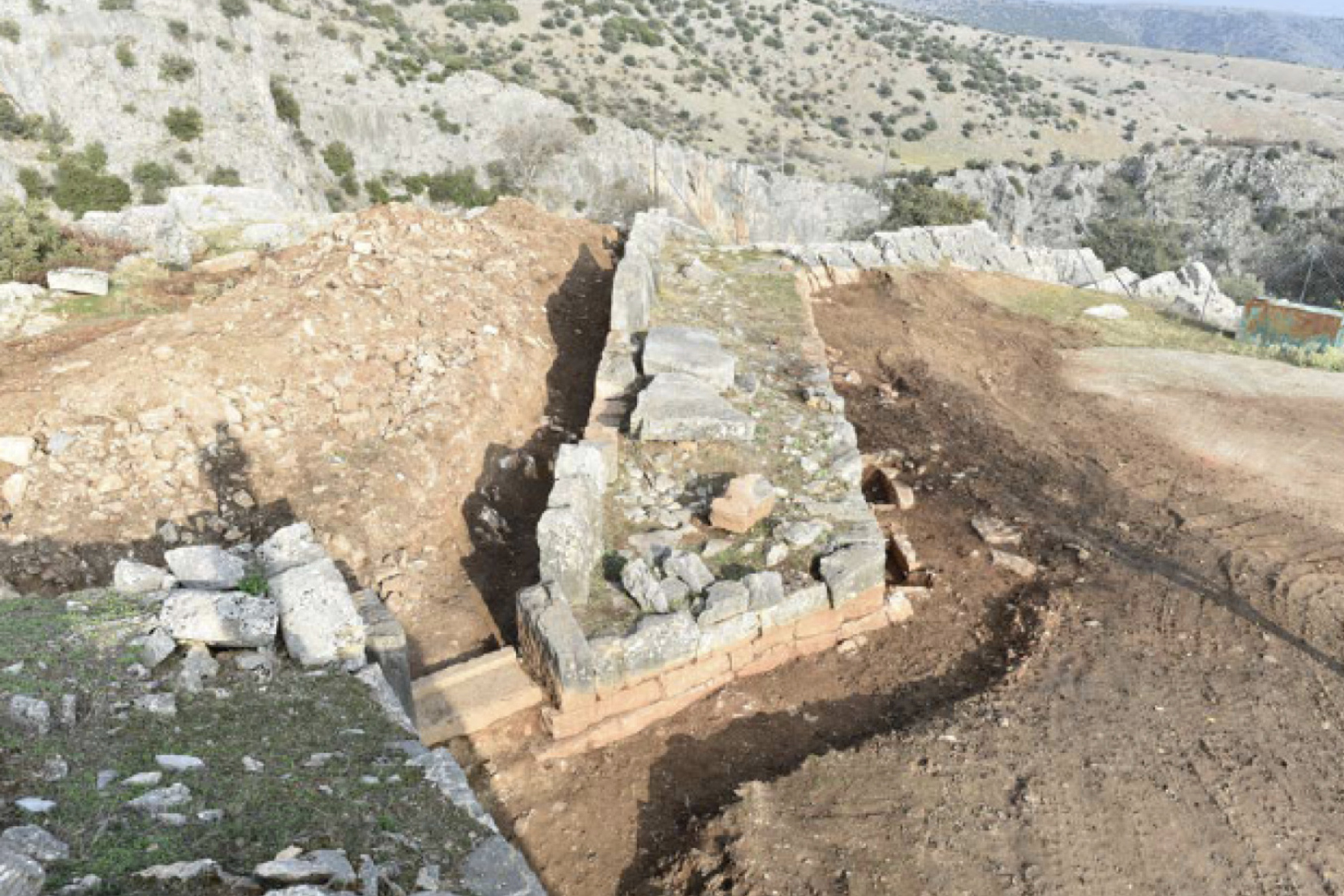
Ancient Pelinna, one of the most important cities of ancient Histiaeotis, is located approximately 16 km east of Trikala. During the late Classical and Hellenistic periods it experienced significant prosperity, when the older settlement was transformed into an acropolis and its lower city expanded into the plain, protected by a strong defensive wall. Macedonian rule in Thessaly ended with the defeat of Philip V in 197 BC. In 191 BC, during the Antiochian War, the Athamanians captured Pelinna, while later the city fell to the Romans and declined into obscurity. However, its strategic importance persisted into the Byzantine period, when the settlement of “Gardikion” developed on the acropolis, with continuous habitation until the early Ottoman years.
The acropolis, built in a naturally fortified position, is surrounded by a trapezoidal defensive wall on its western, southern, and eastern sides. Of particular importance is the northern end of the western side, where a strong bastion is formed with two towers and an intermediate wall section. The central part of the western wall is of ancient construction, with extensive medieval interventions, a fact that requires specialized and multi-layered treatment.
The goal of the ongoing works is to restore the structural cohesion of the remains, address moisture problems, dynamic loads, and foundation issues, as well as preserve all historical phases of the monument. The project includes masonry consolidation, reinforcement of cracks, partial anastylosis in sections at risk of collapse, improvement of drainage, and landscaping of the surrounding area.
Minister of Culture Lina Mendoni stated:
“The walls of Ancient Pelinna constitute one of the most important ancient fortification works in Thessaly. Its acropolis is a monumental complex of particular historical and archaeological value for the entire region, with outstanding architectural remains dating mainly to the Hellenistic period. Through the interventions currently underway by the Ephorate of Antiquities of Trikala, based on approved studies, the protection and restoration of the monument is ensured with full respect for its authenticity and diachronic character. Our aim is also, through the works carried out at the site, reflecting its long historical continuity, to strengthen not only the cultural identity of the wider region but also the sustainable development of local communities. With mild and fully compatible interventions, an important archaeological site is being created—accessible and safe—enhancing the cultural dynamism of Thessaly while generating new economic activities across the region.”
Ask me anything
Explore related questions




