





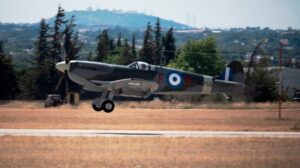
At the age of 103, George Dunn, a British bomber pilot during the Second World War, passed away. In 1947, he delivered the Spitfire MJ755 to his Greek counterparts—one of 77 aircraft provided by the British government after the war to help reorganize the Hellenic Air Force (HAF). The aircraft, later fully restored to flying condition, is now displayed at the Hellenic Air Force Museum in Tatoi.
In 2020, Dunn told the Athens-Macedonian News Agency in a telephone interview: “It was after the war. I flew on January 28, 1947. I carried out the final test flight before the aircraft was sent to Greece, where it had been sold (or transferred) to the Hellenic Air Force. We stopped in Cyprus for refuelling. The aircraft given to Greece were in Egypt, in a maintenance unit at the end of the war.”
According to author, editor, and historical documentary consultant Steve Darlow, who spoke to the Athens-Macedonian News Agency, Dunn served as a pilot in RAF Bomber Command during the war, flying Halifax and Mosquito aircraft on 44 operations. “His dedication and bravery were recognized with the Distinguished Flying Cross, and he was also awarded the Légion d’Honneur,” Darlow said.
Darlow also noted Dunn’s lifelong commitment to honouring his fellow Bomber Command airmen who were lost in the war. “His strong character, humility, love of life, and infectious laugh endeared him to many. Those who met him will feel a deep sense of loss, but also gratitude for having known him. For me, it marks the end of an era,” he added.
Dunn himself recalled in 2020 that he volunteered for the RAF in 1941 to become a pilot. He was sent to Canada for flight training in June of that year. Prior to that, in 1937, at the age of 13, he had left school to work for a transport company. His limited formal education led some in the RAF to question whether he could train as a bomber pilot, suggesting instead that he serve in transport gliders.
He went on to explain: “In July 1942, after returning to England, I began my first assignment on Halifax bombers, and later I was posted to the Mosquito, the light wooden bomber. I flew 30 operations in Halifaxes and 14 in Mosquitos, a total of 44 missions.”
One of his most significant wartime missions took place in August 1943, when he participated in the RAF bombing of Peenemünde in the Baltic Sea, targeting V-1 and V-2 rocket facilities. Because the mission was beyond the range of radio navigation systems at the time, it had to be carried out at night under a full moon, on the night of 17–18 August 1943.
“I was in the first wave of bombers out of three,” Dunn told the Athens-Macedonian News Agency. “Each wave had two squadrons. In our wave, we were not attacked by German night fighters—we were lucky.”
He also recalled that RAF Bomber Command had made clear that if the raid failed, it would be repeated the following night, and again if necessary, despite the expected heavy losses among aircrews.
After completing his Halifax missions and serving briefly as an instructor, Dunn flew the de Havilland Mosquito on operations against Berlin and other German cities. “The Mosquito was a wonderful aircraft to fly. It had everything—speed, climb rate, maneuverability. It was a true multi-role aircraft,” he said.
In 1947, he was posted to Egypt to ferry refurbished aircraft and flew the Spitfire MJ755 to Greece. More than 70 years later, he sat again in the same aircraft at Biggin Hill airfield in Kent, where it was undergoing restoration. After the war, he left the RAF with the rank of captain and returned to work at the transport company Pickfords, where he later retired.
In 2019, at the age of 98, he co-authored the book Resolute – To War with Bomber Command with Steve Darlow, reflecting on his wartime service. In May 2025, he appeared as a guest of honour at commemorations marking the 80th anniversary of the end of World War II in Europe.
Royal Air Force Charity Fund chief executive Air Vice-Marshal Chris Elliott said: “We were deeply saddened to learn of the death of George Dunn. George meant a great deal to everyone at the RAF Charity Fund and the wider Royal Air Force family. While he will always be remembered for his extraordinary service during the Second World War, he was equally admired for his generosity, warmth, and unwavering support for the Fund over so many years. We feel incredibly privileged to have known him and to have benefited from his support.”
Ask me anything
Explore related questions




