





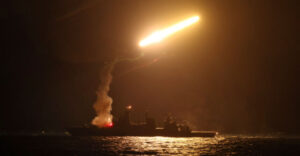
New strikes in southern Iran were launched by American forces, targeting missile facilities and vessels that, according to CENTCOM, were attempting to place mines in the Strait of Hormuz.
The new military escalation comes as negotiations continue between the United States and Iran for a possible de-escalation agreement, with Tehran acknowledging progress in the talks but rejecting assessments that a final agreement is imminent.
The CENTCOM announcement
US Central Command announced that the new raids were carried out in the context of “self-defense,” in order to protect American forces from threats attributed to the Iranian armed forces.
CENTCOM spokesperson Tim Hawkins stated that the US military “continues to defend our forces, demonstrating restraint during the ongoing ceasefire.”
According to him, the strikes took place near Bandar Abbas, a port city in southern Iran and the headquarters of a major Iranian naval base in the Strait of Hormuz, as reported by the New York Times.
Earlier, Iranian state media had reported that local officials were investigating reports of explosions in the area. So far, Tehran has not officially responded to the latest American strikes.
Progress in talks, but no agreement
Iranian Foreign Ministry spokesperson Esmail Baghaei stated that progress has been made in talks with the United States, while clarifying that an agreement to end the crisis “is not imminent.”
His statement came after remarks by US Secretary of State Marco Rubio, who had left open the possibility of an agreement even within Monday.
“It is correct to say that we have reached conclusions on a large part of the issues being discussed. But to say that this means the signing of an agreement is imminent — no one can make such a claim,” Baghaei said.
The memorandum of understanding currently on the table reportedly includes an extension of the ceasefire for 60 days, the reopening of the Strait of Hormuz, and a new round of negotiations over Iran’s nuclear program.
Trump’s statements on enriched uranium
Donald Trump stated that Iran’s stockpile of enriched uranium should either be handed over to the United States or destroyed under international supervision.
In a post on the Truth Social platform, the American president described the enriched uranium as “nuclear dust” and argued that it should either be transferred to the United States for destruction or destroyed on-site or at another acceptable location under the supervision of an international atomic energy organization.
Trump did not clarify whether he was referring exclusively to the approximately 440 kilograms of highly enriched uranium estimated to be possessed by Iran or to the country’s entire stockpile.
According to American reports, US officials are demanding the removal of the entire enriched uranium stockpile as part of a possible agreement.
Open issues in the negotiations
Despite progress in contacts, the talks are not expected to lead immediately to a final agreement.
American media report that critical issues such as sanctions relief, the release of frozen Iranian assets, and Washington’s demands for restrictions on Tehran’s nuclear program are expected to become the subject of new negotiations.
CBS News reported that, according to US intelligence services, Iran’s supreme leader Mojtaba Khamenei is in an unknown location, making communication with his envoys more difficult and slowing the talks.
At the same time, Iran’s chief negotiator and foreign minister were in Doha for meetings with the prime minister of Qatar, according to Reuters.
Fragile ceasefire and pressure on markets
American and Iranian forces have observed a ceasefire since April 8, however the situation remains extremely fragile.
Iran has maintained controls on shipping in the Persian Gulf through the Strait of Hormuz, while the US Navy has attempted to blockade Iranian ports.
The conflict began on February 28, when the US and Israel launched extensive strikes against Iran. Tehran responded with attacks against Israel and Gulf states considered allies of Washington, while the effective closure of the Strait of Hormuz caused major turbulence in international oil markets.
Over the weekend, Trump had implied that the two sides were close to an agreement, but later stated that he had instructed negotiators “not to rush.”
Despite the new military escalation, the price of US crude recorded a significant drop in Asian trading.
West Texas Intermediate (WTI) fell by more than 5% in Tokyo and at around 03:30 Greek time stood at $91.33 per barrel, marking a decline of 5.46%.
By contrast, Brent rose by 1.6%, reaching $97.68 per barrel.
Investors appear to be pricing in a possible full reopening of the Strait of Hormuz, provided there is further progress in talks between Washington and Tehran.
Ask me anything
Explore related questions




