





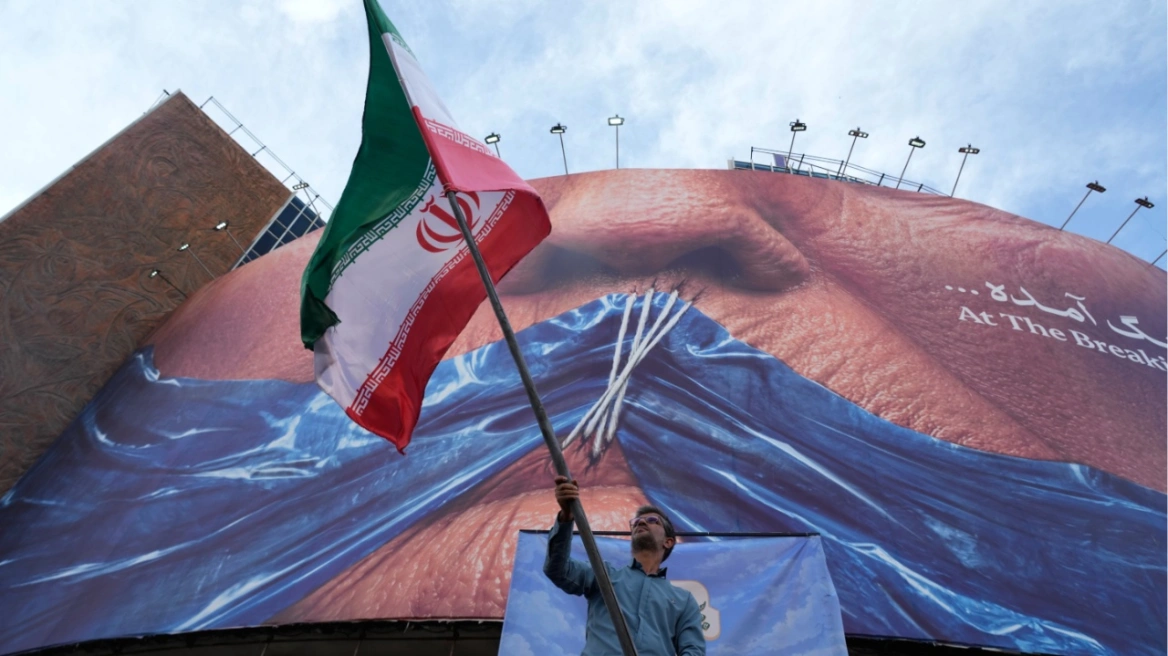
The conflict between the United States and Iran appears to be entering a critical phase, as Washington pushes for an agreement with Tehran while simultaneously maintaining military and economic pressure in the Persian Gulf region. U.S. President Donald Trump says that “the war will end quickly,” as American media reveal a draft 14-point memorandum aimed at ending the crisis, focusing on Iran’s nuclear program, sanctions, and navigation through the Strait of Hormuz.
At the same time, Tehran appears cautious toward the American proposal, while mutual threats, military maneuvers in the region, and diplomatic interventions at the UN continue.
The proposed U.S.–Iran agreement
According to Axios, the White House believes it is close to reaching a deal with Tehran through a one-page, 14-point memorandum that could serve as the basis for broader negotiations over Iran’s nuclear program.
The report, citing two American officials and other sources familiar with the talks, says the framework includes:
- a freeze on Iran’s uranium enrichment,
- lifting U.S. sanctions,
- restoration of free navigation through the Strait of Hormuz,
- gradual de-escalation of military tensions.
Sources cited by Reuters confirmed that mediation efforts between the two sides are underway, though the proposal’s terms have not been officially released.
The spokesperson for Iran’s Foreign Ministry, Ismail Baghaei, told the Iranian agency ISNA that “the American proposal is still being reviewed by Iran” and that Tehran would convey its positions through Pakistani mediators.
Pakistan’s foreign minister stated that his country is “trying to turn the ceasefire into a permanent end to the war.”
Trump: “Iran desperately wants a deal”
Donald Trump appeared especially optimistic about the talks.
During a tele-rally supporting Georgia Republican gubernatorial candidate Burt Jones, he said:
“When you see the things happening, we’re doing this for a very important reason: We cannot allow them to obtain a nuclear weapon.”
He added:
“I think most people understand that. They understand that what we’re doing is right, and it will end quickly.”
Earlier, speaking from the Oval Office during a meeting with UFC athletes, the American president insisted that Iran wants an agreement.
“They desperately want to make a deal,” he said.
Trump also claimed that Tehran’s military capabilities had been destroyed.
“They had a navy with 159 ships, and now every ship has been destroyed and is at the bottom of the sea,” he declared. “I think we won. If we left now, it would take them 20 years to rebuild. We are in a very good position.”
Addressing the UFC athletes, he repeated that Washington would never allow Tehran to acquire nuclear weapons.
“Iran cannot have a nuclear weapon. If that happened, the whole world would be hostage.”
At the same time, Trump warned via Truth Social that if Tehran does not accept an agreement, “the bombings will start again and they will be much more intense than before.”
Markets preferred the optimistic scenario. Wall Street closed significantly higher, inspired by the euphoric atmosphere in European stock markets. In early Asian trading, indexes also posted sharp gains. The price of Brent crude fell nearly 8% to $101.27 per barrel, far below the $126 reached days earlier.
The “freeze” of Project Freedom and Iran’s sarcastic response
The American president also announced the temporary suspension of “Project Freedom,” the U.S. operation aimed at restoring navigation in the Persian Gulf and escorting trapped ships through the Strait of Hormuz.
However, he clarified that the blockade of Iranian ports remains fully in force.
The announcement triggered a sarcastic reaction from Iranian parliament speaker Mohammad Bagher Ghalibaf.
“Operation ‘Trust me bro’ failed. Now back to routine with the ‘fake operation,’” he wrote in a post.
Meanwhile, Iran’s Revolutionary Guards hinted that the Strait of Hormuz could reopen if “the threats of the aggressors” end.
The Strait of Hormuz crisis and accusations at the UN
The crisis in the Strait of Hormuz remains at the center of international concern, as since late February Iran has effectively imposed a blockade on the maritime route through which about 20% of the world’s oil and natural gas passes.
The U.S. announced that it had stopped dozens of ships heading to Iranian ports, while CENTCOM stated that American forces had immobilized an Iranian oil tanker in the Gulf of Oman.
Meanwhile, the UN Security Council held closed consultations following a request from Bahrain after the Iranian attacks of May 4 against the United Arab Emirates.
The UAE alleged that Iran launched 12 ballistic missiles, three cruise missiles, and four drones, causing a fire in the Fujairah industrial zone and injuring three civilians.
According to the UAE’s permanent representative, since February 28 the country has intercepted more than 500 ballistic missiles and over 2,000 drones attributed to Iran.
Iran’s delegation to the UN argued that “the only sustainable solution is a permanent end to the war, lifting the naval blockade, and restoring normal passage.”
Netanyahu: “Full coordination with Trump”
Israeli Prime Minister Benjamin Netanyahu stated that there is “full coordination” with Trump regarding Iran.
“There are no surprises. We share common goals, and the most important is the removal of all enriched material from Iran and the dismantling of enrichment capabilities,” he said.
His comments came after a new Israeli strike in Beirut, where, according to Israel, a senior Hezbollah figure was killed.
Ask me anything
Explore related questions




