





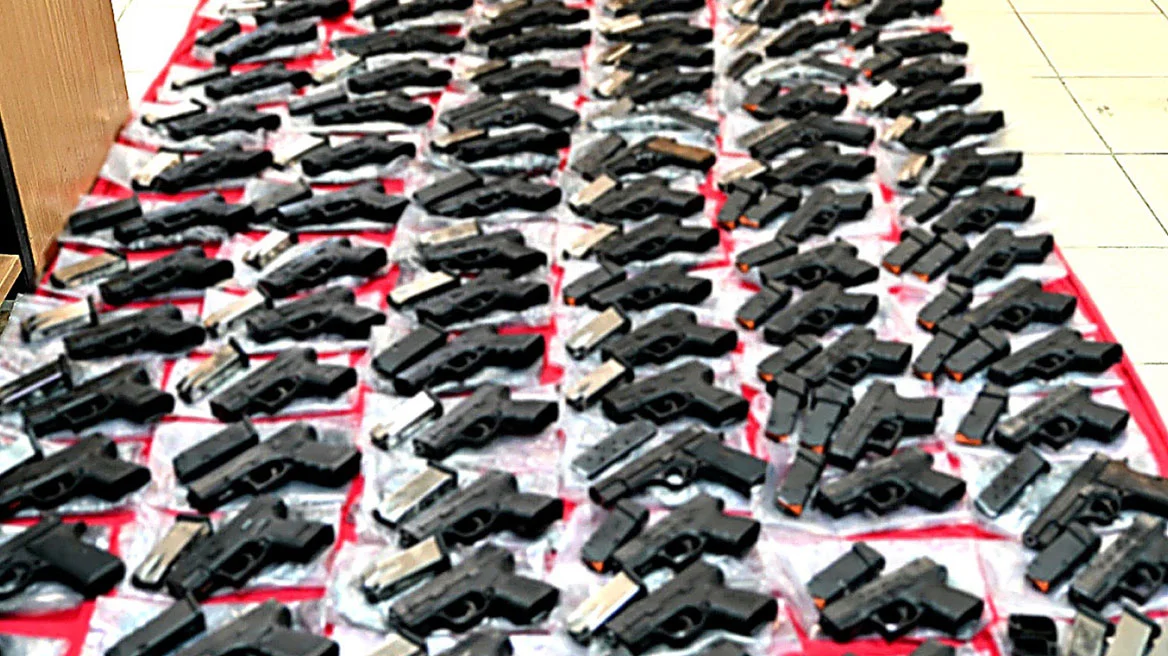
The image of 147 guns lined up in rows, together with magazines and weapon components, caused a sensation in early October 2025 when it was released by Hellenic Police as part of an operation targeting Turkish gangs operating in Greece.
The operation by the Hellenic Police in Evros was presented at the time as a major blow against an arms-trafficking network with international connections, with authorities estimating that the shipment was destined for criminal organizations, including the Turkish gang known as the “Daltons.” However, behind this operation there appears to be another dimension, reflected in defense documents and the defendants’ testimonies. The 15 Turkish nationals arrested at the same location, including two minors, deny any connection to the weapons and say they are members of Fethullah Gülen’s movement, claiming they came to Greece to seek asylum.
How the police arrested them
According to the case file, the investigation began after authorities received intelligence about organized arms-trafficking rings composed mainly of Turkish nationals. The information indicated that a large quantity of weapons was to be smuggled into Greece through unofficial crossing points along the Greek-Turkish border, with the goal of supplying criminal groups.
The area placed under surveillance was the riverside zone of Evros between the villages of Lagyna and Tychero. On the night of October 1, 2025, a police unit was assembled, and in the early hours of the following day officers were deployed in the area. At around 10:00 a.m., police spotted a group of people entering Greek territory and remaining near the riverbank. Initially, discreet surveillance was chosen, as officers believed a vehicle or another person might arrive to pick them up. When no such movement was observed by noon, police intervened.
A total of 15 people were found at the scene. According to the case file, two large bags and a travel suitcase were located no more than one meter from the group. The luggage contained 147 pistols from various manufacturers, 173 magazines, ammunition, and numerous weapon parts such as barrels, firing pins, and trigger mechanisms. The items had been carefully wrapped in plastic bags to protect them from moisture.
Authorities placed particular emphasis on the weight of the bags, which allegedly exceeded 130 kilograms in total, arguing that transporting them required a coordinated effort.
The case file also notes that the weapons could be used either as complete firearms or for assembling new ones. A Bulgarian identity card was also found and later determined to be fake after communication with Bulgarian authorities.
Police assess that the case fits into a broader pattern involving international criminal organizations that use uncontrolled border points and boats to transport weapons. Reference is also made to smugglers and intermediaries responsible for receiving and distributing the arms.
“We are Gulenists”
The detainees present a very different version of events, further complicating the case. According to their statements, they come from areas around Istanbul and paid smugglers around €4,000 each to cross into Greece.
They claim they were transported by boat across the Evros River and that the bags were already on the vessel before they boarded. According to them, they did not know the contents of the luggage and had no connection to the weapons. One of the defendants reportedly admitted receiving instructions via mobile phone to carry luggage but insisted he did not know what it contained.
During preliminary questioning, most denied the charges, saying they would respond before judicial authorities, while one partially retracted his initial statement.
The profile of the defendants, according to defense documents, is also notable. Among them are highly educated individuals, including university graduates and professionals with specialized training. One example in the case file mentions a graduate of a polytechnic university in Turkey.
According to the same documents, one defendant is allegedly a former police officer and graduate of an economics department. He is the husband of the woman detained in Thebes prison together with their infant, who has now spent months in detention.
The woman has repeatedly filed requests for release, primarily invoking the child’s welfare and arguing that the infant should not remain in prison. However, all requests have so far been rejected by judicial councils in Alexandroupoli. Another release request, submitted on February 20, 2026, remains pending before the investigating judge in Alexandroupoli, although reports indicate the prosecutor has already recommended rejection.
All detainees identify themselves as members of the Gülen movement and claim they fled Turkey fearing persecution. They say they remained for hours on the riverbank waiting to be discovered by Greek authorities and made no attempt to escape.
An infant and a young child among those arrested
A particularly sensitive aspect of the case is the presence of children among the detainees. According to defense submissions, an infant who was six months old at the time of the arrest is now 12 months old and remains detained with the mother.
The mother, accused in the same case, is being held in Thebes prison, with the child staying with her due to the child’s age. The defense also points out that the 45-page judicial ruling contains no reference to the fact that the woman is imprisoned together with her baby. The defense argues that this omission reflects shortcomings in portraying the true circumstances.
There is also mention of a second minor child from the same family, aged five, who is temporarily living in Greece with a relative — specifically the child’s uncle. According to the documents, the child is currently an asylum seeker.
The accused were placed in pretrial detention from the first day, while requests for release or replacement of detention measures were rejected by the competent judicial councils. Court documents also raise issues regarding translation of the case file and the defendants’ access to its contents, as well as claims of insufficient evidence.
What is the detainees’ real connection to the weapons?
The Evros case is therefore unfolding along two parallel tracks that are difficult to reconcile at this stage of the investigation.
On one hand, the police case file describes an organized arms-smuggling operation with concrete evidence, a specific operational timeline, and material whose existence is not disputed. The weapons are real, catalogued, and numbered, in quantities that police sources say could equip a small “army.” The image of 147 pistols, dozens of magazines, and weapon parts leaves little doubt about the scale and seriousness of the discovery.
On the other hand, the defendants maintain a completely different account, insisting they had no knowledge of the contents of the bags found beside them. They claim they were simply being smuggled into Greece to seek asylum and had never been involved in weapons trafficking.
Within this framework, they also raise another claim: that they themselves may have fallen victim to a setup, with the weapons allegedly placed or “loaded” in a way designed to implicate them. According to their account, they do not rule out the possibility that individuals or networks connected to supporters of Erdoğan’s government were behind the incident in order to target people associated with the Gülen movement. These allegations are not confirmed by the case file, but they form part of the defense strategy.
Between these two levels — the undisputed physical evidence and the claims of entrapment — lies the ground on which the judicial assessment of the case will have to proceed. The central question remains: what is the real relationship between the detainees and the weapons found beside them?
Until that question is answered, the case continues to attract attention not only because of the weapons discovered in Evros, but also because of the human and political dimensions surrounding it. Among them is the image of an infant growing up inside a prison and a child living apart from their parents — silent reminders that behind every criminal case file there are also personal stories and tragedies unfolding alongside the judicial process.
Ask me anything
Explore related questions




