





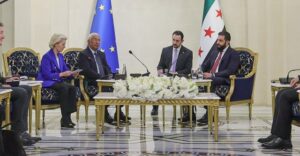
According to the announcement, the decision is considered an important step toward strengthening bilateral relations between the European Union and Syria, following years of restrictions and sanctions imposed because of the civil war.
The European Council stressed that the move “sends a clear political message about the European Union’s commitment to re-engage with Syria and support its economic recovery.”
The suspension, initially imposed in 2011 and expanded in 2012, mainly concerned restrictions on imports of certain Syrian products, including oil, petroleum products, gold, precious metals, and diamonds.
Assad’s Fall and the EU’s Shift in Position
According to the European Council, the conditions that led to the suspension no longer exist following the fall of the Assad regime in December 2024 and the EU’s May 2025 decisions to lift economic sanctions on Syria, except for those related to security matters.
The EU noted that the decision is part of its broader policy to support a “peaceful and inclusive political transition” in Syria, as well as to facilitate the country’s social and economic recovery.
“The decision sends a clear political message about the European Union’s commitment to re-engage with Syria and support its economic recovery,” the Council’s statement said.
What the Agreement Provides
The Cooperation Agreement between the European Union and Syria was signed in 1977 and served as the main framework governing economic and trade relations between the two sides.
Following the outbreak of the war in Syria and the Assad regime’s crackdown on anti-government protests, the EU imposed a series of restrictive measures and sanctions, including the partial suspension of the agreement.
The European Council also announced that the European Commission will officially notify the Syrian authorities of the termination of the suspension.
The decision takes effect immediately from the date of its adoption, while the provisions of the agreement being reinstated will apply from the first day of the following month after notification to Damascus, allowing time for technical implementation.
At the same time, the EU reiterated its support for a political process based on respect for human rights and Syria’s reintegration into the international economic system.
Ask me anything
Explore related questions




