





Seismic activity has always been a defining characteristic of Greece. However, the intensity of an earthquake alone does not determine the consequences. The real scale of destruction is directly linked to the quality and characteristics of the building stock, which in Greece remains highly uneven.
Apartment buildings from previous decades, constructed under older anti-seismic regulations, coexist with newer buildings built to higher standards, creating a complex picture regarding the actual resilience of structures.
In many areas, the aging building stock increases vulnerability to damage regardless of seismic activity levels, highlighting weaknesses that still exist in a large portion of buildings. The key question, therefore, is not only where a strong earthquake may occur, but mainly where its consequences could be most severe.
As Professor Konstantinos Spyrakos of the National Technical University of Athens explains to protothema.gr, scientific groups in Greece have in recent years opened discussions on revising the country’s anti-seismic framework, alongside updates to European regulations. According to him, a new seismic hazard map for Greece is being examined, which will redefine maximum seismic accelerations and, consequently, construction design requirements.
The “Red Zone” Areas
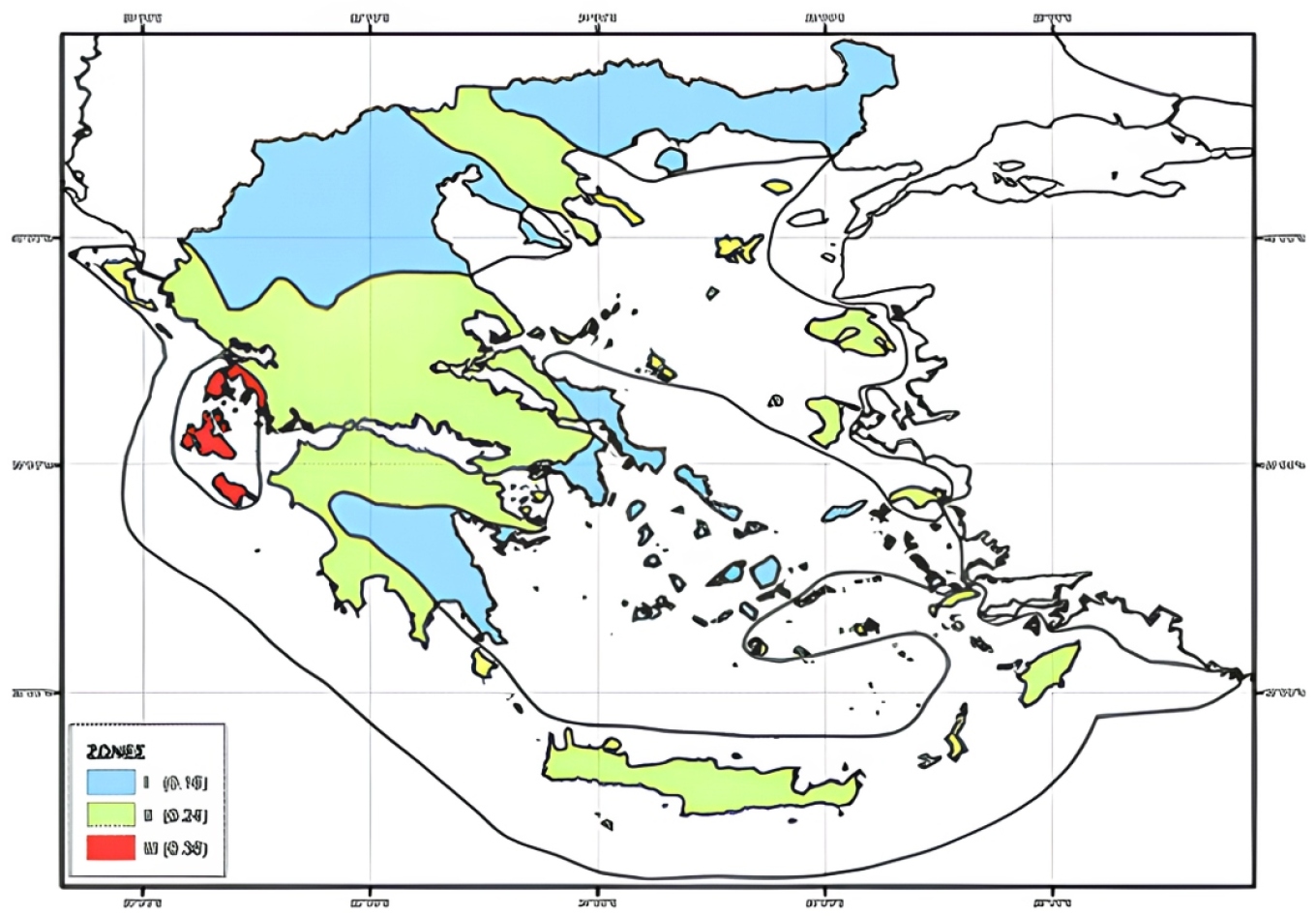
According to the professor, “today the strictest anti-seismic design requirements are found in Kefalonia, Zakynthos, and the wider Ionian Islands region, due to the intense seismic activity recorded there.”
At the same time, he notes that “changes resulting from the new seismic map lead to stricter standards for Western Greece, the Corinthian Gulf, and Northern Peloponnese as well — areas where seismicity coincides with a significant presence of older structures.”
This update, according to the professor, is based on modern scientific data and the new European anti-seismic code, aiming for a more realistic assessment of seismic risk in Greece.
Mr. Spyrakos also reminds that Greece’s first anti-seismic regulation was introduced in 1959, while the current Greek Anti-Seismic Regulation dates from 2000, revised in 2003, for the design of new buildings.
For evaluating and strengthening existing structures, Greece now applies the Intervention Regulation (KAN.EPE.) and the KADET regulation for masonry structures, both most recently revised in 2022.
“30% of the Building Stock Was Constructed Without Any Anti-Seismic Code”
The professor places particular emphasis on the condition of Greece’s buildings, stressing that around 80% of constructions in the country either were not designed under anti-seismic regulations or were based on the earliest codes in force between 1959 and 1985.
As he states:
“30% of buildings nationwide were designed without any anti-seismic regulation at all and concern constructions built before 1959, while more than 50% were constructed under the first anti-seismic code that applied from 1959 to 1985.”
Overall, this accounts for roughly 80% of the country’s building stock.
According to the data presented by the NTUA professor, around 50% of structures are made of reinforced concrete, while 40% are masonry constructions, which show the highest vulnerability, especially when not designed with anti-seismic criteria.
He emphasizes that this is the most vulnerable segment of the building stock, mainly in rural Greece but also in older urban districts where listed and historic buildings are common.
He also points out that “the safest constructions are those designed and built after 1990,” but these account for only 10–15% of the total building stock.
Elsewhere in the discussion, he estimates that “the cost of damage to existing buildings could reach around €110 billion in the event of a major nationwide earthquake.”
Energy Upgrades Combined with Seismic Reinforcement
According to him, milder interventions modeled after countries with high seismicity, such as Italy, could be implemented through incentives and targeted programs to strengthen the most vulnerable buildings and reduce the risk of widespread destruction.
Within this framework, he raises the issue of combining energy upgrades with seismic reinforcement, emphasizing that the two programs should operate in parallel.
The Case of Attica and Other Major Cities
Referring to Attica, the professor notes that it has unique characteristics, “as it combines high population density with extensive urban development, increasing the likelihood of damage during an earthquake.”
As he explains, “the Attica basin also presents significant soil peculiarities that decisively affect building behavior.”
Additionally, much of the building stock was constructed between 1960 and 1980, when the earliest anti-seismic regulations were in force. The area also includes many buildings with pilotis (open ground floors on columns), which, he notes, can increase the vulnerability of certain structures during seismic stress.
“For this reason,” he says, “Attica requires special and separate treatment.”
He adds that similar characteristics are found in other large urban centers such as Thessaloniki and Patras, which developed during the same period and contain significant stocks of old and vulnerable buildings.
Bridges and Ports
Speaking about transportation infrastructure — especially bridges, where insufficient maintenance is often observed — the NTUA professor notes that, despite their critical role, systematic inspections remain limited.
“There is an inspection program, but it concerns only about 150 bridges out of the thousands that exist in the country,” he says, stressing that the current framework does not cover all needs.
At the same time, he underlines that inspections should not focus exclusively on seismic performance but should consider all natural hazards.
Infrastructure, he explains, must be examined holistically, both for earthquake resilience and against phenomena such as flooding.
He also highlights issues concerning port infrastructure. As an example, he mentions Thessaloniki, “where soil liquefaction phenomena must also be taken into account, as they affect the structural behavior of facilities.”
The professor explains that this is a geotechnical phenomenon related to soil stratigraphy and composition, stressing the need for targeted interventions and comprehensive upgrades to port infrastructure to improve resilience against seismic loads.
Aging, Maintenance, and New Technologies
Concluding, the professor says that building age and maintenance levels play a decisive role in seismic behavior and often determine a structure’s real resistance under earthquake stress.
“These issues are particularly important for listed buildings and monuments,” he notes.
At the same time, he refers to modern repair and reinforcement methods, which are now less invasive and can even be applied while buildings remain in use.
Techniques using composite materials and advanced insulation systems allow more targeted interventions without major disruption to building operations.
As he concludes, engineers today can essentially “X-ray” a building without extensive interventions, accurately understanding its structure and behavior.
“The use of artificial intelligence and modern computational tools has radically changed the way reinforcements are designed, offering more effective and less invasive solutions compared to the past,” he says.
Ask me anything
Explore related questions




