





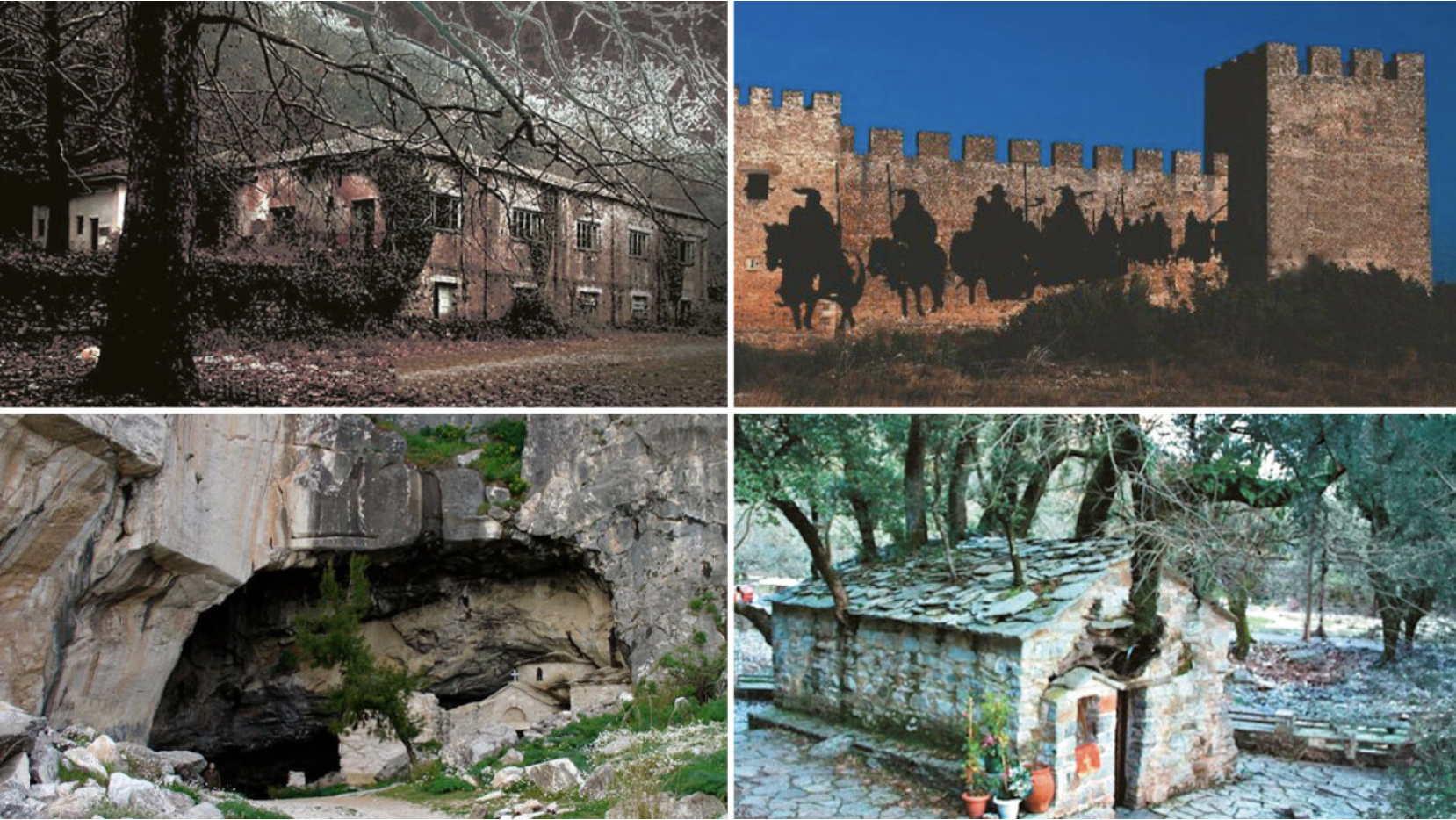
Nearly 200 years ago, one of the many glorious chapters of the 1821 Greek War of Independence was written in Crete. Although its outcome was far from victorious.
It was the battle between the men of the brave commander Hatzimichalis Dalianis, who were defending Frangokastello — an imposing Venetian-built fortress — against the hordes of Mustafa Pasha. It was May 18, 1828. The battle was fierce but unequal. The Greeks were defeated, leaving behind 338 dead, among them Dalianis.
From this sacrifice, another legend was born. As the bodies of the Greeks remained unburied and were quickly covered by sand, their souls were said to never find rest. And since then, every year around this time — in the days following the battle, late May or early June — just before dawn, human-shaped shadows appear on the castle walls, moving one after another for 8–10 minutes, resembling the heroic warriors of Dalianis. In a silent, otherworldly procession of mourning, a kind of annual memorial they hold for their disembodied selves before disappearing into the sea.
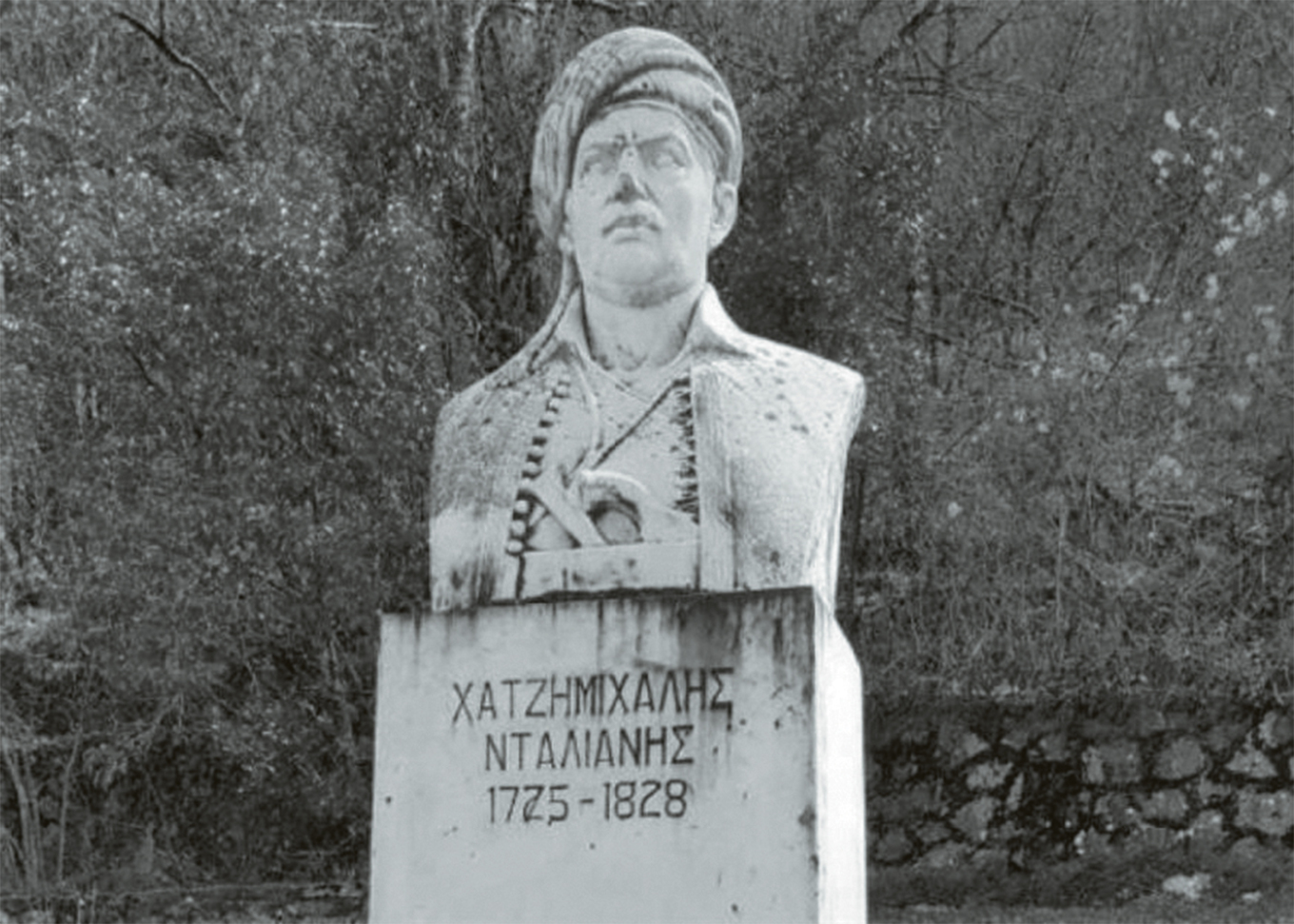
Bust of commander Hatzimichalis Dalianis
These are the famous Drosoulites. Well known in Crete ever since, but their fame has spread beyond the island and Greece, attracting significant international scientific interest.
Scientists from various fields have at times visited Frangokastello to observe the phenomenon firsthand and attempt to interpret it. Visitors from around the world patiently wait for hours, trying to confirm a reality that fuels their imagination.
And so the legend of the Drosoulites persists and is passed down from generation to generation — as is the case with many other stories in different parts of Greece.
From roads, wells, caves, churches, and buildings to simple rocks, lakes, entire locations, and even villages, stories of unexpected mysterious phenomena captivate visitors, as rational explanations are often not so easy to find.
Places that carry legends of harsh, sometimes chilling narratives and stories — real or imagined — where the boundaries between truth and fiction are often blurred.
Many embrace the view of Nobel laureate Harold Pinter, who expressed it nearly 70 years ago: “There is no clear distinction between what is real and what is unreal. One thing is not necessarily true or false. It may be both at the same time.”
And indeed, the accounts of emotionally charged stories about haunted places that carry the heavy shadow of the past — sometimes from tragic events that occurred there, sometimes from scattered beliefs continuously enriched in newer versions with additional layers of mystery — have now become part of collective memory as strange and unexplained phenomena, providing ample material for enthusiasts of parapsychology.
There are usually recurring patterns: shadows appearing in the dark, ghosts, wandering souls, roads leading into the unknown, unnatural phenomena such as split rocks by the sea or abruptly sunken enclosed areas, caves with inexplicable occurrences, and similar stories.
Occasionally conspiracy theories arise, balancing between myth and reality, legend and truth. Logical explanations exist for almost everything. But some are not satisfied. And where legend runs, imagination is ignited — and it takes you on a journey…
Frangokastello – Drosoulites: The riders from the other world
Some claim they have clearly seen the Drosoulites — as shadows under specific conditions of high humidity and calm winds, just before sunrise during the relevant time period mentioned above. However, the phenomenon has never been officially recorded, as the light at those hours is minimal.
The first sightings were made by shepherds, who saw above the Monastery of Agios Charalambos an entire army of black human-like shadows, foot soldiers and horsemen with weapons and swords advancing toward the sea. Frangokastello — the “castle of the Franks” — is located in southwestern Crete, in the Chania region, about 12 km east of Chora Sfakion.
It was built between 1371–1374 by the Venetians at the request of the Sfakians to protect the area from pirates, and later came under Ottoman control when they conquered Crete. It was used as a base to suppress ongoing Cretan uprisings. This brings us to 1828.
The legend of the Drosoulites is so strong that much later, one morning in 1942, German soldiers also claimed to have seen several armed men in formation walking into the castle. They took defensive positions thinking they were rebels or intruders; according to some accounts, they even opened fire on the shadows.
Some scientists attributed the human shapes to shadows cast from the mountains onto the water vapor over the beach in front of the castle, others to mass autosuggestion, and others to mirages from soldiers in distant Libya under certain atmospheric conditions.
The most widespread explanation attributes the phenomenon to a simple optical illusion caused by the evaporation of morning dew. The light mist often created can produce shapes on the walls that may be perceived as human figures.

Terror from otherworldly figures: The “Well of Souls” in Kato Kifisia
At a spot in Kato Kifisia, on Pesmazoglou Street 145, among apartment buildings and houses, very close to the road, in a very small plot of land hidden perfectly among reeds that suggest the presence of water nearby, there is an eerie well. Its opening is tightly sealed with cement, with strange symbols carved on it of unknown origin.
Most passersby walk by without paying attention, unaware of the chilling legend it hides, which survives to this day. According to local accounts, the well has been linked to stories of apparitions and unexplained incidents that occurred in the area at night. It was said that the souls of the dead dwell there, appearing on many nights as strange, otherworldly figures, terrifying those who passed by.
A local resident in 1945 allegedly shot one of these figures one night, but the next day he was found dead under unclear circumstances.
Descriptions of strange and bizarre figures—some of which were said to resemble fairies—appearing near the well also included reports of screams during the night. An ancient Thracian custom known as “pigadismos” says that if you look into a well, you may see the relatives you have lost and loved…
What is striking is that the entire surrounding area is built up, except for this single small space where the well is located. Adding to the mysterious atmosphere is the fact that recently an additional large amount of cement, about 20 cm thick, has been poured over it, raising questions. Who did it and why? Could something else be hidden inside the well?
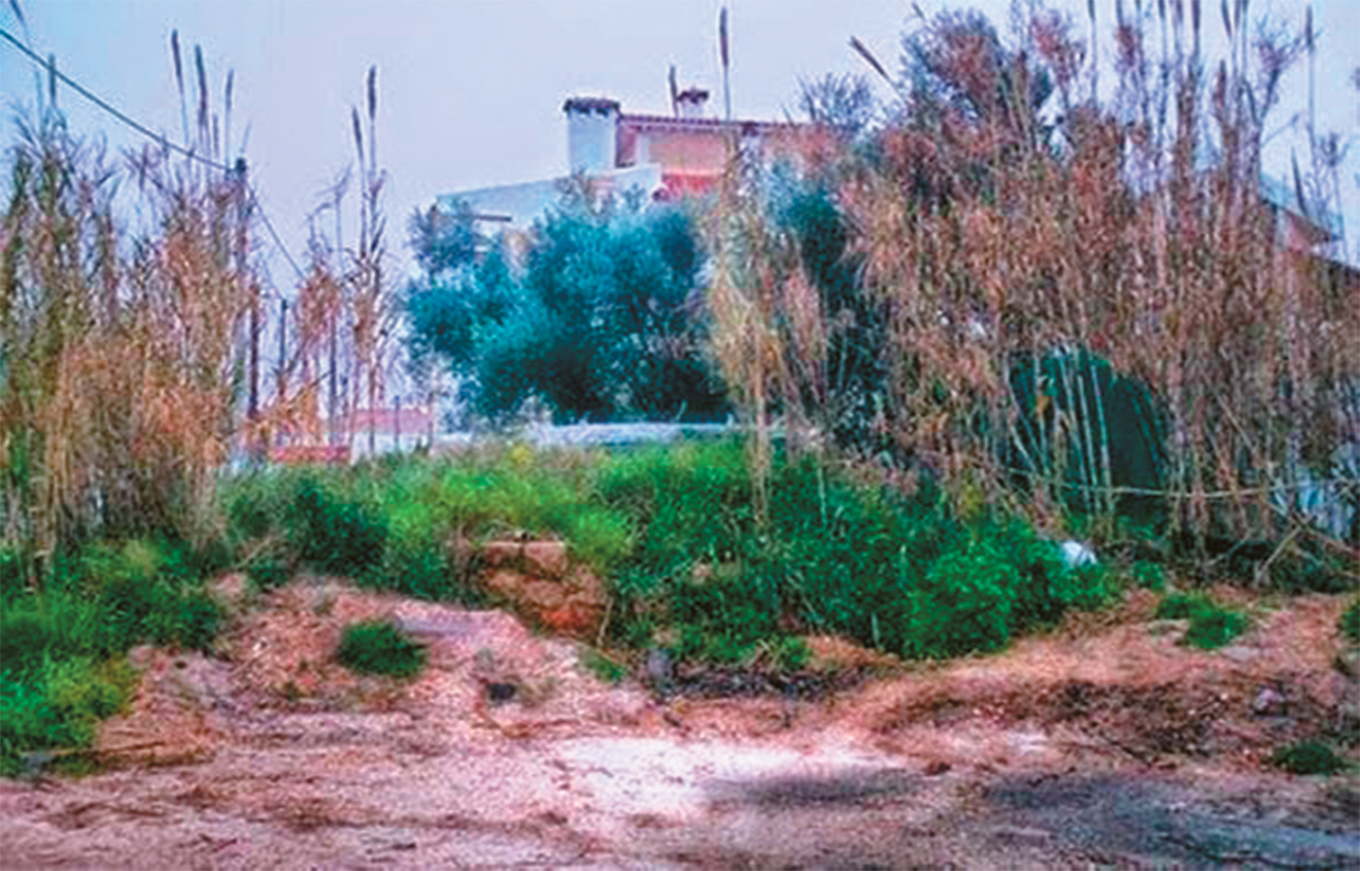
At Pesmazoglou Street 145 in Kato Kifisia, the “Well of Souls” is hidden among foliage.
Vasta, Arcadia: The church with 17 trees on its roof
A small chapel that “grows branches.” Incredible but true. It is even listed in the Guinness Book of Records. This is the Church of Agia Theodora in Vasta, Arcadia, 30 km from Megalopolis, known as “the chapel with 17 trees on its roof.” An astonishing monument in a magical landscape of dense vegetation and running waters, a Byzantine small church from the 12th century, only four meters wide and five meters long.
The roots of the trees are not visible; only trunks and branches can be seen passing through the roof and walls. According to religious tradition, their number corresponds to the years of Saint Theodora when she died. Legend also says that at the place where she was executed, her blood turned into a river and her hair into trees.
In 1996, the Laboratory of Geophysics at the University of Patras investigated how the chapel withstands the weight of the trees. A pioneering study using electrical and ground-penetrating radar tomography showed that the trees’ root systems have penetrated the stone structure of the walls, creating voids through which they reach the ground, forming a network that keeps the small building standing.
Restoration works followed (1998–1999), including cleaning and repointing of the masonry without cement injections, so as not to dry out the roots. According to one version, Theodora was the daughter of Emperor Constantine VIII, ruled for one year, until Michael VI Stratiotikos succeeded her. He claimed she became ill and died, but many suspected she was murdered and buried where the chapel now stands.
According to another version, Theodora was the eldest child of a poor family from Vasta. She was forced to disguise herself as a man to fulfill the family’s obligation to send a member to the Byzantine army, since her father was ill. She proved equal in ability to male soldiers. However, a woman, believing she was a man, fell in love with her.
Theodora did not reciprocate, and in revenge, the woman became pregnant by another soldier but claimed to the commander that the child was Theodora’s. Theodora refused to marry her. She was sentenced to death and executed at the site where the church now stands. According to tradition, her last words were: “Lord, make my years become trees and my blood water to nourish them.”
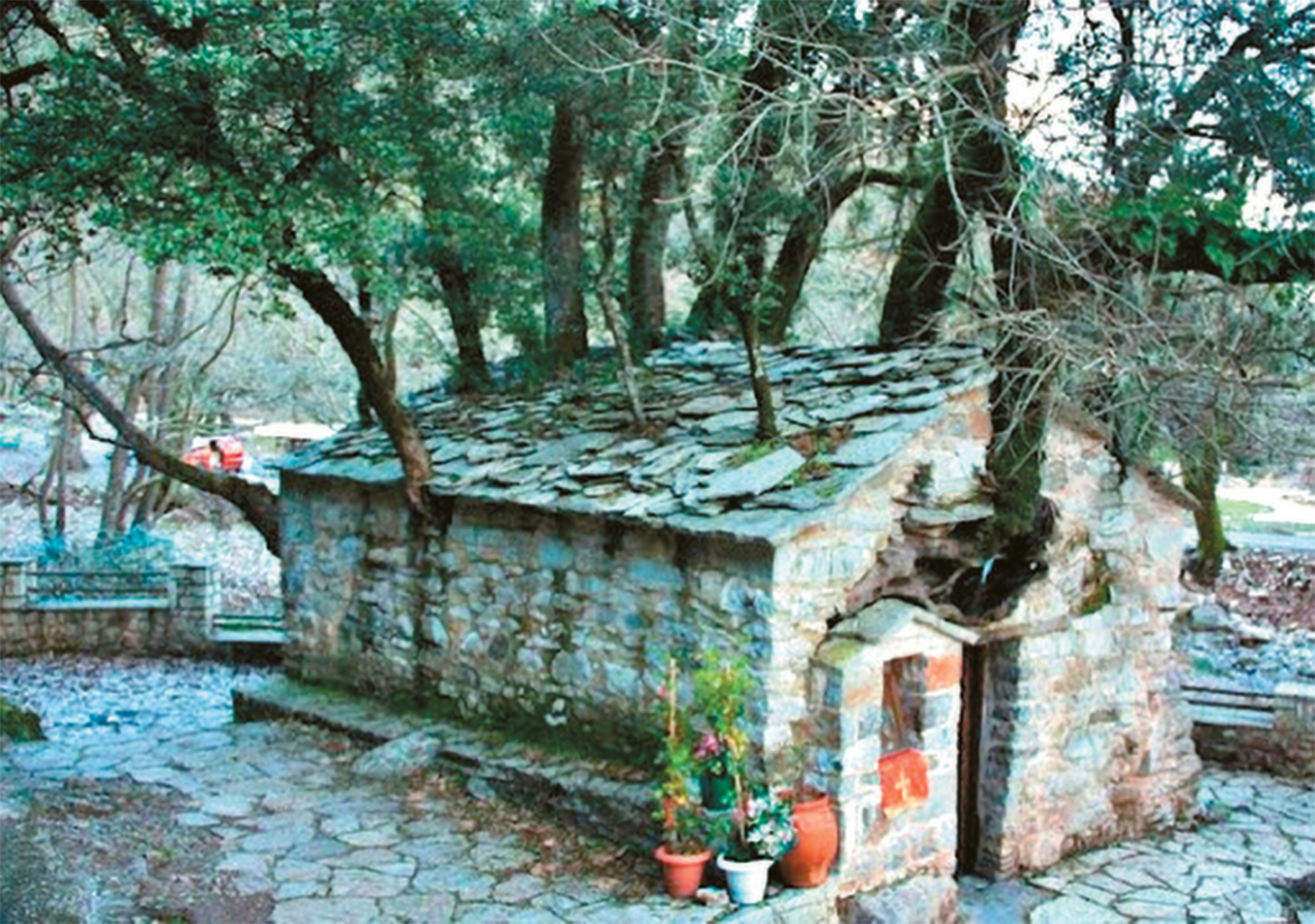
The Church of Saint Theodora with the 17 trees in Vasta, Arcadia
Penteli: The strange uphill road and Davelis Cave
Beyond its famous marble—which was used to build masterpieces from the Parthenon and the Erechtheion to the Academy of Athens and the Panathenaic Stadium—its cool summer climate, and its endless view over every side of the Attica basin, Mount Penteli is also accompanied by a series of legends.
The strange uphill road of Penteli, a stretch of about 250 meters between the 3rd and 4th kilometer of the Old Penteli–Nea Makri road, presents a well-known—and demonstrable—phenomenon: a stationary car that, instead of rolling backward due to the slope, appears to roll uphill.
This phenomenon, which in any case creates a strong impression, has been attributed to electromagnetic fields and the existence of gravitational anomalies, but the more logical explanation given by instruments is that it is essentially an optical illusion. The supposed uphill is actually, even if only slightly and imperceptibly, a downhill slope.
Cyclists report the same sensation, and similar data is provided by modern GPS devices. The same phenomenon occurs in Leivithra of Mount Olympus near Leptokarya, in Lassithi in the village of Krasi, in Proti of Serres, in Skotina of Pieria, and on Mount Paiko.
On the other hand, a characteristic landmark of southwestern Penteli, at an altitude of 720 meters, is Davelis Cave. It was previously called the “Cave of the Pure,” meaning of the pure and sinless, because only they were said to be able to enter. To its right lies the Church of Saint Nicholas and the hermitage of Saint Spyridon.
The legend begins with the notorious bandit Christos Davelis, who used it as a hideout in the mid-19th century, while he was said to have discovered tunnels leading to the center of Athens as well as to the palace of the Duchess of Plaisance, with whom legend claimed he had a romantic relationship. The existence of these tunnels, however, has never been confirmed.
Until the late 1960s, there were numerous reports from local residents of strange lights in the sky, small humanoid figures, unusual sounds and noises, and even ghosts. Inside the cave, which is 112 meters long and up to 40 meters wide—and was eventually fully explored by the Greek speleologists Ioannis and Anna Petrocheilos—there is a strong smell of ozone.
In some nearby areas, the levels of radiation in the soil and air are slightly elevated. Strange phenomena have occasionally been described, such as a fluorescent lamp turning on by itself, flashlights flickering without any apparent reason, and many others.
In the 1980s, the wider area was declared a military zone and access to civilians was prohibited for six years (1977–1983). It was rumored that secret experiments were being conducted there, among other things.
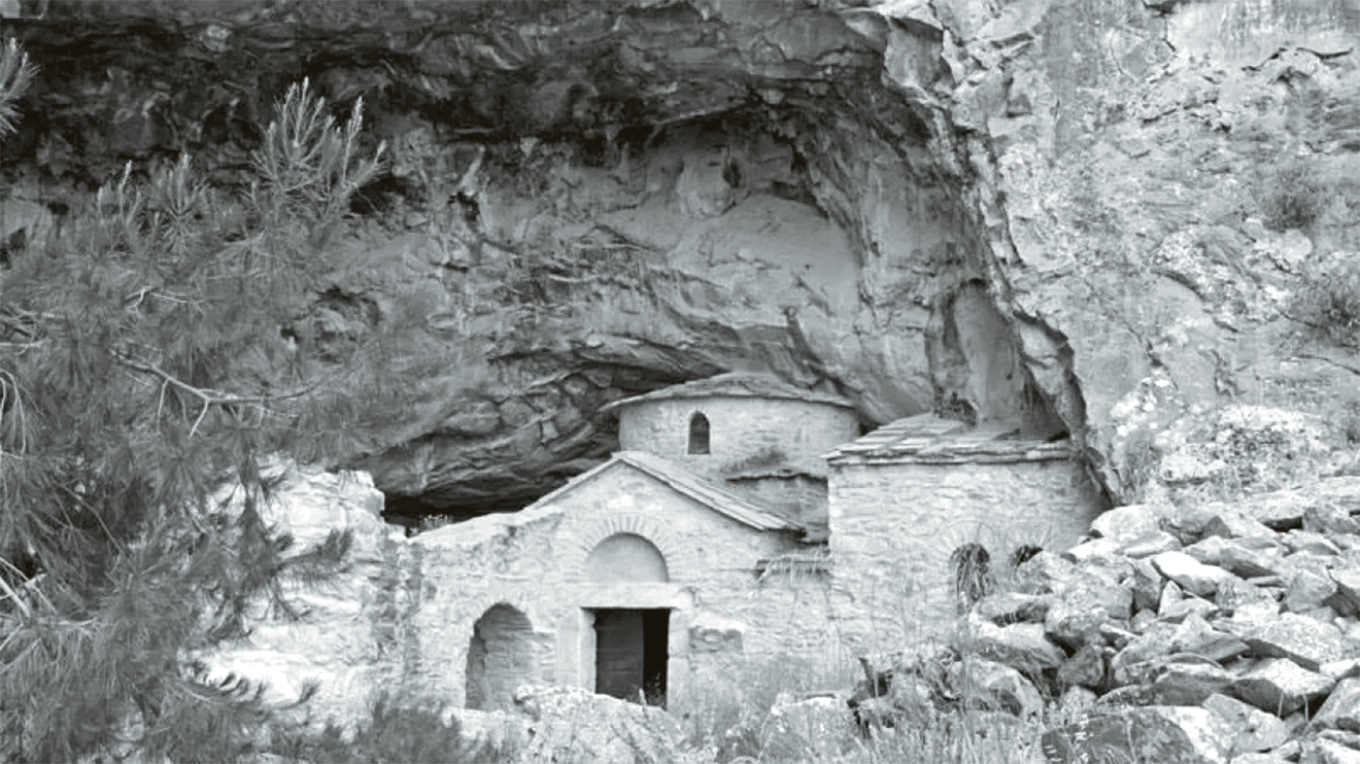
Mavri Petra Street: The gateway of space-time
In Ano Poli (Upper Town) of Thessaloniki, in the famous Castles area, within a labyrinth of narrow cobbled streets overlooking the Thermaic Gulf, there is a road that combines picturesque charm with mystery and inevitably with myth. A place where the paradoxical and the unexplained intrude, creating the conditions for a journey into imagination.
It is the famous Mavri Petra Street (“Black Stone Street”). The legend begins with its name. It is said to come from a black iron stone that fell from the sky during the great fire of 1917, creating a crater at that exact spot.
A negative aura is said to permeate this small street, where, when someone walks through it, the houses seem to lean over them, watching every step. It ends in a dead end, where legend says that every 15 days, at midnight, a hidden road appears that no one knows where it leads.
From there begins the main legend: that at the end of this road lies the gateway of space-time. At once fascinating and terrifying, a secret portal connecting space and time and leading anyone who crosses it into another universe.
This gate appears suddenly, as if one is passing through an invisible curtain that pulls them in and transfers them to a different space-time dimension. Anyone who crosses it has only 15 minutes to return; otherwise, the gate closes and they remain trapped forever, lost.
Some testimonies from residents and visitors reinforce the mystery, though without confirmation. All of this is described in Pantelis Giannoulakis’ fantasy short story “Beyond the Depths of the Night.” Is it therefore a case of suggestion that fuels the imagination?
For many lovers of the paranormal, however, Mavri Petra Street is a point of reference. Some visit it on specific nights hoping to see the gate or feel the energy that, as they say, fills the atmosphere.
Others claim to have heard strange buzzing sounds or felt a sudden chill while walking down the street, which is also known for an even more frightening figure: a woman dressed in black who appears on cloudy nights and has haunted local imagination for decades.
The stories describe a tall, thin woman in a long black dress with her face covered, silently wandering. Some say her piercing gaze causes shivers in anyone who meets it. Of course, there is no evidence of her existence, but the myth continues to be passed down and still fascinates.
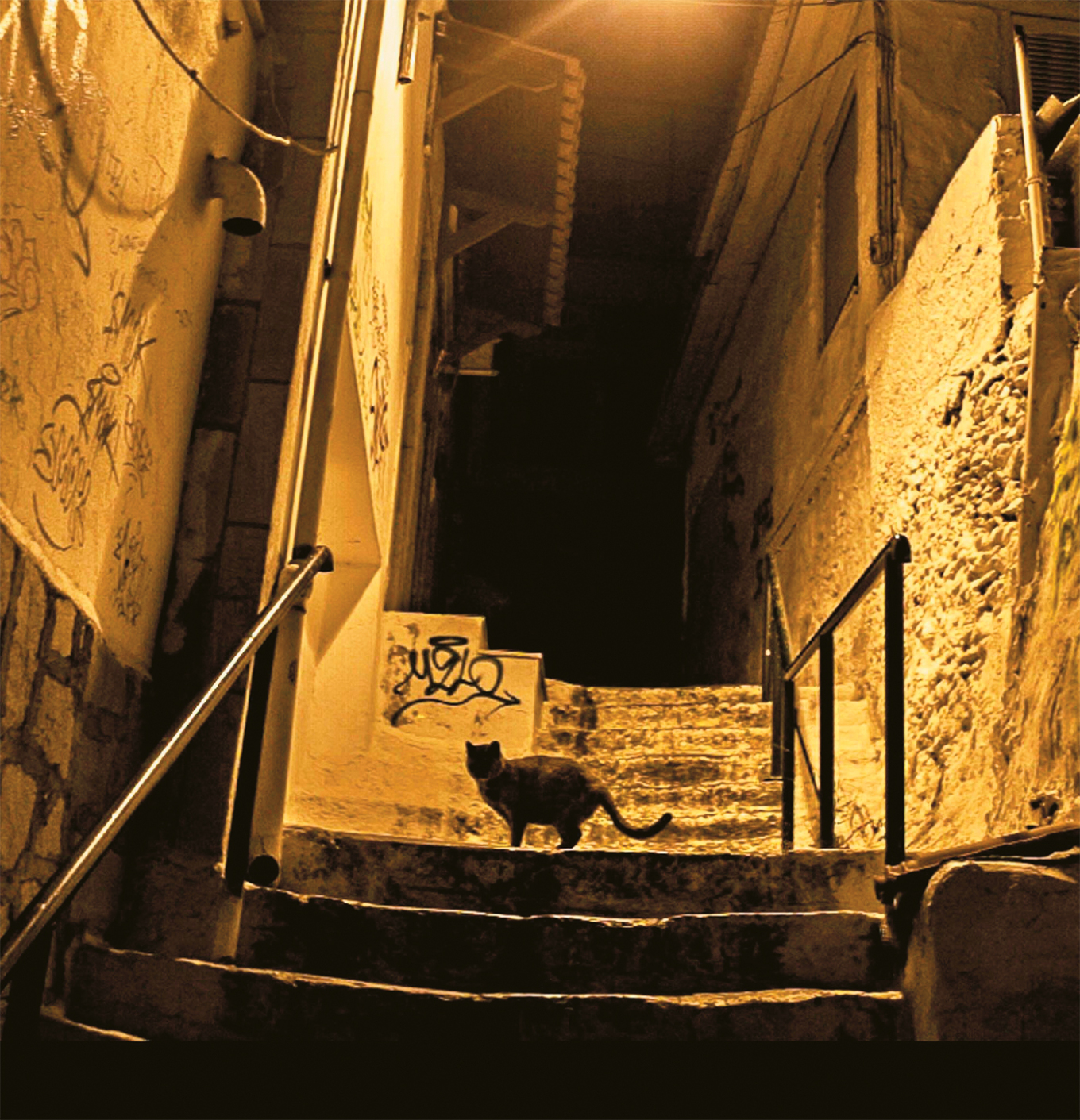
Mavri Petra Street is said to lead to a secret portal
Morna: The cursed village
In the Pieria Mountains, at an altitude of 700 meters, lies the uninhabited village of Morna, associated with countless secrets and legends, also known as Skoteina (“the Dark Ones”). It is built in a hollow, where sunlight reaches only sparsely due to the dense vegetation.
Until 1967 it was full of life, as the State Wood Processing Factory was located there. However, when it closed, abandonment followed. From that point on, various stories and legends emerged, quickly giving the village the label of “haunted.” People spoke of doors opening and closing on their own, otherworldly voices being heard, and much more.
One frightening story refers to seven unknown girls who, from midnight onward, would dance in ecstasy but also weep bitterly around the village. The residents, out of fear, would hide in their homes until the girls returned at dawn to the top of the mountain and hid in a cave, waiting to repeat the dance. Others spoke of a “hairy hand” that chased anyone it encountered, emerging from an abandoned house.

Crete: The “Sunken Threshing Floor” and the… weather-predicting rock
A vast piece of land in Crete, 15 km from Heraklion near the old road to Rethymno, with enormous dimensions—90 meters in diameter and 50 meters deep—resembling a sunken threshing floor surrounded by steep vertical walls, impresses visitors.
Many also use it as a climbing destination. Scientists argue it was likely once a cave whose roof collapsed either due to a strong earthquake or a violent flood.
But there is also the accompanying legend about its origin. According to it, a farmer once had his threshing floor there. One summer, on July 20, the feast day of Prophet Elijah, he went to thresh there with his wife and daughter, despite their objections, as religious custom forbade working on that day.
The act of disrespect was punished: the threshing floor collapsed and swallowed the “sinful” family. To this day, as some locals say, on the day of Prophet Elijah, the sound of straw being stirred and the daughter’s song can be heard: “Round and round, and all the straw is theirs…”
Crete has many more legends with imaginative stories that spark the imagination. For example, the fairy who occasionally appears with her child, crying, whose tears cloud the water of the Neraydospeleo spring near Heraklion. There is also the legend of a girl who haunts the beautiful Lake Kournas in Rethymno.
Another concerns the “Dragon Rock” in the cave of Saint Myron in Kato Asites, which has the “magical” ability, like a meteorologist, to predict the weather: when small bubbles like white foam emerge from its cracks, rain is expected; when a strange noise is heard from within the rock, it signals an approaching severe winter.
Legends and mysteries haunting Greece, from Davelis Cave to the Drosoulites
Athens: A funeral procession on Piraeus Street
Ninety years ago, the newspaper Akropolis published on its front page (Saturday, October 3) a major article titled: “GHOSTS IN THE HEART OF ATHENS!” with the subtitle “AIRY PIGS AND LADIES,” containing testimonies from people in the wider area of Kallithea and Tavros, near the New Slaughterhouses, about unbelievable events beyond any logic.
The article stated: “Every night an… ethereal funeral is seen. Witnesses describe details: first appear the candles, followed by priests, the coffin, the grieving relatives of the deceased crying, and crowds following behind. No vehicles are seen, so they believe the funeral must have come from some village where people follow it on foot.
The vision disappears as it approaches Piraeus Street. Others report that after 2 a.m., thousands of animals—cattle and sheep—appear in the air despite the darkness, running as if chased into infinity. They are said to be the souls of the slaughtered animals from the slaughterhouses.”
What is notable is that just as suddenly as this story emerged in the Athens of 1936, it disappeared completely. No one followed it up. Yet the legend remained…

Skopelos: The Drakontoschisma (Dragon Split Rock)
Between the areas of Amarantos and Stafylos on Skopelos stands a tall and imposing rock formation, known by locals as Drakontoschisma (“Dragon Split”), which gives the impression that it has been carefully cut by human hands.
A mysterious story links Drakontoschisma to a… dragon, as well as to the efforts of the island’s patron saint, Saint Riginos, to save the inhabitants. According to legend, nearly 800 years ago a terrifying dragon appeared on the island, devouring the locals. Many were forced to leave Skopelos, while neighboring islands even sent boats carrying condemned prisoners so that the dragon would kill them.
To deal with the problem, Saint Riginos boarded one of the boats transporting the condemned men. When the dragon saw him, it was frightened and began running away from him toward the Stafylos area. There it became trapped.
Having no other escape route, it leapt off the cliff and died, splitting the mountain in two and causing the ground to collapse. The small beach in the area can only be reached by sea.
Ask me anything
Explore related questions




