





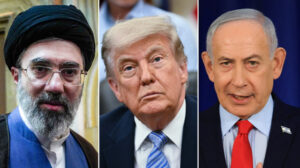
Despite the strong criticism he has faced since Sunday, when he announced that he had reached an agreement with Iran—both domestically and from Iran—Donald Trump continues to defend his decision, clarifying that the terms of the memorandum are ultimately what he had demanded from the beginning of the war: a “complete unconditional surrender” by Tehran.
At the same time, the rift between Washington and Tel Aviv is widening following recent statements by JD Vance, who—shortly before cancelling his trip to Switzerland—surprised Israelis by noting that, given their current situation, they effectively have only one ally in the world who views them with sympathy at this time: Donald Trump.
“There are no limits to my power”
The US president defended the agreement with Tehran, arguing that it prevented a global economic crisis and kept open the possibility of stabilizing shipping through the Strait of Hormuz.
Trump rejected claims that the war with Iran exposed limits to American power or his own political influence, arguing instead that the conflict proved the opposite. In an interview with The Axios Show, he defended the agreement reached after hostilities and said the alternative could have led to a global recession.
He stated that he still believes there are “no limits” to his ability to exert influence, dismissing the idea that the outcome of the Iran war revealed constraints on US power. When asked what he learned from the conflict about the limits of his authority, he replied: “I haven’t learned that lesson yet. I know there are limits, but there are no limits.”
Trump said the US achieved its military objectives fully: “We defeated them completely on a military level,” adding that even the memorandum of understanding “could probably be considered an unconditional surrender.”
He also claimed the conflict demonstrated US military strength, citing a naval blockade: “Who else could carry out such a blockade? I imposed a naval blockade and not a single ship could pass. Some tried, but it didn’t last long.”
He acknowledged, however, that continuing the war would have carried serious economic risks, especially for global energy markets. He warned that prolonged fighting could have shut down the Strait of Hormuz and triggered a global recession.
Sources familiar with White House discussions said Trump had privately expressed concern about declining global oil reserves and the risk of an international energy shock if the strait remained closed.
This concern is seen as one of the reasons he accepted an agreement that fell short of his original, more ambitious wartime demands.
Outrage in Israel over Vance’s remarks
Vance’s comments sparked a direct confrontation with members of the Israeli government, as he criticized attacks on the US-Iran agreement and urged Israel to support the diplomatic process.
He said he was troubled by the fact that ministers in Benjamin Netanyahu’s government publicly criticized the deal and, in some cases, personally attacked the US president.
“We’ve seen members of the government attack the agreement and in some cases personally attack the President of the United States,” he said.
The US vice president stressed that the United States is Israel’s most important international ally and main supplier of weapons. “Donald Trump is the only world leader currently genuinely sympathetic toward Israel,” he said, noting that two-thirds of Israel’s recent defense systems were manufactured in the United States and funded by American taxpayers.
While avoiding direct criticism of Netanyahu, Vance sharply targeted National Security Minister Itamar Ben Gvir and Finance Minister Bezalel Smotrich, who have publicly opposed the US-Iran memorandum.
“What exactly is their proposal?” he asked, arguing that national security challenges cannot be solved through military means alone.
The remarks came shortly before his planned trip to Switzerland, where talks on the second phase of the US-Iran agreement were expected to begin.
Under the agreement, all military operations were to cease immediately and permanently across all fronts, including Lebanon. Israel is not a signatory to the deal, but developments directly affect its strategy toward Hezbollah. Netanyahu’s government insists it will not withdraw from areas it currently controls in southern Lebanon and reserves the right to respond militarily to any attacks.
Smotrich recently said the Israel Defense Forces must retain “full freedom of action” against Hezbollah, calling the agreement with Iran “bad for Israel and for the entire free world.”
Tensions between Washington and Tel Aviv have increased in recent days. Trump has reportedly expressed dissatisfaction with Israeli military actions in Lebanon and has personally criticized Netanyahu’s stance on de-escalation efforts.
According to Israeli media, the government chose not to respond publicly to Vance’s statements to avoid further damaging relations with the White House. However, senior Israeli officials believe the country must maintain its “red lines” in Lebanon even if US pressure increases.
A source familiar with the matter told Ynet that Vance’s comments reflect a broader shift within parts of the Republican Party and leave Netanyahu in a difficult position, questioning how relations reached a point where even US support appears uncertain.
Ben Gvir responds
In response, Itamar Ben Gvir posted on social media comparing Iran to Nazi Germany and argued that it should be treated as the US treated Nazi Germany during World War II, writing: “This is my proposal, JD Vance: treat the Nazis of the 21st century exactly as the United States treated the Nazis of the 20th century.”
Ask me anything
Explore related questions




