





Hellas Sat participated in Eurosatory 2026, the world’s largest international defence, security, and technology industry exhibition. The event took place in Paris and brought together more than 2,100 exhibitors from 65 countries, over 330 official delegations from 93 countries, and thousands of industry professionals from around the world.
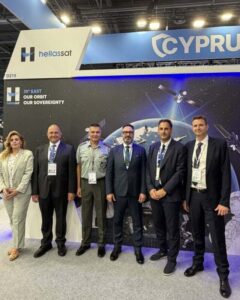
A key highlight of this year’s participation was the company’s dual presence at both the Greek pavilion of the Association of Greek Defence Equipment Manufacturers (SEKPY) and the Cypriot pavilion of the Cyprus Chamber of Commerce and Industry (CCCI). This dual representation underscored its role as a bridge between Greece and Cyprus in sectors that are increasingly strategic for European security, technological autonomy, and space development.
The event opened with Hellas Sat’s participation in the inauguration of the Greek pavilion, where company executives welcomed representatives of the defence industry, institutional bodies, and partners from Greece and abroad. Throughout the exhibition, a series of meetings were held with existing and prospective partners, focusing on the capabilities of the company’s satellite infrastructure and services for government, defence, and other critical operational applications.
A major highlight was the official opening of the Cypriot pavilion, attended by the Minister of Defence of the Republic of Cyprus, Vasilis Palmas, the Commander of the National Guard, Lieutenant General Emmanouil Theodorou, and the Ambassador of the Republic of Cyprus to France, Pavlos Kombos, underscoring the importance placed on space and satellite infrastructure as a key pillar of modern defence and security.
During the exhibition, Hellas Sat’s stands were visited by representatives of governments, armed forces, organisations, and companies from Europe and the Middle East. Among them were Panagiotis Hatzipavlis and Major General Ioannis Bouras, with whom substantive discussions were held on current operational connectivity needs and prospects for further cooperation.
Of particular importance were meetings with international defence industry organisations, including a delegation from the Ukrainian Council of Defence Industry (UCDI), led by CEO Ihor Fedirko. These discussions highlighted the growing role of satellite communications in enhancing interoperability, resilience, and operational effectiveness in modern defence and government missions.
Following the conclusion of Eurosatory 2026, Hellas Sat carried out an extensive programme of meetings with representatives from the defence, space, and technology sectors across Europe and other strategic markets. Over the five-day event, the company strengthened existing partnerships, exchanged expertise with international organisations, and explored new opportunities for cooperation, reaffirming the importance of connectivity, innovation, and resilience in addressing today’s security challenges.
From the opening of the national pavilions to meetings with international delegations and leading defence industry actors, Eurosatory 2026 served as a key platform for developing synergies, exchanging know-how, and exploring new avenues of cooperation. The event made clear that the need for secure, resilient, and reliable communications is more critical than ever.
As a satellite provider for Greece and Cyprus, Hellas Sat remains committed to delivering advanced satellite solutions that meet the needs of governmental, defence, and commercial organisations, enhancing connectivity, security, and operational effectiveness at national, regional, and international levels.
Hellas Sat is a company licensed by the Greek and Cypriot governments (pursuant to the relevant licensing agreements and Greek Law 4506/2017) regarding the right of exclusive access to and use of the geostationary orbital position at 39 degrees East, as well as the associated radio frequencies.
It is one of the leading satellite providers in Europe, operating and commercially exploiting three geostationary satellites—two of which are located at the 39° East orbital position—as well as two telecommunications facilities (teleports) in Greece and Cyprus, covering 15,000 m² and 30,000 m² respectively. Through its proprietary infrastructure and satellite network, it provides satellite and ground-based services to governmental and defence authorities worldwide. For more information, visit hellas-sat.net.
Ask me anything
Explore related questions




