





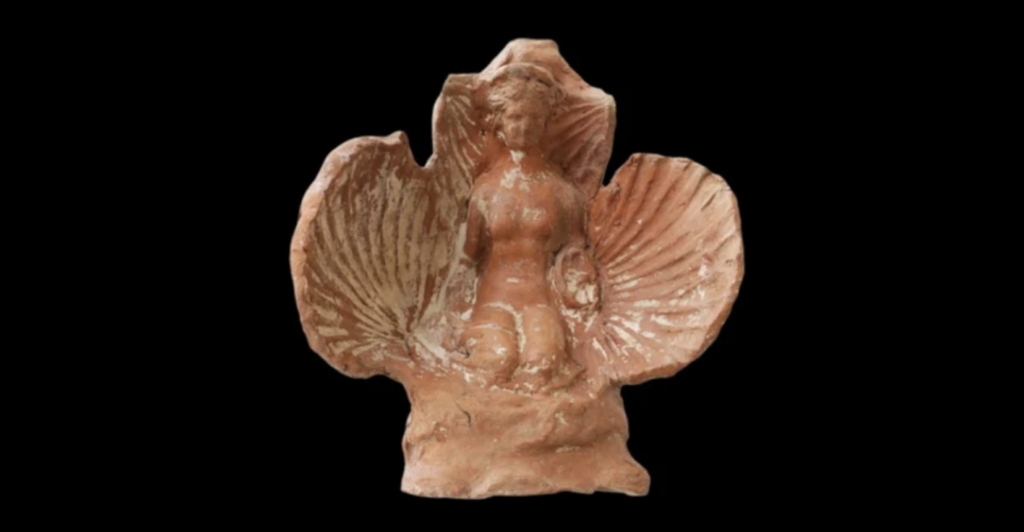
A remarkable depiction of Aphrodite, the goddess associated with love, beauty, fertility, and the renewal of life, is being showcased this month at the Archaeological Museum of Thessaloniki (AMTh) as part of its “Exhibit of the Month” programme.
The object attracting visitors’ attention is a terracotta figurine of Aphrodite Anadyomene (“Aphrodite Rising from the Sea”) in a shell (inv. no. MΘ 10870), which is on display in the museum’s permanent exhibition, Thessaloniki, Metropolis of Macedonia (Display Case 19). It represents an exceptionally rare version of one of antiquity’s most widespread iconographic types—an image that remained influential from the Hellenistic period through to the Renaissance.
The birth of Aphrodite gave rise to several mythological traditions from an early period. In the best-known version, recorded in Hesiod’s Theogony, the goddess is born from the foam of the sea, while Homer describes her as the daughter of Zeus and Dione. The image of the young goddess emerging from the water became one of the most beloved themes in ancient art, gained widespread popularity during the Hellenistic period, and was even associated with the celebrated painting by Apelles in the Asklepieion of Kos.
The figurine was recovered from a tile-covered grave uncovered in 1969 at the Ramona site, in the western cemetery of ancient Thessaloniki. It is dated to 300–270 BC and is considered the work of a local coroplastic (terracotta sculpture) workshop.
The goddess is depicted nude and kneeling inside a large open shell. Behind her figure unfolds an opened cloak, which serves as a scenic backdrop and accentuates her presence. In her left hand she holds a phiale (a shallow libation bowl with a central omphalos), symbolising her divine status, while her right hand delicately touches her garment. Her hair is parted in the middle, forming rich curls, and is adorned with a circular diadem. The figurine is made of fine-grained reddish-brown clay, with traces of white slip still preserved in places.
Although the shell does not appear in the earliest versions of the myth, from the Hellenistic period onwards it became one of Aphrodite’s most distinctive symbols. The image of the nude goddess emerging from it came to represent not only her marine origins but also concepts such as fertility and beauty.
The fact that the figurine was found inside a grave is of particular interest. In antiquity, Aphrodite was associated not only with love and birth but also with the Underworld, through epithets such as Epitymbia, Epitymbidia, and Melainis. For this reason, her presence among grave goods carried a deeper symbolic meaning, referring to rebirth and the continuation of the cycle of life.
The enduring appeal of this iconography is demonstrated by its long artistic legacy. From Hellenistic terracotta figurines and Roman artworks to Sandro Botticelli’s famous The Birth of Venus, the image of the goddess emerging from the sea has remained one of the most recognisable and iconic representations in the history of Western art.
Ask me anything
Explore related questions




