





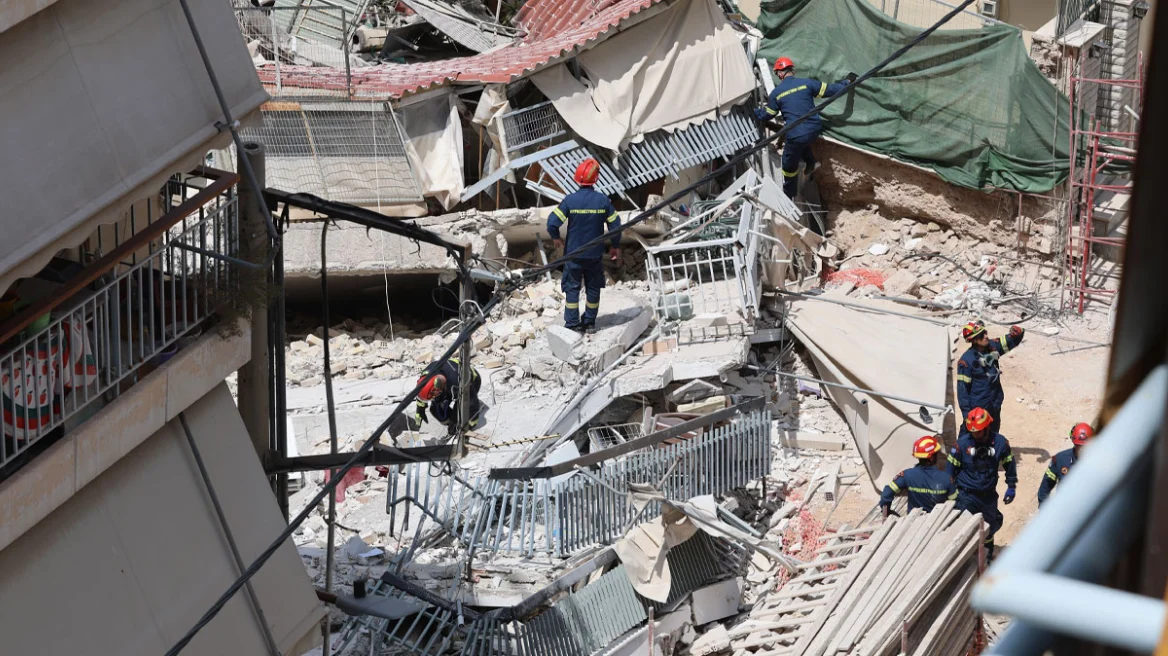
Special teams of engineers from the Ministry of Infrastructure and the Municipality of Athens will continue inspections and structural safety assessments today on all buildings neighbouring the apartment block that collapsed at 22 Alkminis Street in Petralona.
Initial inspections identified signs of structural instability in the building next to the four-storey block that collapsed yesterday, including a hole at its base. The engineers will determine whether there is any further risk to nearby properties due to ground subsidence. The main concern is that excavation work on the adjacent plot caused the underlying soil to give way. As the ground in the area is considered unstable, the movement of the soil combined with the violent collapse of the four-storey building may also have affected the foundations of neighbouring properties, particularly those directly adjoining it.
Using specialist equipment, the engineering team measured whether the neighbouring building had begun to lean. The process will be repeated today before a decision is made on whether it must remain evacuated.
Meanwhile, the five people initially detained following the collapse have now been formally arrested. They include the two owners of the plot, who are also shareholders in the company responsible for the development and are themselves engineers, the two supervising engineers, and the contractor.
According to reports, those arrested have so far attributed the collapse to a leaking pipeline in the preceding days, which they claim eroded the ground where the excavation was taking place. However, relatives of residents from the collapsed building allege that an engineer working with the construction team responsible for building the planned five-storey luxury apartment block on the site attempted to dismiss residents’ concerns, responding with sarcasm.
“Even the Leaning Tower of Pisa Tilts, But It Hasn’t Fallen”
The same witnesses claim that residents had been hearing creaking noises from the apartment block since yesterday morning, while a neighbour noticed a large crack in the building. Concerned by what they saw, they called their own engineer, who found that the building had already developed a five-degree lean. When they raised their concerns with the engineer overseeing the new development, he allegedly replied: “Even the Leaning Tower of Pisa tilts, but it hasn’t fallen.”
The apartment block, however, did not share the Leaning Tower of Pisa’s fate. Within just one hour, its lean increased from five degrees to 14 degrees.
By that stage, the residents’ engineer had already taken the initiative to warn the six families living in the building by going door to door. Shortly afterwards, construction workers from the neighbouring site began ringing doorbells and asking residents to evacuate the building, citing the excuse of “excessive noise”.
That detail has led police investigators to suspect that the construction crew may already have realised they had caused damage to the neighbouring building’s foundations and were attempting to contain the situation. It also appears that plans had been made to pour rapid-setting concrete at the site to provide temporary support for the leaning building. The question, however, remains: how and why did the apartment block collapse?
The answers will ultimately be provided by the competent authorities through the criminal investigation now under way. So far, however, experts believe the collapse resulted from a combination of factors and, above all, a series of omissions.
The apartment block that collapsed had been built in 1970. It had no basement, and its foundations were between one and 1.3 metres deep. By contrast, the new five-storey apartment building with a basement planned for No. 20 required foundations approximately six metres deep. Excavation work to that depth began after the demolition of a storage building that had stood on the site since 1956.
One of the key questions is whether a technical inspection team that had visited the site in previous days had warned of the danger and recommended the application of sprayed concrete to prevent the neighbouring apartment block from collapsing — a solution that was ultimately rejected because of its cost.
On the other hand, structural experts point out that a properly constructed building should not have been affected by works on an adjacent plot, let alone collapse. They argue that there must already have been an underlying structural weakness, either due to construction defects or a void beneath the foundations. In any case, the area’s ground is known to consist of loose, relatively unstable soil. They also stress that a detailed geotechnical survey and appropriate retaining works should have been carried out before construction began. Even so, they say, a total collapse cannot be explained unless the building already suffered from serious structural weaknesses or there was a particular geological anomaly.
Ask me anything
Explore related questions




