





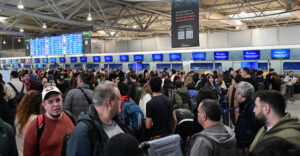
A broad meeting is being held today involving the Greek Civil Aviation Authority (HCAA), the Civil Aviation Authority (CAA), air traffic controllers, Athens International Airport (“Eleftherios Venizelos”), and the country’s two main airlines, AEGEAN and SKY express, to address growing flight delays. Officials are looking for solutions to improve airspace capacity and air traffic management, based on data from Eurocontrol.
For another year, Greece is experiencing a familiar summer problem, with passengers facing significant delays. The country now ranks among the top three in Europe for flight delays.
According to Eurocontrol, during the last week of June, Greece accounted for 13% of all flight delays across Europe. Of those:
- 9% were attributed to the Athens Area Control Centre.
- 4% were linked to the Macedonia Area Control Centre.
The main causes are capacity constraints and staffing shortages, while an additional, though smaller, factor is the increase in aircraft passing through Greek airspace because of the conflict in the Middle East.
As a result, en-route delays in Greece have increased by 63% compared with the same period in 2025.
Together with France and Spain, Greece is among the three European countries responsible for the largest share of delays. However, Greece has recorded the steepest deterioration compared with last year.
France remains the worst-performing country, accounting for 29% of all European flight delays, mainly due to capacity problems, staffing shortages, and the transition to new technical systems. Even so, French delays are 38% lower than last year.
Spain follows with 21% of total delays, driven by heavy traffic, staffing issues, and capacity limitations. Delays there have increased by 26% compared with last year.
Across Europe, 71% of flights arrived on time, down 0.5 percentage points from last year, while 64% of departures were on time, a slight improvement of 0.2 percentage points over 2025.
Athens International Airport
Officials note that during the summer, Athens International Airport handles approximately:
- 900 commercial flights per day, and
- around 100 additional flights, including private aircraft, cargo flights, and other operations.
Roughly 80% of delays, particularly during peak hours, are caused by air traffic restrictions. These delays create a domino effect across both domestic and international flight networks and also affect aircraft and crew availability, since crews are subject to strict mandatory rest periods.
New Capacity Management Measures
To improve traffic management, Athens Airport has this year been classified as a Schedule Facilitated Airport (IATA Level 2).
In practice, this means the national slot coordinator works closely with airlines to align flight schedules with the airport’s hourly capacity.
According to officials, this coordination has ensured that 98% of flights scheduled for summer 2026 fall within the agreed capacity limits, avoiding unexpected scheduling conflicts.
Under a Joint Ministerial Decision issued on 10 June, Athens Airport’s minimum operating capacity during the summer is:
- 35 departures and 31 arrivals per hour during peak periods,
- 35 departures and 28 arrivals per hour during off-peak periods,
- 22 departures and 22 arrivals per hour overnight.
Today’s meeting aims to determine why delays remain so severe despite these measures.
Current data indicate that these minimum service levels are achieved less than 50% of the time. Several factors contribute, but the main issues involve operational planning and air traffic management. Eurocontrol ranks Greece as having the third-worst performance in Europe for capacity and staffing among air navigation service providers during the last week of June.
Although there have also been delays in upgrading equipment and recruiting new personnel, officials stress that the existing systems remain adequate and safe for managing air traffic.
What Air Traffic Controllers Say
Olga Toki, Vice President of the Greek Air Traffic Controllers’ Association, told Protothema:
“The problem is that demand at the airport is currently much higher than the agreed capacity limits, including those set out in the ministerial decision, and slot allocations are not being respected.”
She gave Monday, 6 July, as an example:
- 991 flights are scheduled for the day.
- During the 7:00–8:00 a.m. peak hour, the agreement allows 35 departures, yet 40 departures are scheduled.
- Between 9:00–10:00 a.m., 35 arrivals are planned, exceeding the agreed limit of 31 arrivals.
- Between 10:00–11:00 a.m., there are 39 departures.
- Between 12:00–1:00 p.m., another 35 arrivals are scheduled.
“These flights will inevitably be delayed, and those delays will cascade throughout the day,” she said. “If the airport starts the morning overloaded, the problem only gets worse.”
The controllers will propose at today’s meeting that Athens Airport be upgraded to IATA Level 3, where slot allocations are strictly controlled and cannot exceed airport capacity.
Controllers also point to the increased pressure caused by the conflict in the Middle East, which has resulted in more aircraft crossing Greek airspace.
“We’re also seeing increased traffic at the Athens and Macedonia Area Control Centre,” Toki said. “Last year the peak was around 4,500 flights per day. This past weekend it was close to 5,000. New controllers have been hired, but they have not yet completed their training, so we cannot open additional control sectors.”
Ask me anything
Explore related questions




