





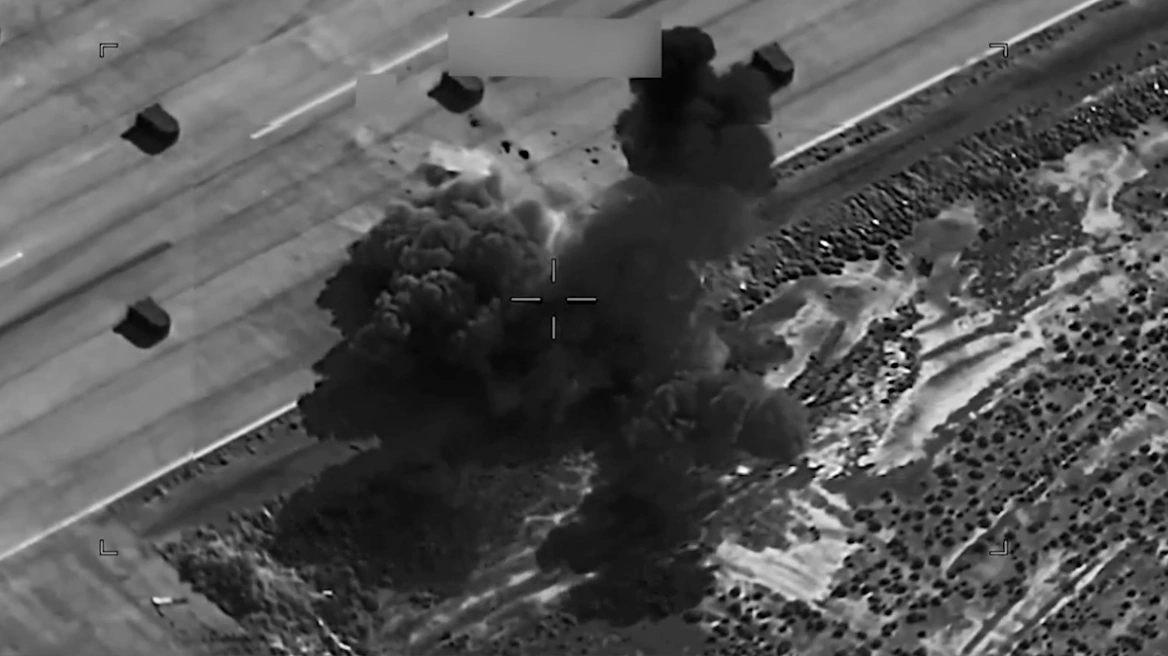
A new escalation is unfolding in the U.S.–Iran conflict, with American strikes on Iranian infrastructure, Donald Trump threatening an even tougher response, and Tehran warning that the Strait of Hormuz will only reopen under “Iranian arrangements.” The tensions triggered alarm in Gulf countries and pushed oil prices higher.
The U.S. Central Command (CENTCOM) announced that American forces struck approximately 90 Iranian military targets in the latest wave of attacks, while Tehran responded with strikes against U.S. bases in the region.
According to the relevant statement, the latest operations targeted “air defense systems, coastal surveillance assets, missile and drone storage facilities, naval capabilities, and military logistics infrastructure along Iran’s coastline.” The new strikes were carried out approximately 24 hours after a previous series of U.S. attacks, during which, according to CENTCOM, another 80 Iranian military targets had been hit.
“CENTCOM forces completed an additional round of strikes against Iran on July 8 in order to further reduce Iran’s ability to attack commercial shipping and innocent civilian maritime workers in the Strait of Hormuz,” the statement published early this morning via X said.
For its part, Iran’s Islamic Revolutionary Guard Corps (IRGC) announced that it had carried out attacks against U.S. bases in Kuwait and Bahrain, describing them as retaliation for U.S. armed forces strikes on Iranian territory.
According to a statement broadcast by Iranian state television IRIB, the IRGC claimed that it launched drone and missile attacks against “infrastructure and facilities” at the U.S. bases of Arifjan and Ali Al Salem in Kuwait, as well as Juffair and Sheikh Isa bases in Bahrain. At the same time, Tehran warned that retaliation could expand to other Middle Eastern countries if the United States carries out further military operations against Iran.
Trump: “I don’t know if they are worthy of making a deal”
Speaking to journalists aboard Air Force One while returning from the NATO Summit in Ankara, Donald Trump said early Thursday that Iran had contacted him seeking a deal after repeated U.S. strikes.
“We just hit them very hard, and I say we hit them 20 to 1,” Trump said, referring to the new wave of attacks, while claiming that the United States had already “won militarily” in this war, adding that Tehran wants “very much” to reach an agreement.
“They called a little while ago and they want to make a deal very much — I just don’t know if they are worthy of making a deal,” the U.S. president added.
“I don’t know if they will honor the deal, that’s the problem,” he explained to reporters.
When asked whether the United States would return to a large-scale war with Iran, Trump replied: “I don’t know, but we would win it very quickly.”
At the same time, he clarified that the conflict with Iran is not a “war.”
“Actually, it’s not really a war. It’s the denuclearization of Iran (…) This is all about taking away nuclear weapons, not allowing Iran to have nuclear weapons, and everyone should like that.”
A few hours earlier, Trump had threatened Iran that it would suffer “much worse” strikes if there were further attacks on commercial ships in the Strait of Hormuz.
“These are retaliations for yesterday’s bombings of ships by Iran. If it happens again, it will be much worse!” he wrote on Truth Social, above a photograph showing a facility in the city of Chabahar engulfed in flames and smoke rising.
“We will hit them very hard (…) Every time they hit us, we will strike back twenty times harder,” he later told journalists traveling with him on Air Force One.
“They did a small thing today, but it is probably retaliation” for the previous day’s strikes, he added.
Ceasefire “is over,” but negotiations remain open
The U.S. president nevertheless sent mixed messages, saying that the ceasefire “is over” after the exchange of fire that is testing efforts to end the war in the Middle East.
At the same time, he assured that the new hostilities would end “very quickly” and left open the possibility of continuing negotiations with Tehran.
A U.S. official told CNN that the ceasefire with Iran had “at least temporarily ceased to be in effect,” stressing that the situation remains extremely fluid and that new military strikes cannot be ruled out.
According to the official, U.S. armed forces are currently maintaining a wait-and-see posture, while the night’s operations targeted missiles and drones that could be used against U.S. military assets, such as aircraft carriers.
The United States also struck targets around the Strait of Hormuz in order to neutralize potential threats to international shipping. The latest attacks involved the U.S. Navy, with operations conducted both from land and sea.
Firefighter killed in Iranshahr
A firefighter was killed after U.S. attacks against airport facilities in Iranshahr, southeastern Iran, according to the state news agency IRNA.
The governor of Iranshahr said that four powerful explosions were heard in the city at approximately 12:30 a.m. local time.
Following on-site inspections, it was determined that projectiles struck the airport’s flight facilities building as well as the meteorological station, causing damage to both infrastructures.
According to the official, emergency teams arrived immediately at the scene; however, firefighter Khaled Kanderi, who was on duty, was killed during the attack.
Explosions at ports and strike on a bridge in northern Iran
Powerful explosions were heard at various locations along Iran’s southern Gulf coastline, shortly after the United States announced that it was conducting new strikes against the Islamic Republic for a second consecutive night.
According to IRNA, fighter jets were heard flying over Kish Island, while a series of explosions occurred in the cities of Bandar Abbas, Konarak, and Chabahar, where Iranian ports are located. Power outages were also reported in some areas.
The Islamic Revolutionary Guard Corps (IRGC) further announced that an American cruise missile struck the Ak Taka Khan Bridge in the city of Aq Qala, Golestan Province, northern Iran, according to the Fars news agency.
The local IRGC branch in Golestan said there were no casualties from the attack, but warned that Iran’s response would be “crushing.”
The IRGC announcement followed reports of U.S. strikes against railway infrastructure in northern Iran.
Ghalibaf: “If you attack, you will be hit”
Iranian Parliament Speaker Mohammad Bagher Ghalibaf said that the Strait of Hormuz would reopen only through “Iranian arrangements” and not under pressure from American threats.
In a post on the X platform, he said: “America has not yet understood that intimidation and the violation of promises will no longer come without consequences. I will say it clearly: if you attack, you will be hit.”
Ghalibaf also argued that international shipping through the Strait of Hormuz would be restored only through “Iranian arrangements” and not through American threats.
Sirens in Bahrain and interceptions in Kuwait
Air raid sirens sounded early Thursday in Bahrain, the country’s Interior Ministry announced, after the Revolutionary Guards warned that Iran would respond to U.S. strikes.
“The siren was activated,” the Interior Ministry said in a post on X, calling on citizens and residents “to remain calm and proceed to the nearest safe location.”
So far, there have been no immediate reports of damage in the three Arab Gulf countries.
Kuwait’s military announced that it was in the process of intercepting incoming drones and missiles.
In a statement cited by Iranian state television IRIB, the Revolutionary Guards said they had launched attacks using unmanned aerial systems and missiles against “infrastructure and facilities” at the U.S. bases of Arifjan and Ali Al Salem in Kuwait and Juffair and Sheikh Isa in Bahrain. They threatened to expand retaliation to other countries in the region if the United States carries out new strikes.
Oil prices rise
Oil prices moved higher on Thursday after the new U.S. strikes against Iran, as expectations for an end to the war and the full reopening of the Strait of Hormuz—a critical passage for one-fifth of prewar global oil supplies—declined.
Brent crude futures rose by 78 cents, or 1%, to $78.80 per barrel at 00:54 GMT.
U.S. West Texas Intermediate (WTI) crude increased by 74 cents, or 1.01%, to $74.26 per barrel.
Both WTI and Brent had risen by more than one dollar in after-hours trading on Wednesday, when the U.S. military began launching new strikes against Iran.
Earlier, the indices had closed at their highest levels in more than two weeks following Trump’s threat of new strikes against Iran even from Wednesday night.
The U.S. military said that the new strikes on Iran were aimed at keeping the critical Strait of Hormuz open, hours after Trump said that the temporary agreement to end the war was “over.”
Ask me anything
Explore related questions




