





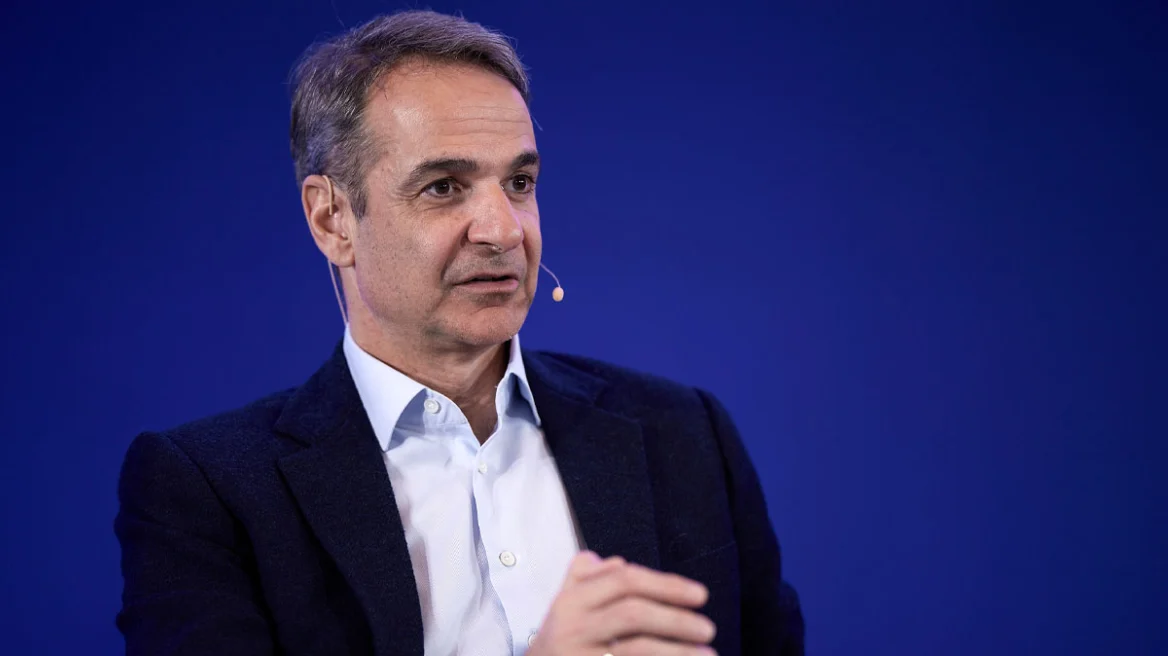
Greek prime minister Kyriakos Mitsotakis addressed the delivery of justice for what he called “four murders of our fellow citizens that have wounded us deeply”, in his weekly Sunday review. He was referring to the recent murder of Vagia Nestora, mother of New Democracy (ND), Greece’s governing centre-right party, MP Afroditi Nestora, who died following an arson attack on her daughter’s Thessaloniki home on 1 July, and to the murders 16 years earlier of the pregnant Angeliki Papathanasopoulou, Epaminondas Tsakalis and Paraskevi Zoulia in the Marfin bank arson, the 2010 Athens attack in which three bank employees died during anti-austerity protests.
“With the arrest of the suspects, a decisive step has been taken towards delivering justice and fulfilling an obligation to the victims of the Marfin arson, their families and their colleagues. This is the response that a democratic state always gives to violence: not through revenge, but through institutions, the rule of law and the effective action of the authorities,” Mitsotakis wrote.
The prime minister also referred to the recent NATO summit and his message to Turkey specifically regarding its casus belli threat, a term used in international relations to describe a formal justification for war, writing: “We cannot ignore Turkey’s longstanding casus belli, a historical anomaly that has no place in relations between two neighbouring countries. We want dialogue, but peace and cooperation cannot coexist with threats of war. This is a matter of principle that we express consistently towards all our allies.”
Read the full text:
Good morning. Before I turn to what happened this week, I feel it necessary to begin with a development of particular significance for our democracy and the rule of law. On Friday, arrests were made of those suspected of carrying out four murders of our fellow citizens that have wounded us deeply. I am referring to the recent murder of Vagia Nestora, and to the murders 16 years earlier of the pregnant Angeliki Papathanasopoulou, Epaminondas Tsakalis and Paraskevi Zoulia. One day after Nestora’s funeral, the state made good on its pledge not to let these cases fade into obscurity.
The arrest of the suspects marks a decisive step towards delivering justice and fulfilling an obligation to the victims of the Marfin bank arson, the 2010 Athens attack in which three employees died during anti-austerity protests, as well as to their families and colleagues. This is the response that a democratic state always gives to violence: not through revenge, but through institutions, the rule of law and the effective action of the authorities. It is now for the justice system to act. I also consider it important that, at such a difficult moment, there were voices calling for unity and understanding. There is no room for point-scoring or political calculation in the face of terrorism, only a common front that denies anyone who chooses violence any trace of tolerance or political cover. That is the very least we owe to the memory of every victim of political violence, and to future generations.
Turning to the main part of this review, I will start with the NATO summit, where all the critical geopolitical challenges of our time were discussed. In an environment of heightened geopolitical uncertainty, Greece remains a stable and reliable ally without stepping back from its national positions. At the summit, I reiterated that our country is a consistent ally that has always honoured its commitments and makes a substantial contribution to collective security. Reaching the defence spending target of 3.5 percent of GDP as early as 2026, together with the largest Armed Forces modernisation programme in recent decades, worth 28 billion euros, is concrete proof that we are investing in our country’s security, so that Greece remains strong and safe in an especially demanding geopolitical climate. In my remarks, I made clear that the strength of a defence alliance is measured not only in armaments, but also in respect for the principles on which it was built, and that its cohesion is also judged by good neighbourly relations, relations our country consistently pursues with every country in the region.
That, however, does not mean we can ignore Turkey’s longstanding casus belli, a term used in international relations to describe a formal threat or justification for war, which remains a historical anomaly with no place in relations between two neighbouring countries. We want dialogue, but peace and cooperation cannot coexist with threats of war. This is a matter of principle that we express consistently to all our allies. Finally, at a time when international crises are directly affecting the economy and citizens’ daily lives, I stressed the need for diplomacy to prevail in Iran and the wider Middle East. Stability in the region is not only a matter of security but also a basic precondition for protecting households from fresh rises in energy prices and the cost of living.
Closing
Developments in the Middle East and the conflict with Iran have already driven a fresh rise in international oil prices, directly affecting fuel costs. As we have done in every previous crisis, we are not standing by as external price rises squeeze incomes. In cooperation with Greece’s two oil refineries, we are therefore launching a new initiative so that, by the end of August, the price of petrol will fall by 10 cents per litre and diesel by 5 cents. Implementation details will be announced in the coming days. This is a further intervention that builds on measures we have already taken, such as the Fuel Pass subsidy scheme and support for diesel, with one consistent aim: to absorb as much as possible of the international price rises, protecting citizens’ purchasing power without endangering the country’s fiscal stability.
Within this complex geopolitical environment, an important development is that Greece is becoming a founding member of the Defence, Security and Resilience Bank (DSRB), a new international financial institution that will operate to complement European funds and programmes. Its main goal is to mobilise additional resources, chiefly from the private sector, to finance critical projects in defence, advanced technology and the protection of our infrastructure. What do we gain from this? Our participation, as a founding member no less, creates substantial prospects for the domestic defence industry and for the economy as a whole. It opens new funding routes for Greek small and medium sized enterprises involved in the defence supply chain, translating into new investment and highly specialised jobs in our country.
From the past week, I want to highlight the delivery of the first of 25 modern, new generation hybrid trains, under our agreement with Italy. These new trains are fitted with the most advanced traffic management systems and will enter service once the necessary tests are complete and they receive official certification from the Regulatory Authority for Railways. It is another piece of the wider, ongoing effort to give the country a modern railway, with new rolling stock, better infrastructure and up to date operating systems.
From rail travel, I turn to road safety, where figures for the first half of the year show that road deaths continue to fall compared with previous years, this year’s total of 213 compares with 313 in 2019. There is, of course, no room for complacency, especially now during the summer months, when the seasonal relaxation of habits is no excuse for carelessness behind the wheel. That is why Traffic Police checks are continuing at full intensity. From now on, violations will be recorded via smartphones, using the new digital ticketing devices issued by the Ministry of Citizen Protection. Of the 390 smartphones, 250 went to the Attica Traffic Police, 60 to the Thessaloniki Traffic Police and the rest to the Immediate Action rapid response police unit. That, then, marks the end of the traditional paper “pink slip” traffic ticket.
Turning to technology, Greece’s new microsatellite, Hyperion GR-1, is now also in orbit around the Earth, bringing the number of Greek microsatellites in orbit to 18, as part of the Ministry of Digital Governance and Artificial Intelligence’s plan to strengthen the country’s space capabilities. Like the other six satellites of its type, Hyperion GR-1 was built by the Greek company Open Cosmos Aegean in Pallini. It is another example that our country can produce high value added technology by investing in knowledge, innovation and its people, and it naturally links to what I said earlier about the domestic defence industry.
I want to mention two measures that settle long standing problems inherited from the past. First, the state will stop pursuing claims over agricultural land that it had itself granted to citizens, in some cases dating back to the era of Eleftherios Venizelos. Pending court cases will be dropped and ownership will be finalised in favour of the current holders, while corrections to the Hellenic Cadastre, Greece’s national land registry, will be made automatically. Second, we are modernising the rules governing co-ownership and apartment blocks, a framework that is almost a century old. The Ministry of Justice is preparing a new code by the end of the year that will simplify decision making on repairs, energy upgrades and shared building expenses. We will say more about this when the time comes.
While on the subject of the Ministry of Justice, a few months ago I presented the first results of the new Judicial Map, the reform reorganising the country’s courts. It is worth highlighting the latest figures from JustStat, the justice observatory we set up to track the performance of every court. The picture is even better than before. The average time to issue a first instance ruling has now fallen from 774 days to 357, and in the first quarter of 2026 it dropped further still, to 309 days. At the same time, courts are now clearing more cases than come in. This shows that a difficult reform is starting to deliver measurable results, with the aim of placing Greece among Europe’s five fastest countries for the administration of justice by 2030.
Turning to Greece’s regions and strengthening their core infrastructure, we have approved a new round of funding worth 66.4 million euros from the Ministry of Environment and Energy, covering 31 municipalities across the islands and mainland Greece, for 61 water supply, irrigation and sewerage projects, interventions that change daily life and protect public health in areas that still struggle today with ageing water networks or poor water quality. These projects add to a further 42 launched at the end of 2025. In total, we are supporting 63 municipalities with almost 142 million euros for 103 projects, with one clear goal: securing better quality, safer and more affordable water for citizens.
I also want to focus on Western Macedonia and the areas entering the post-lignite era. I am well aware of local people’s concern for the future of their region. That is why we are acting on a fair demand from Greece’s Just Transition regions, areas moving away from lignite dependent economies, by introducing a special protection clause: from now on, every new law or funding programme will be required to make specific provision for these areas. At the same time, we are launching 10 specific actions in Western Macedonia, ranging from absorbing former employees of the Public Power Corporation (PPC) and energy saving projects, to supporting the fur industry, upgrading the police academy in Kastoria and improving road infrastructure. Some 3.7 billion euros have already gone into the region for projects such as the E-65 road in Grevena, district heating networks and double scoring points for local residency in public sector recruitment. We are not leaving Western Macedonia on its own, and I want that to be clear.
Changing topic but staying in the regions, I turn to the famous Shipwreck Beach (Navagio) on Zakynthos. There are two pieces of news here. First, meeting a longstanding and fair request from local residents, management of the site is now passing to the Municipality of Zakynthos. Second, working with the National Technical University of Athens, a restoration plan has been designed for the coastline, with full respect for the environment and visitor safety as the top priority, while maintenance work on the historic wreck itself, the ship “Panagiotis”, is beginning through the EU’s Interreg cross border cooperation programme. Our goal is to save this unique site and hand it back to the public, protected and safe.
As I have often said, every issue, including protecting our cultural heritage, matters even more when it reaches our smallest and most remote islands. So, after Argos last week, we have now delivered to Agathonisi the 33rd museum to be built or renovated since 2019. It may have just two floors, but it holds a history stretching back to the third millennium BC. The state stands firmly beside the communities of Greece’s Aegean border islands, supporting their identity and the future of their homeland.
I left the big economic news for last, because this week saw a cluster of very significant reports from international organisations. I know economic indicators can often feel far removed from everyday life, but they actually show whether the country is standing on solid ground. First of all, the European Stability Mechanism (ESM) confirmed that Greece is among the countries that cut their debt and deficits most sharply after the pandemic. What does that mean in practice for the future? It means that over the next 10 years, our country will need far less additional fiscal effort, in other words much less pressure, compared with major eurozone economies currently under strain, such as France, Italy or Spain. That would have been unthinkable just a few years ago.
At the same time, according to the annual report of the United Nations Conference on Trade and Development (UNCTAD), foreign investment in Greece reached 13 billion dollars in 2025, a historic 35 year record. And while investment fell by 29 percent across the rest of Europe, here it rose by almost 69.4 percent in a single year, an increase more than double that of 2021 and 10 times higher than in 2015. I mention this not to boast about the capital itself, but about what this money brings: new, better and higher paying jobs. That is the key to bringing our young people home from abroad. As I mentioned in my previous review, OECD figures already show that, since 2023, more Greeks are returning than are leaving. That is the real gain. Much of this investment drive is being fuelled by the Recovery and Resilience Fund, which remains fully on schedule. We have already received 24.6 billion euros, having completed 256 milestones, and with the next instalment we will reach 82 percent of the total programme. Some 15.5 billion euros have already been channelled into the economy over five years, while the entire loan component, worth 17.7 billion euros, has been absorbed and contracted ahead of the deadline. Criticism is often heard that this money goes only “to the few and the large”, but the numbers say the opposite: 6 in 10 loan agreements involve small, very small and medium sized businesses. With these funds, Greece has now covered enormous ground in digitalising the state and in energy, overtaking the European average and reaching the point of exporting clean electricity.
So we hold on to these positive results, we are well aware of the difficulties that remain, and we continue the work without complacency. Have a good rest of your day.
Ask me anything
Explore related questions




