





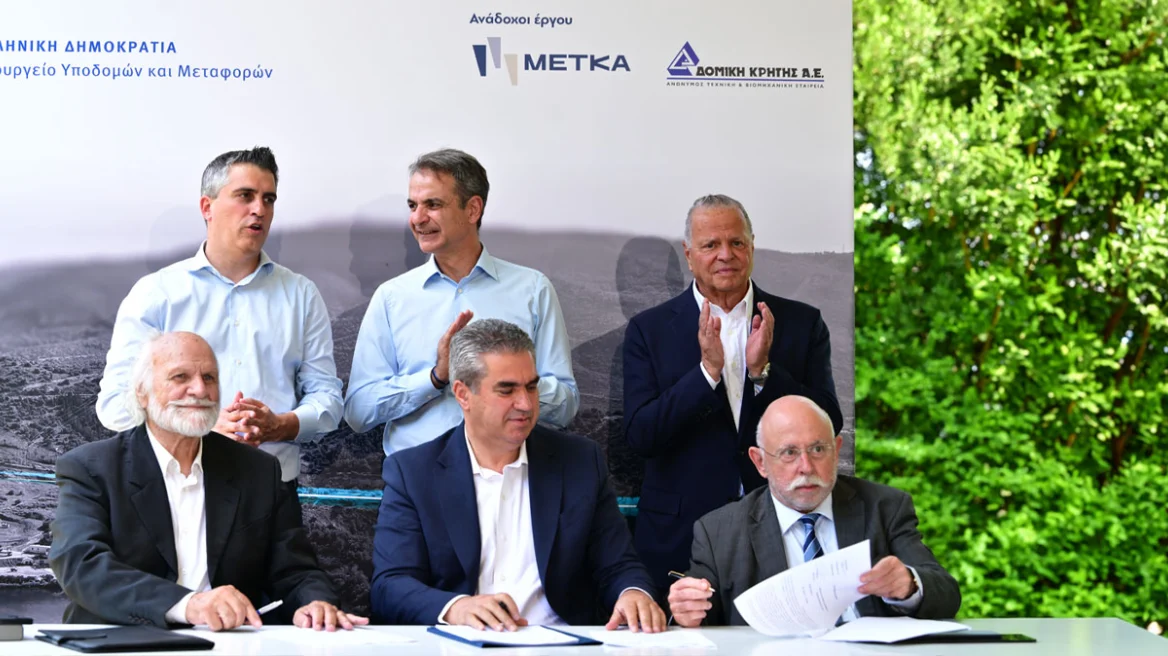
Prime Minister Kyriakos Mitsotakis described the Skaramangas Triple Interchange as an extremely important infrastructure project during the contract-signing ceremony, emphasizing that the government is addressing long-standing deficiencies in Greece‘s infrastructure.
“The image we see here is that of an area where time seems to have stood still—a neglected Western Attica,” Mitsotakis said. “Today’s signing concerns an exceptionally important project for all of Attica.”
He highlighted the area’s two unfinished tunnels as symbols of the country’s past decline and planning failures. Construction had begun years ago but was abandoned due to poor planning and a lack of funding during Greece’s fiscal crisis.
According to the Prime Minister, completing the Western Aigaleo Ring Road will provide a major new outlet from the Port of Piraeus, allowing heavy trucks to travel directly to the Attiki Odos motorway.
He also linked the project to the rapid growth of Aspropyrgos as a logistics and freight hub of both European and global importance.
“Just imagine the relief this will bring to the Port of Piraeus when this road allows heavy vehicles to reach Attiki Odos directly,” he said.
Mitsotakis said the project’s full value would become evident once completed in 36 months, expressing hope that construction could finish even sooner.
He acknowledged that traffic disruptions would occur during construction but said the government and contractors would work to minimize inconvenience.
The Prime Minister placed the Skaramangas project within the government’s broader infrastructure program, mentioning:
- Thessaloniki’s Flyover, expected to be completed in early 2027;
- the E65 motorway, which is due to open fully within days;
- the Northern Road Axis of Crete (BOAK);
- Athens Metro Line 4; and
- the planned extension of the Metro to western Athens, which he described as a personal commitment.
“There is no magic solution to Attica’s traffic problem,” Mitsotakis said, stressing that both new roads and improved public transportation are necessary.
He also announced that the Ministry of Infrastructure will move forward with another major road project connecting Elefsina and Oinofyta, following a proposal submitted by the GEK TERNA group under Greece’s unsolicited proposal framework.
At the end of his speech, Mitsotakis remarked:
“Let’s meet again in 2029 when this project opens to traffic and changes many things.”
Someone in the audience replied:
“You’ll still be here—don’t worry.”
The Prime Minister responded:
“I was talking about the project. As for everything else, that’s up to the Greek people.”
Minister Christos Dimas: Average Speed Will Increase from 28 km/h to 47 km/h
Infrastructure and Transport Minister Christos Dimas emphasized the project’s traffic benefits, noting that the tender was launched on 10 November 2025 and the contract has been signed just eight months later.
According to ministry traffic simulations:
- Current average speed in the Skaramangas area: 28 km/h
- Expected average speed after completion: 47 km/h
Approximately 100,000 vehicles use the area daily, including nearly 20,000 heavy trucks.
Dimas stressed that one of the project’s greatest advantages is providing heavy vehicles with an alternative route that avoids urban neighborhoods.
The project includes:
- Connecting the Western Aigaleo Ring Road with the National Highway and Schistou Avenue;
- Upgrading the Skaramangas, Shipyards, and Schistou interchanges;
- Improving the existing bridge;
- Eliminating traffic lights.
“We are not solving Attica’s traffic problem entirely. But this is a very significant step and a major relief for the area,” he said.
He also announced that work will begin immediately on the Metamorfosi interchange, another targeted intervention on Attica’s road network.
Evangelos Mytilineos: “The Project with the Highest Benefit Relative to Its Cost”
METLEN Executive Chairman Evangelos Mytilineos focused on the project’s economic importance, arguing that infrastructure investments enable economies to produce more, export more, and attract new investment.
Speaking off script, he said that METKA’s internal assessment considers the Skaramangas Triple Interchange:
“For quite some time, the project with the greatest benefit relative to its cost.”
He added:
“Remember that. The improvement it will bring to Western Attica is far greater than its construction cost.”
Although the project costs approximately €60 million, he stressed that:
“€60 million is still €60 million—it comes from the sacrifices of the Greek people. But the benefits generated over the coming years will repay that investment many hundreds of times over.”
According to Mytilineos, the project is much more than another road.
By improving connections between Piraeus, the Thriasio logistics center, and Greece’s national road network, it will:
- facilitate freight transport,
- strengthen supply chains,
- improve conditions for industry,
- boost trade,
- and support exports.
“Major infrastructure projects are not merely public works—they are productive investments. They are the foundation upon which a country’s competitiveness is built.”
He also cited Germany, noting that one of the country’s recent challenges has been deteriorating infrastructure, contrasting it with Greece’s substantial investment in the sector.
Mytilineos said Greece’s geographic location, ports, energy upgrades, and strong domestic companies create major development opportunities.
“Greece’s image abroad has changed dramatically. There is greater trust, greater interest, and a stronger willingness to invest.”
He attributed much of that improvement to the policies of Prime Minister Mitsotakis.
He also emphasized the importance of cooperation between the public and private sectors, arguing that large projects require shared objectives, mutual trust, and a stable investment environment without unnecessary delays or cost overruns.
For METKA, participation in the Skaramangas project is, he said, both an honor and a significant responsibility, reaffirming the company’s commitment to delivering a high-quality project safely and on schedule.
Other Officials
Deputy Infrastructure Minister Nikos Tachiaos said all conditions are in place for rapid implementation, noting that the same consortium is successfully constructing the Thessaloniki Flyover.
He also acknowledged Dimitris Koutras, representing Domiki Kritis, calling him the “dean of Attica’s infrastructure projects.”
Attica Regional Governor Nikos Hardalias said:
“We’re not just talking about roads. We’re talking about safer transportation and better connections between Piraeus, Western Attica, and the Thriasio Plain.”
He added that numerous infrastructure projects are correcting decades of neglect while improving traffic conditions.
Alternate Infrastructure Minister Giorgos Kotsiras said the project will help create a safer road environment.
Project Overview
The project was awarded to the METKA–Domiki Kritis consortium after winning the tender held last December. Parliament recently approved the contract, allowing construction to begin.
Once completed, the project will:
- improve connections between Piraeus, Western Attica, and the Thriasio logistics center;
- upgrade traffic conditions throughout Western Attica;
- modernize the Athens–Corinth National Highway at the Schistou and Skaramangas interchanges;
- create a continuous corridor linking Schistou Avenue with the Western Aigaleo Ring Road; and
- help relieve congestion on Kifissos Avenue by providing an alternative route to the Port of Piraeus.
The project is expected to be completed within 36 months.
Ask me anything
Explore related questions




