





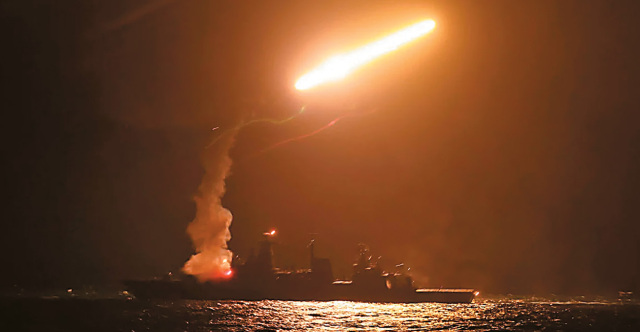
The fourth day of US airstrikes against targets in Iran took place yesterday, this time accompanied by a naval blockade and an escalation of pressure by Washington beyond purely military means. Iran, for its part, is responding with ballistic missiles and drones against targets across the wider region, once again demonstrating that it retains the ability to strike sites of US interest.
The naval blockade came into effect at 11:00 p.m. on Tuesday, Greek time, backed by substantial forces from US Central Command (CENTCOM), the American military command responsible for operations across the Middle East, comprising 20 warships and hundreds of aircraft. The stated US aim is to prevent Iran from continuing to harass commercial vessels transiting the Strait of Hormuz.
CENTCOM confirmed on social media that US forces had resumed the naval blockade against vessels travelling to and from Iranian ports and coastal areas at 4 p.m. Eastern Time, adding that more than 20 US Navy warships and hundreds of military aircraft remain deployed across the Middle East, with American forces “vigilant, lethal, and ready.”
U.S. forces resumed the naval blockade against vessels transiting to and from Iranian ports and coastal areas today at 4 p.m. ET.
— U.S. Central Command (@CENTCOM) July 14, 2026
There are currently more than 20 U.S. Navy warships and hundreds of military aircraft operating across the Middle East. American forces remain… pic.twitter.com/ATRJHlLQNo
An hour before the blockade took effect, US forces launched a fresh wave of strikes against targets in Iranian cities on or near the strait. Explosions were again reported in Bandar Abbas, Ahvaz, and on Qeshm Island, although the exact nature of the targets remains unclear. Iranian officials were quick to claim that one of the American strikes had hit a bottled water plant.
The attacks continued into the early hours of Wednesday morning. The US military said it had “completed an additional round of strikes against Iran” after bombing dozens of targets near the Strait of Hormuz and in coastal areas for the fourth consecutive night.
According to CENTCOM, the seven hour wave of strikes targeted facilities housing missiles and unmanned aerial systems, naval capabilities, and coastal defence systems, with the stated goal of “further degrading Iran’s ability to threaten commercial shipping and merchant marine crews.”
Separately, the US Treasury Department imposed fresh sanctions on Iran, targeting individuals, entities, and vessels, and froze cryptocurrency wallets linked to Tehran worth a combined 130 million dollars.
Iranian drone and missile strikes also hit Kuwait, with footage circulating online reportedly showing the impact of a Shahed 136 drone. Targets inside Bahrain and Kuwait have increasingly borne the brunt of Iranian retaliation as the exchange of fire between Washington and Tehran continues.
Footage, reportedly taken during Iranian drone and missile strikes against Kuwait earlier, shows a Shahed-136 impact. The U.S. continues to trade strikes with Iran, as targets inside Bahrain and Kuwait are now bearing the brunt of Iranian fires. pic.twitter.com/AC07mtqi96
— OSINTdefender (@sentdefender) July 15, 2026
Trump: energy plants and bridges next
President Trump made clear that sustained bombing has become the new normal. In an interview with Fox News, he said in no uncertain terms that he would continue bombing Iran until he personally judged it was enough, adding that from next week US targets would expand to include power plants and bridges unless Iran returned to the negotiating table.
BREAKING: Trump tells Fox News in an interview that the U.S. military is going to bomb Iran's power plants and bridges next week, if it doesn't come to the table and negotiates pic.twitter.com/ydxNt0jfxv
— Insider Paper (@TheInsiderPaper) July 14, 2026
Iran’s response came in a series of overnight statements claiming attacks on a major US air base in Jordan where F-18 aircraft are stationed, as well as on a US base in Kuwait said to hold a large quantity of military equipment, which Tehran claimed had been set ablaze. Kuwait and Bahrain were again targeted at the same time.
Iranian state radio and television also attributed the sounds of explosions heard in Bandar Abbas and in coastal cities and islands across the Gulf to what it described as clashes and exchanges of fire in the Strait of Hormuz between US and Iranian forces, while another Iranian source referred to engagements involving the naval branch of the Islamic Revolutionary Guard Corps (IRGC). The accuracy of Iran’s claims remains difficult to verify independently.
Hormuz to remain closed until attacks end, Tehran says
Iran’s Revolutionary Guard announced early on Wednesday that the Strait of Hormuz would remain closed until what it called US “aggressive actions” cease, while threatening to close other strategically important energy export routes in the region, according to a statement broadcast by state broadcaster IRIB.
“Retaliatory operations will continue, and the Strait of Hormuz will remain closed until the US puts an end to its aggressive actions,” the statement said, adding that the “enemy must also expect the closure of other oil and gas export routes that serve the interests of the US and its allies.” It concluded: “Oil and gas exports from the region will either be accessible to everyone or to no one.”
Ask me anything
Explore related questions




