





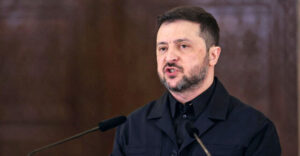
As President Volodymyr Zelensky prepares to reshuffle his cabinet, the spotlight is on 35-year-old Defense Minister Mykhailo Fedorov, a technology expert described as possessing the “military instinct of the Cossacks.” His possible removal could affect Kyiv’s war effort against Russia.
Since taking office just six months ago, Fedorov has led an ambitious campaign to transform Ukraine’s understaffed military into a more efficient fighting force.
Maria Berlinska, a prominent volunteer and advocate for the use of drones in warfare, said Fedorov’s innovative thinking has helped cut through bureaucracy in every position he has held.
“I see before me a thoughtful, mature Ukrainian with the military instinct of the Cossacks,” Berlinska wrote yesterday, recalling their first meeting after his appointment.
It remains unclear whether Zelensky—who is carrying out his second government reshuffle within a year—plans to keep Fedorov in office as the war with Russia reaches a critical stage.
Even if he is reappointed, some lawmakers believe Parliament may not approve him due to concerns voiced across party lines, adding uncertainty ahead of Thursday’s confirmation vote.
Supporters say Fedorov’s efforts to clean up defense procurement have angered parts of the political establishment. He has also faced criticism from some lawmakers for failing to quickly deliver on promised reforms to Ukraine’s military recruitment system.
Political Turmoil
In a surprise announcement on Sunday, Zelensky said the reshuffle was intended to “renew” the government and law enforcement agencies, but the move has caused significant upheaval within Ukraine’s political establishment.
The departure of outgoing Prime Minister Yulia Svyrydenko, after just one year in office, triggered the resignation of the entire government.
Under Ukraine’s political system, the president nominates the ministers of Defense and Foreign Affairs, who must then be approved by Parliament.
Critics of the reshuffle warn that replacing Fedorov could destabilize one of the country’s most important ministries at a time when Ukraine is again increasing pressure on Russia by disrupting its energy infrastructure and slowing Russian advances on the battlefield.
Ukraine also continues to face critical challenges, including shortages of air defense systems and military personnel.
“We can reshuffle everything else, but I have one request: at least leave the Defense Ministry stable,” opposition lawmaker Solomiia Bobrovska told Parliament yesterday.
Even if the widely popular Fedorov remains in office, the controversy threatens to further undermine public and parliamentary confidence in Zelensky’s leadership during wartime, at a moment when Ukraine’s fortunes appear to be improving.
Strong Support from the Military
As Ukraine’s first Minister of Digital Transformation, Fedorov modernized key public services by integrating them into a widely used government app.
As Defense Minister, he is credited with expanding drone procurement and implementing a data-driven strategy aimed at wearing down Russian forces.
Andriy Nazarenko, commander of the Bulava drone systems battalion within Ukraine’s 72nd Mechanized Brigade, told Reuters that he “strongly” supports Fedorov—a view he said is widely shared among military personnel.
A Sensitive Moment
Ukraine, now in its strongest position since 2022, has intensified strikes on Russian oil refineries and battlefield supply facilities, weakening the Kremlin’s war machine.
Russia, however, maintains that it remains on course to achieve its objectives in the war, now entering its fifth year.
Despite Ukraine’s recent successes, the country still lacks sufficient U.S.-made air defense missiles needed to intercept the growing number of ballistic missile attacks targeting major cities such as Kyiv.
Officials are also preparing for another winter of Russian strikes against the country’s power grid.
Meanwhile, Fedorov’s sweeping reforms to address manpower shortages in the armed forces continue, even as problems with recruitment, poor treatment of personnel, and mismanagement persist in some military units.
On the battlefield, Russian forces continue to make gradual advances toward Ukraine’s fortified defensive zone, centered on key cities in the eastern Donetsk region, which Russian President Vladimir Putin aims to capture in its entirety.
Whether or not Fedorov remains in office, any progress made under his leadership must be institutionalized within the Defense Ministry so it does not depend too heavily on a single individual, said Serhiy Kuzan, head of the Kyiv-based think tank Ukrainian Security and Cooperation Center.
“That is precisely the approach that ensures the long-term stability of state institutions,” Kuzan said.
Ask me anything
Explore related questions




