





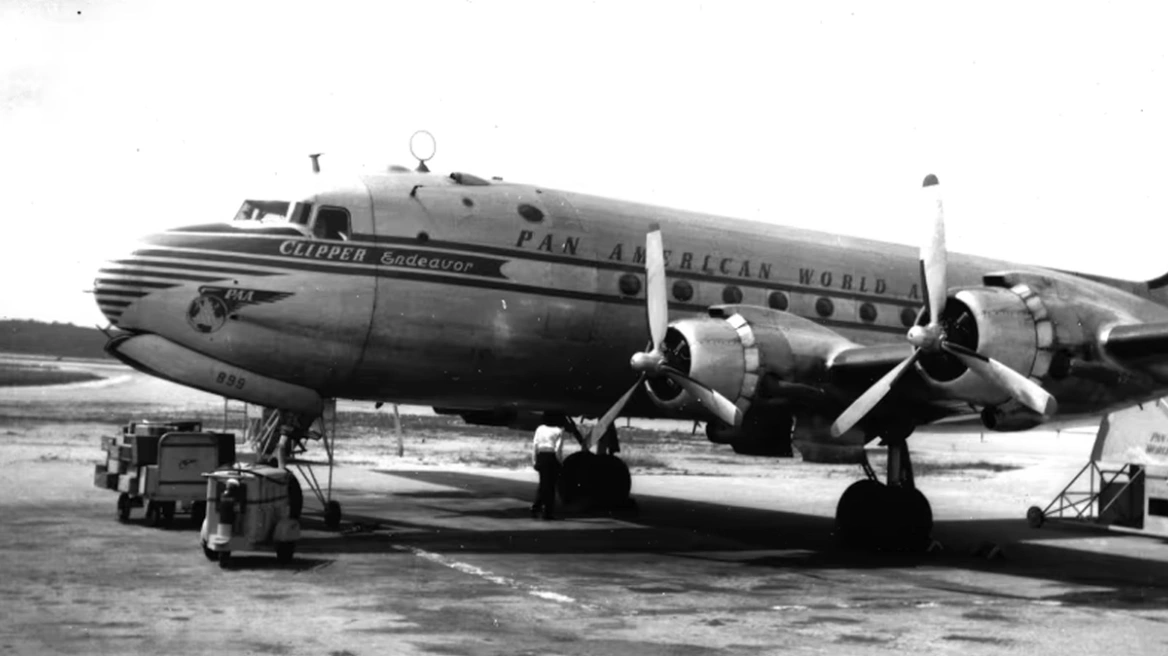
More than seven decades on, a research team has located the wreckage of Pan American World Airways (Pan Am) flight 526A on the floor of the Atlantic, an aircraft lost in 1952 in an accident that left a lasting mark on civil aviation history.
The plane was found on 2 June, at a depth of roughly 600 metres and around eight kilometres off the coast of San Juan, Puerto Rico. The discovery was made using an autonomous underwater vehicle fitted with sonar and high-resolution cameras, which spent days scanning the seabed in the area.
According to The New York Times, the first images clearly showed the Pan Am logo, sections of the fuselage, the landing gear and the cabin windows, with parts of the aircraft found to be remarkably well preserved.
The flight, also known as the “Easter Special”, had taken off from San Juan bound for New York on Good Friday, 11 April 1952.
Less than nine minutes after take-off, two of the Douglas DC-4’s four engines failed. The captain attempted to turn back to the airport, but continuing loss of altitude forced him to carry out an emergency landing on the Atlantic.
All 69 people on board survived the impact with the water. Minutes later, however, the rear section of the aircraft broke away and the fuselage began to sink.
The confusion that broke out during the evacuation proved fatal. Many passengers refused to follow the captain’s instructions to abandon the aircraft and remained strapped into their seats, while rough seas and fear of sharks led several others to stay inside the cabin.
In total, 52 people lost their lives, most by drowning, and 39 bodies were never recovered, in an accident that left its mark on the history of civil aviation and led to major changes in flight safety rules.
“When we saw the first photographs, we were speechless,” said Josh Gates, host of the Discovery Channel series Expedition Unknown, who took part in the mission.
“It took my breath away, because what we were looking at exceeded every expectation. The aircraft is so well preserved, and seeing the aluminium, which doesn’t corrode, still shining on the seabed was truly overwhelming.”
The tragedy that changed safety rules
The accident marked a turning point for civil aviation. At the time, pre-flight safety briefings were not mandatory, nor were there standardised instructions telling passengers how to react in an emergency.
Following the tragedy, new safety procedures were adopted, forming the basis for the safety briefings still given before every flight today. “This is an accident that fundamentally reshaped aviation as we know it,” Gates said.
Locating the wreckage of the Clipper Endeavor had become a personal mission for Russ Matthews, president and co-founder of the nonprofit Air/Sea Heritage Foundation, who played a key role in the expedition.
In an interview, Matthews explained that the site where the aircraft had sunk lay at such depth that divers could not reach it. Poor weather conditions also significantly hampered the operation, while, he said, the coronavirus pandemic delayed the research for years. “We had to wait two years to get our chance,” he said.
An autonomous underwater vehicle made almost 30 passes over the site, capturing more than 350,000 photographs. The research team made clear that it does not intend to raise the wreckage or search the site for human remains.
Ask me anything
Explore related questions




