





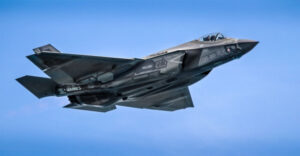
US policy on the potential transfer of F-35 fighter jets to Turkey remains unchanged, and Ankara has yet to satisfy the conditions set out in US law, the State Department has told Congress in an official response.
The position appears in a letter from the State Department’s Office of Legislative Affairs, the branch responsible for the Department’s communications with Congress, addressed to Democratic Representative Wesley Bell. The letter was sent in reply to Bell’s request to US President Donald Trump concerning US-Turkish relations, sanctions under the Countering America’s Adversaries Through Sanctions Act (CAATSA), the F-35 programme, and Turkey’s ties to Hamas.
According to the letter, the White House asked the State Department to respond on the president’s behalf.
The State Department notes that US policy remains governed by Section 231 of CAATSA and Section 1245 of the National Defense Authorization Act for Fiscal Year 2020, the annual legislation that sets defence policy and spending priorities.
Before any F-35 delivery to Turkey can take place, the letter states, Ankara must fully comply with the requirements set out in that legislation. This means Turkey must no longer possess the Russian-made S-400 air defence system or its associated equipment, must provide assurances that it will not acquire the system again in future, and must satisfy the remaining certification requirements written into the law. The State Department states plainly that these conditions have not yet been met.
At the same time, it stresses that any process to resolve the S-400 issue must be transparent, lawful and consistent with US national security interests.
The letter adds that, following President Trump’s recent meeting with Turkish President Recep Tayyip Erdoğan in Ankara, the United States will continue working with Turkey to resolve the S-400 issue while also seeking to deepen cooperation within NATO.
On bilateral relations more broadly, the State Department says cooperation between the two countries rests on shared security concerns and balanced trade ties, adding that Washington will keep working with Ankara in areas of mutual interest while demanding accountability whenever Turkish actions undermine US interests.
On the question of Hamas, the letter acknowledges that Washington continues to have concerns about Turkey’s relations with the group, a US-designated terrorist organisation. However, it credits Ankara with helping to advance the president’s peace plan for Gaza, using its contacts with Hamas’s political leadership to secure acceptance of the first phase of the ceasefire.
Ask me anything
Explore related questions




