





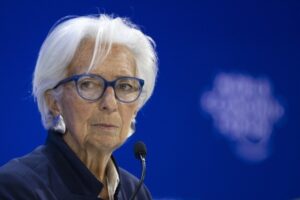
The European Central Bank (ECB) adopted a wait-and-see approach, keeping its key interest rates unchanged at 2.25% during its meeting today. The decision reflects officials’ heightened caution over the new wave of uncertainty caused by the escalation of the conflict in the Middle East.
The corrective “pause” following the interest rate increase last June was deemed necessary, as the sharp rise in oil prices and the threat of further supply chain disruptions have brought inflation risks back into focus.
ECB President Christine Lagarde has repeatedly stressed the importance of basing future decisions on incoming economic data (a data-dependent approach), avoiding commitments regarding the path the central bank will follow in upcoming meetings.
At the same time, markets are seeking clearer signals about the possible scenarios that may emerge by the end of 2026. Although analysts’ baseline scenario had pointed towards a gradual easing of monetary policy, recent geopolitical turmoil has complicated the outlook.
Investment portfolios are now weighing two opposing forces. On one side, the slowdown of the European economy calls for lower interest rates, while on the other, persistent energy-related inflationary pressures could force Frankfurt to keep borrowing costs elevated for longer.
With today’s decision, the ECB opted to gain more time, assessing the depth of the Middle East crisis before determining its final strategy for the remainder of the year.
ECB statement
The Governing Council decided today to maintain the ECB’s three key interest rates unchanged.
Energy price developments, although highly volatile, are currently close to the levels included in the baseline scenario of the Eurosystem staff projections from June and remain significantly above the levels recorded before the conflict in the Middle East.
Uncertainty remains high, and the inflationary effects of the energy shock have not yet fully materialised. The Governing Council is therefore closely monitoring the intensity and duration of the disruption, as well as its indirect and secondary effects.
The Council remains committed to setting monetary policy in order to ensure that inflation stabilises at its 2% medium-term target.
With today’s decision, the Governing Council remains prepared to address the uncertainty caused by the conflict. It will continue to follow an approach based on incoming data and will make decisions meeting by meeting to determine the appropriate monetary policy stance.
Specifically, decisions on interest rates will be based on the Council’s assessment of the inflation outlook and the risks surrounding it, taking into account incoming economic and financial data, underlying inflation dynamics, and the strength of monetary policy transmission.
The Governing Council is not committing in advance to any specific path for interest rates.
ECB key interest rates
The interest rates on the deposit facility, main refinancing operations, and marginal lending facility will remain unchanged at:
- 2.25%
- 2.40%
- 2.65%, respectively.
Asset Purchase Programme (APP) and Pandemic Emergency Purchase Programme (PEPP)
The APP and PEPP portfolios continue to decline at a measured and predictable pace, as the Eurosystem no longer reinvests principal payments from maturing securities.
The Governing Council remains ready to adjust all instruments available within its mandate to ensure inflation stabilises at the 2% target over the medium term and to safeguard the smooth transmission of monetary policy.
In addition, the Transmission Protection Instrument (TPI) remains available to counter unwanted, disorderly market developments that could pose a serious threat to the transmission of monetary policy across euro area countries, allowing the Governing Council to more effectively fulfil its price stability mandate.
Ask me anything
Explore related questions




