





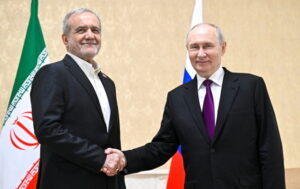
Russian President Vladimir Putin offered his help in contributing to a settlement of the war in the Middle East during a meeting with his Iranian counterpart, Masoud Pezeshkian, ahead of a regional summit expected to take place today in Turkmenistan.
“We are ready to do everything within our power to help resolve this situation,” the Russian president said, according to remarks reported by Russian news agencies yesterday evening, Thursday.
According to Putin, Iran is making “genuine efforts to bring the conflict to an end,” a conflict that began in late February with US-Israeli airstrikes against the Islamic Republic.
Pezeshkian, for his part, assured Putin that his country remained committed to dialogue, but noted that “every time we negotiate with the United States, they attack again,” the Iranian state media outlet IRIB reported.
The two leaders are expected to attend a summit of the Commonwealth of Independent States (CIS) today, held in Avaza, a resort on the Caspian Sea coast.
The Russian head of state also expressed satisfaction with the “positive development” of relations between Russia and Iran, which have strengthened their diplomatic and military ties since Russia’s invasion of Ukraine in 2022.
Iran is accused by Kyiv and Western countries of having supplied Russia with Shahed unmanned aerial vehicle (drone) technology and short-range missiles, while Russia is accused of providing Tehran with targeting data to strike US interests in the Middle East.
The previous meeting between the Russian and Iranian presidents took place in September in Kyrgyzstan, on the sidelines of a Shanghai Cooperation Organisation summit, amid increased economic and military cooperation between Russia and Iran following the outbreak of the war in Ukraine.
Further bilateral meetings are also scheduled on the sidelines of the Avaza summit, which brings together countries that emerged from nine former Soviet republics.
Sphere of Influence
The CIS, founded in December 1991 during the final weeks of the Soviet Union, was intended to preserve ties among the former Soviet republics following the USSR’s collapse.
“The aim was to manage problems” between them, “such as economic issues and certain political and governance-related problems,” explains Yanibek Arinov, a Central Asia geopolitics researcher based in Kazakhstan. The CIS “played an important role during the 1990s, but since then it has not really evolved,” he points out.
Some countries have since left the commonwealth.
Georgia withdrew following the Russo-Georgian war of 2008, while Ukraine stopped participating after Russia’s annexation of Crimea in 2014. Moldova announced its withdrawal in 2023 as part of its move closer to the European Union.
For Moscow, which continues to play a dominant role in the region, “the CIS demonstrates that Russia has its own sphere of influence, one that is consolidated and institutionalised through this organisation,” according to Temur Umarov, a researcher at the Carnegie Russia Eurasia Center in Berlin.
However, CIS countries are seeking to diversify their economic and diplomatic partners, notably by strengthening ties with Beijing and Western countries.
“Even if Russia decides to use this platform as a vehicle for anti-Western or anti-Ukrainian rhetoric, that does not mean the other members will systematically endorse its position,” Yanibek Arinov stresses.
More than four and a half years after the start of Russia’s invasion of Ukraine, the conflict has seen a clear increase in long-range strikes by both sides of the front in recent months.
US diplomatic efforts to find a peaceful solution have reached an impasse, while US Secretary of State Marco Rubio described the situation yesterday as “very dangerous.”
Ask me anything
Explore related questions




