





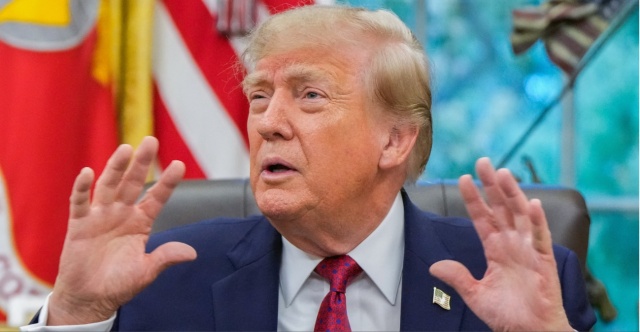
Donald Trump has signalled the prospect of a broad agreement to end the war in Ukraine, one that could reshape the security framework across Europe, revealing that he met Kirill Dmitriev, Vladimir Putin’s special envoy, at the White House on Thursday (5 November). The US president, who said he believed the war was nearing its end, clarified that he had not held a similar meeting with the Ukrainian officials who were at the presidential residence that same day for an event hosted by Melania Trump.
His remarks came at a critical juncture in diplomatic efforts, as US envoys held parallel discussions with Ukrainian and European officials at NATO headquarters in Brussels, focusing on security guarantees for Kyiv and the future architecture of European security.
Next week, delegations from the United States, Russia and Ukraine are expected to meet in Abu Dhabi for the first trilateral peace talks since February. Trump’s reference to an agreement that could involve the whole of Europe takes on particular significance ahead of those discussions, while also raising questions about the scope of the negotiations and the role of European allies.
Trump: “It will be a great deal and everyone will be thrilled”
Speaking to reporters at the White House, the US president struck a particularly optimistic note about the prospects for a diplomatic resolution to the conflict.
“There will be a deal. It will be a great deal and it will involve more than Ukraine… I would even say it could involve all of Europe. It will be a great, fantastic deal and everyone will be thrilled,” he said.
Trump confirmed that he had met Kirill Dmitriev, but did not disclose any details about the substance of their discussions.
He said, however, that he had not met with the Ukrainian delegation, which was also at the White House. He did not explain why, while the US presidency did not immediately respond to a request for comment.
The decision is particularly noteworthy given that Trump has repeatedly criticised Ukrainian President Volodymyr Zelensky, blaming him for delays in reaching an agreement because of his refusal to accept concessions.
Meanwhile, in the final weeks of the US midterm election campaign, Trump had reached an agreement with Vladimir Putin to lift sanctions on Russian diesel exports, a move that forms part of the broader contacts between Washington and Moscow.
Talks in Brussels on security guarantees for Ukraine
As Trump met the Russian envoy in Washington, US representatives were holding talks with Ukrainian, NATO and European officials in Brussels.
Among them was the US president’s son-in-law, Jared Kushner, who described the discussions as productive, noting that they focused both on security guarantees for Ukraine and on shaping a broader European security framework.
“We are working intensively with all sides to find practical solutions that could end this war and lay the foundations for lasting peace,” Kushner said in a post.
The parallel discussions in Washington and Brussels indicate that the negotiations are no longer confined exclusively to the terms for ending hostilities, but are also extending to the guarantees that would accompany any potential agreement.
For now, however, it remains unclear exactly what Trump means by an agreement that could involve the whole of Europe, or whether the discussions concern specific changes to relations between Russia and NATO.
The six-day ceasefire in Oleshky and Melania Trump’s role
Kirill Dmitriev’s presence at the White House was linked to an event hosted by Melania Trump concerning the recent six-day ceasefire between Russia and Ukraine in Oleshky, a town in the Kherson region of southern Ukraine that is under Russian control.
The temporary ceasefire was in effect from 27 October to 1 November and was one of the most significant local ceasefires since Russia launched its full-scale invasion in February 2022.
Its aim was to deliver humanitarian aid and evacuate civilians from the town, where living conditions had deteriorated dramatically.
According to Melania Trump, nearly 800 residents were evacuated from Oleshky during the operation.
When the ceasefire came into effect, an estimated 2,000 people were still in the town. Residents were given the option of leaving for areas under Ukrainian or Russian control, or remaining in place with access to fresh supplies of food and medicine.
The First Lady explained that she had initiated the contacts after being briefed on the humanitarian situation in Oleshky during an event on the sidelines of the United Nations General Assembly in September.
She said that she and her close associate, Marc Beckman, had worked directly with the Russian and Ukrainian leaderships to establish the terms of the temporary ceasefire.
Putin’s thanks and Zelensky’s message
During the White House event, Dmitriev thanked Melania Trump for her humanitarian role, conveying the Russian president’s gratitude as well.
He said Vladimir Putin had personally issued instructions for the operation, acknowledging the First Lady’s contribution to securing the temporary ceasefire.
Also attending the event were David Arakhamia, head of the parliamentary group of Zelensky’s party, and Ukraine’s Human Rights Commissioner, Dmytro Lubinets.
Arakhamia congratulated Melania Trump on her initiative and urged her to continue her humanitarian efforts.
“We would certainly like to ask you to continue and take on new missions, so that you can contribute as much as possible to de-escalation,” he said.
For his part, Volodymyr Zelensky had referred to the Oleshky ceasefire the previous week during a speech in Spain, stressing that the operation had demonstrated that Moscow had the ability to halt hostilities whenever it chose to do so.
“When Putin wants the fighting to stop, it stops. And there was real quiet, with no attacks for several days, and we saved hundreds of lives,” he said.
“A small spark that will grow into lasting peace”
Melania Trump expressed hope that the example of Oleshky would provide a starting point for broader and more lasting ceasefire agreements.
“Let Oleshky become the small spark that grows into an enduring flame of peace,” she said.
Over the past year, the First Lady has taken on a more active role in humanitarian initiatives linked to the war in Ukraine, participating in efforts to reunite families separated by the conflict.
To date, her interventions have helped secure the return of nearly 36 children to their relatives.
At the end of the event, she handed representatives of Putin and Zelensky a large white envelope each, asking them to deliver personal letters from her to the two leaders.
Dmitriev presented her with a painting by an 11-year-old girl, while Zelensky awarded her a Ukrainian honorary distinction in recognition of her contribution to securing the ceasefire.
The humanitarian disaster in Oleshky
Oleshky, which had a pre-war population of around 24,000, is situated on the Dnipro River, which separates Ukrainian forces from the territory controlled by Russia.
The town was captured by Russian forces on the first day of the invasion and has since suffered extensive damage from shelling, fires and the collapse of essential infrastructure.
The situation deteriorated dramatically in June 2023, when the destruction of the Kakhovka Dam caused widespread flooding. An investigation by the Associated Press concluded that the explosion which caused the dam’s collapse was likely attributable to Russian forces.
Today, residents who remain in Oleshky face severe shortages of food and medicine, with no electricity, heating or running water, as another difficult winter approaches.
Ukraine had repeatedly called for a local ceasefire to allow the evacuation of civilians. Under international law, Russia, as the occupying power, is obliged to ensure that the civilian population’s basic needs for survival are met.
Europe awaits next moves after Democrats’ victory
The diplomatic landscape is taking shape following the Democrats’ sweeping victory in the US midterm elections on 3 November, a development that has shifted the balance of power in Congress.
The EU’s foreign policy chief, Kaja Kallas, expressed the expectation that the new Congress would exert “greater pressure on Russia”, highlighting the different emphasis placed by the European side on managing the war.
The next round of talks in Abu Dhabi is expected to show whether Trump’s optimism can be translated into concrete commitments from Moscow and Kyiv.
The key question, however, concerns not only how the war in Ukraine will end, but also the substance of the broader agreement described by the US president, and the role European countries will play in shaping it.
Ask me anything
Explore related questions




