





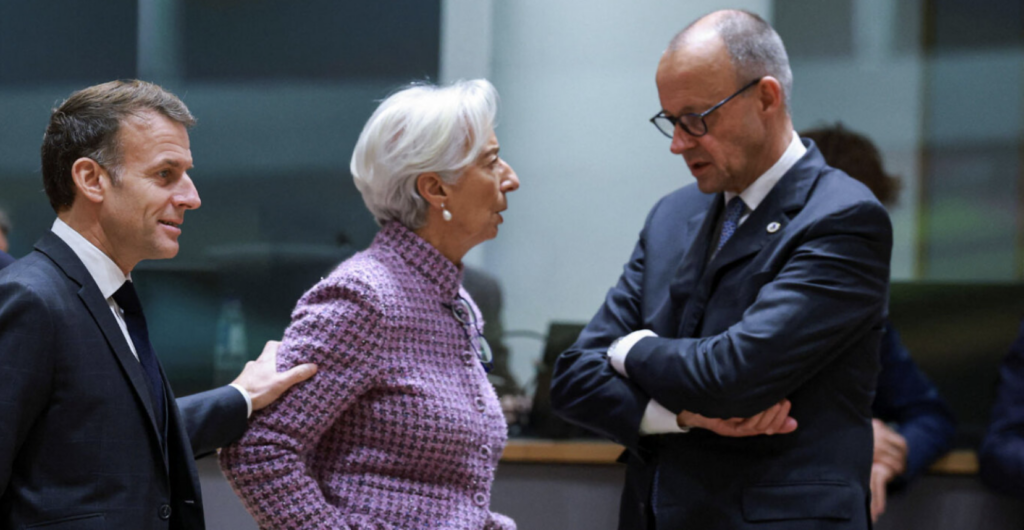
The European Union summit in Brussels appears to have turned into a deadlock, with no agreement on the bloc’s budget, as differences between member states over the next seven-year EU budget remain irreconcilable, with Italian Prime Minister Giorgia Meloni appearing unwilling to commit to an agreement even in December and German Chancellor Friedrich Merz threatening a veto unless funding for Ukraine is secured.
Earlier, after the plenary discussion ended without any meaningful convergence, European Council President António Costa decided to divide European leaders into seven smaller groups, holding successive meetings in the presence of European Commission President Ursula von der Leyen, in an attempt to narrow the differences – but what he achieved was arguably to exacerbate them.
According to Politico, citing two European diplomats, during these meetings Costa proposed further cuts to the EU’s next seven-year budget in an effort to bring countries closer to an agreement. The Portuguese politician had already reduced the budget proposal by €44 billion last Saturday, triggering reactions from most EU countries.
This was because, according to diplomatic sources, the countries described as “frugal” walked out of the small-group discussions organised by European Council President António Costa, protesting what they viewed as an attempt to divide them. The decision was taken after Finnish Prime Minister Petteri Orpo appeared “really furious” with Costa’s approach, prompting the other countries in the “frugal” group to decide not to participate in the subsequent meetings.
“Costa was going to organise discussions in small groups. It was obvious that this was a move aimed at dividing us, buying each of the seven of us off with some kind of concession. The whole thing went very badly. It was not a genuine discussion,” the same sources said.
By around 11pm Greek time, it was clear that the summit was in crisis, as Denmark, Germany, the Netherlands, Austria, Finland, Sweden and Belgium were expressing strong objections to the way the negotiations were unfolding, according to three diplomats familiar with the talks. One of them said the leaders were “furious”.
German Chancellor Friedrich Merz said late on Thursday evening, according to Reuters, that the summit would not continue on Friday, as originally scheduled. “We will not reach an agreement tonight,” Merz predicted, adding that talks between EU leaders in Brussels had brought a “new development” towards reducing the proposed size of the next budget, as Germany and other countries had demanded.
The leaders of the 27 member states will now attempt to reach an agreement during a two-day summit beginning on December 17, the German chancellor said. He reiterated his position that all 27 EU member states should contribute to providing assistance to Ukraine, adding that the issue would be discussed further during a final round of talks between leaders expected to begin later tonight, around midnight.
In Brussels, however, concerns are mounting that the differences are so deep that even the goal of reaching an agreement at the December 17–18 summit is now in doubt.
French President Emmanuel Macron, notably, said he believed an agreement on the EU’s seven-year budget would ultimately be reached, although it would probably not satisfy him. “Europe is making a strategic mistake,” he said, stressing that the EU was not following the recommendations of the Draghi and Letta reports on economic competitiveness.
Macron made clear that he would not sign an unbalanced agreement, while pointing out that after December 31 he would be unable to sign any agreement because of the upcoming elections in France.
Mitsotakis intervenes
While consultations were under way, Prime Minister Kyriakos Mitsotakis intervened with a social media post, warning that further cuts to the European budget undermine the European Union’s own ambitions to strengthen its competitiveness.
“If we continue to insist on further cuts to the EU budget, we might as well throw the Draghi report and its high ambitions into the dustbin of European history,” the prime minister said.
See Mitsotakis’s post:
If we continue to insist on further cuts to the EU budget, we can throw the Draghi report and its lofty ambitions into the dustbin of European history.
— Prime Minister GR (@PrimeministerGR) November 26, 2026
Mitsotakis’s intervention highlights the contradiction between European leaders’ declarations about the need to strengthen competitiveness and the pressure exerted by several governments to reduce EU spending.
Athens has made clear that it will not accept further cuts to funding for the Common Agricultural Policy and cohesion policy, while insisting on the need to find new sources of revenue for the European budget.
At the same time, the prime minister has stressed the need to reach an agreement in December, estimating that political developments in several member states will make negotiations significantly more difficult in 2027.
Meloni remains firm and is in no rush to reach an agreement
One of the biggest obstacles to António Costa’s efforts remains Italy’s position.
Giorgia Meloni said European leaders were “light years away from a solution”, making clear that Rome was not prepared to accept an agreement simply to meet the December timetable.
The Italian government is calling for a revision of the allocation of EU funds, opposes cuts to agricultural subsidies and cohesion funding, and has also raised objections to proposals for introducing new European taxes.
Meloni, together with Romanian President Nicușor Dan, has been tasked with representing the common negotiating position of the “Friends of Cohesion” group, which also includes Greece.
Meanwhile, Hungarian Prime Minister Péter Magyar expressed pessimism about the outcome of the discussions, estimating that the chances of reaching an agreement tonight were virtually zero, while questioning even the possibility of a deal before Christmas.
Merz’s veto threat
A further complication in the negotiations is Friedrich Merz’s insistence on linking approval of the next EU budget to funding for Ukraine.
The German chancellor has made clear that Berlin will not agree to a budget deal unless all 27 member states’ participation in financial support for Kyiv is secured.
At the centre of the dispute is the European Commission’s proposal for a new €45 billion loan to Ukraine to cover the country’s financial and military needs in 2027.
Hungary, Slovakia and the Czech Republic are seeking to opt out of the funding, with Slovak Prime Minister Robert Fico accusing Merz of blackmail.
The Commission’s proposal provides for €20 billion for non-military needs and €25 billion for military support. Bulgaria has already expressed its intention to participate exclusively in the non-military component.
Two opposing camps over the EU budget
António Costa’s compromise proposal for the 2028–2034 budget, worth approximately €1.78 trillion, continues to face opposition from different sides.
The group of seven fiscally conservative countries – Germany, Austria, Belgium, Denmark, Finland, the Netherlands and Sweden – is calling for further spending restraint and the reallocation of funds to areas such as defence, technology and innovation.
By contrast, the 17 countries in the “Friends of Cohesion” group oppose further cuts to the European Union’s traditional policies.
France, for its part, insists on maintaining agricultural subsidies, while seeking to accelerate the agreement ahead of the presidential elections in spring 2027 and the possibility of the National Rally coming to power.
António Costa’s challenge is no longer to secure an agreement during the emergency summit, but to ensure sufficient progress to keep a December deal within reach.
Eurozone gives green light to de Cos for ECB presidency
Meanwhile, eurozone member states agreed to nominate Spain’s Pablo Hernández de Cos for the presidency of the European Central Bank. They are proposing France’s Laurence Boone and Germany’s Markus Brunnermeier for the Executive Board.
The decision was announced by European Council President António Costa in a post on X.
The euro area member states have agreed to recommend Pablo Hernández de Cos as President of the @ecb, and Laurence Boone and Markus Brunnermeier as members of the ECB Executive Board. I will propose that the European Council launches consultations with the @Europarl_EN and the Governing Council of the ECB. This will pave the way for the formal appointment of the new ECB leadership by the #EUCO in December.
— António Costa (@eucopresident) November 26, 2026
Ask me anything
Explore related questions




