





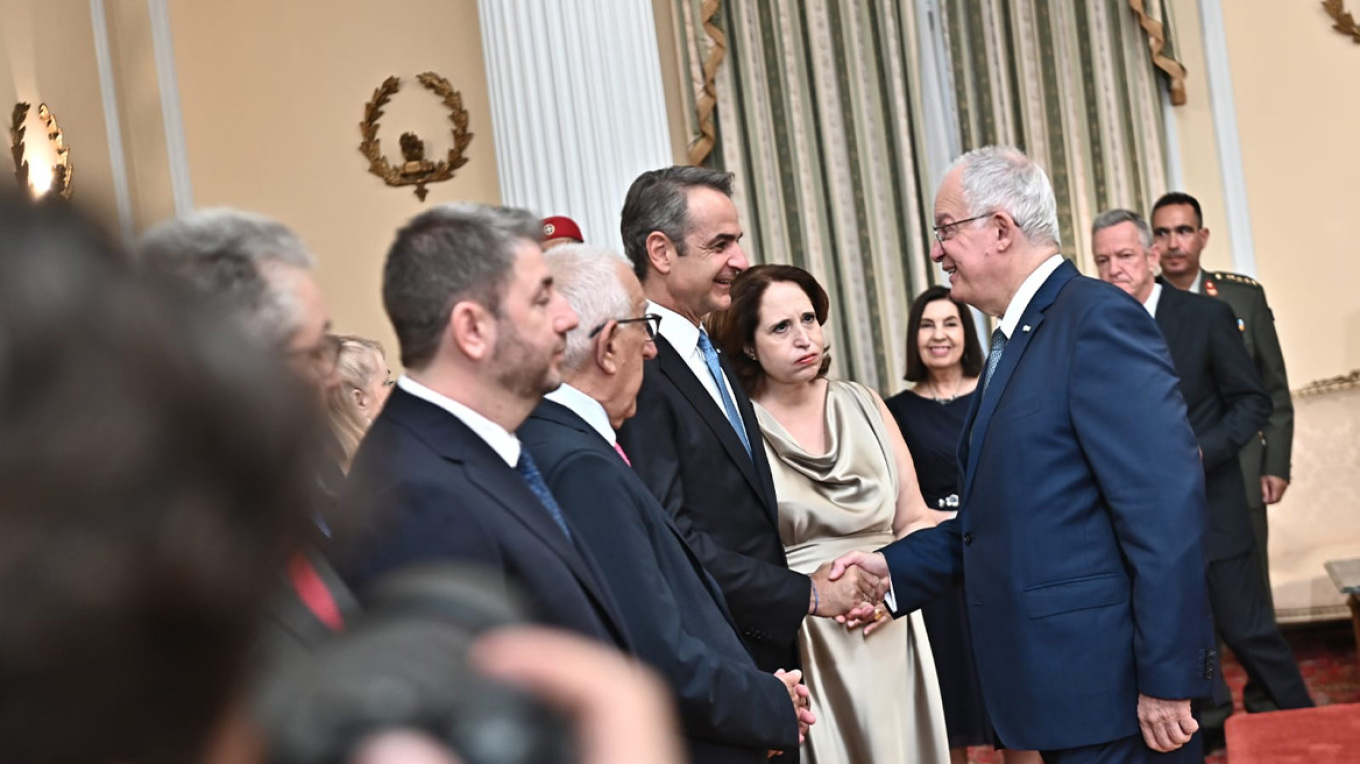
A reception is currently under way at the Presidential Mansion in Athens to mark the 52nd anniversary of the Restoration of Democracy, the return to parliamentary rule after the fall of the 1967-1974 military junta on 24 July 1974. The event is being hosted by President of the Hellenic Republic Konstantinos Tasoulas. The Mansion’s gates have opened and guests are arriving for the major anniversary event, which this year is taking place against a very different backdrop because of the weather.
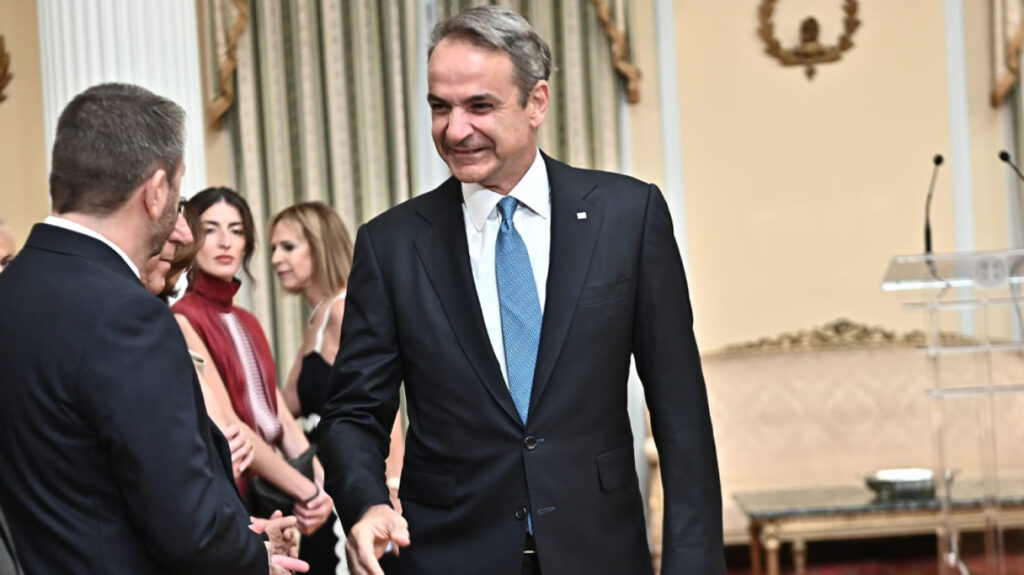
Receiving guests are the Presidency’s Director of Public Relations, Deniz Liapi, the Secretary General of the Presidency of the Republic, Aliki Chatzi, and the Director of the President’s private office, Vasilis Davonis. For the first time in years, the reception has been moved inside the Mansion after forecasts of rain and storms prompted officials to decide against using the gardens. It is only the third time in the history of the tradition that the event has been held indoors.
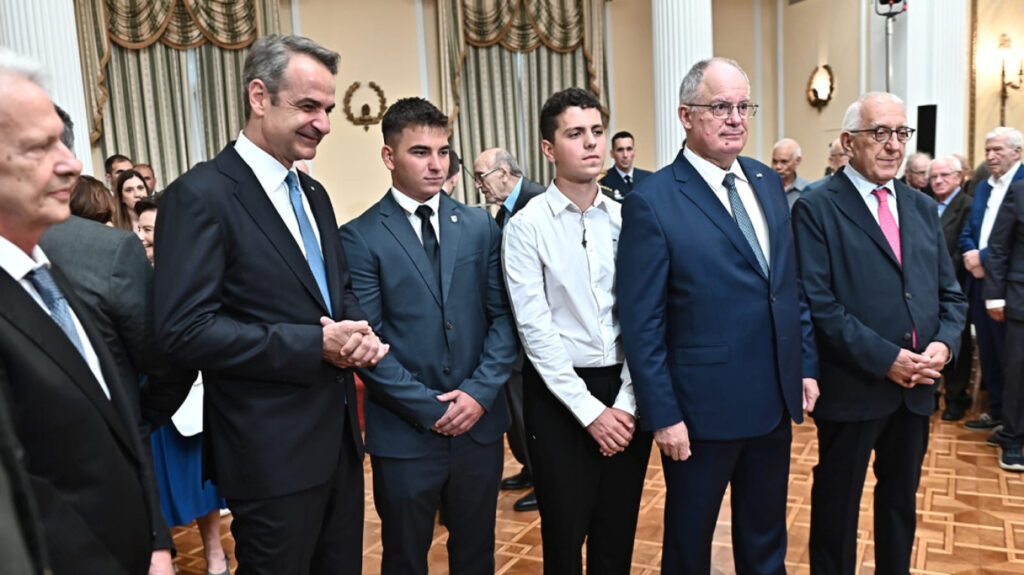
Around 1,700 people have been invited to this year’s reception, a higher figure than in previous years, after President Konstantinos Tasoulas extended invitations to the spouses of political figures as well.
Among those attending are Prime Minister Kyriakos Mitsotakis, Speaker of the Hellenic Parliament Nikitas Kaklamanis, PASOK leader Nikos Androulakis and Dimitris Koutsoumbas, General Secretary of the Communist Party of Greece (KKE). The rest of the political party leaders have chosen not to attend the event.
President Tasoulas: The last decade must be a lesson for politicians and the public
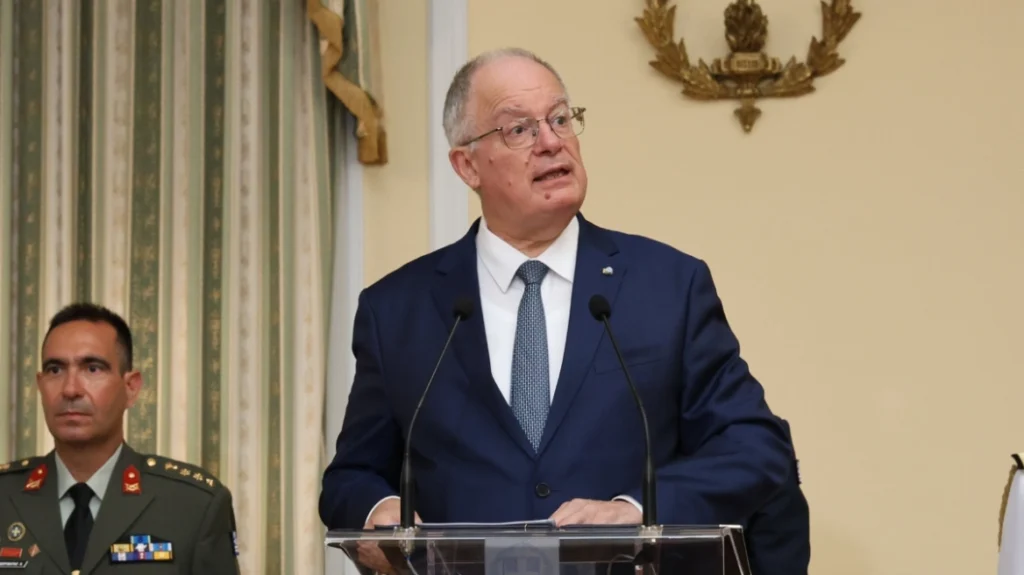
The President of the Hellenic Republic addressed this year’s reception marking the 52nd anniversary of the Restoration of Democracy at the Presidential Mansion with a speech laden with symbolism and sharp geopolitical messaging. He placed particular emphasis on strengthening Hellenism, preserving political unity on major national issues, the social responsibility of the country’s economic elite, and Greece’s enduring presence in the Aegean and Eastern Mediterranean.
Among the most striking lines of the speech was his remark that “the heart of Hellenism beats strongest along the frontier arc, from the Evros to Cyprus,” a reference to Greece’s border regions and communities. He also made a pointed historical and geopolitical statement against Ankara’s revisionist rhetoric, reclaiming the concept of the “Blue Homeland”, the term at the heart of Turkey’s own Mavi Vatan maritime doctrine, and rooting it instead in Greek history: “Greek civilisation has been bound to the sea for more than 50 centuries, at least 1,000 years before Mycenae and Knossos, as the excavations at Keros have shown. Greece’s homeland has therefore always been blue, throughout the fullness of time. The homeland of Hellenism was, and always has been, blue, from Cyprus and Ionia to Sicily and Massalia, centuries before the founding of Rome. And today too, the homeland of the blue and white flag is blue.”
The President made clear that reversing the consequences of Turkey’s 1974 invasion of Cyprus remains the Metapolitefsi’s top and non-negotiable national goal, describing it as the only strategy that guarantees both economic progress and national security.
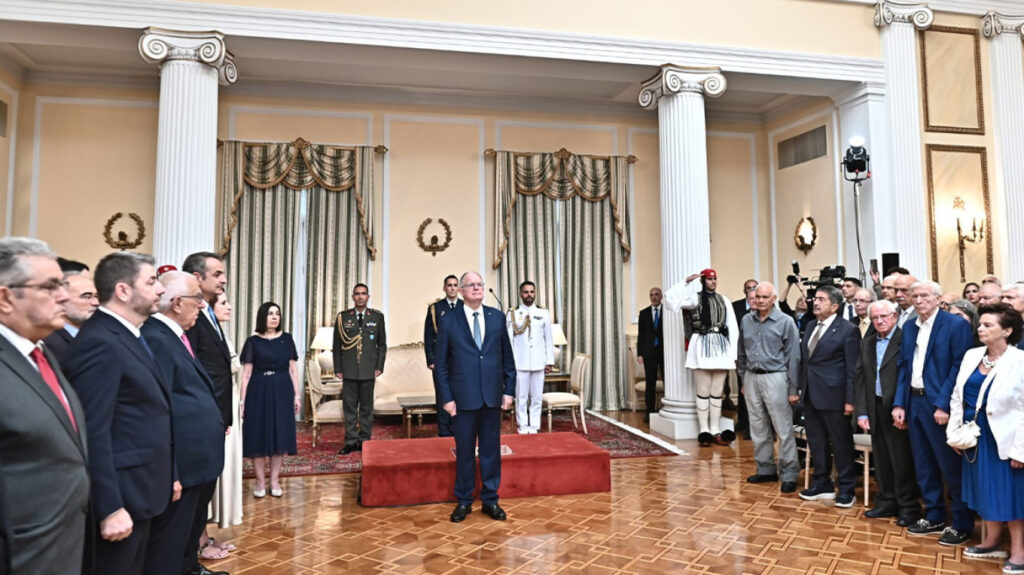
Tasoulas was notably pointed on domestic politics too. Looking back at the decade of the bailout memoranda, he stressed that the sharp polarisation of that period left wounds that have yet to heal. “The acute polarisation that marked the crisis years left consequences from which we have still not recovered,” he said. “The last decade must become a lesson, both for the political class and for the public. The main lesson is that confrontation must give way once it reaches the hard core of the national interest.” He added: “Democracy must show zero tolerance for violence, but citizens too must exercise the restraint needed to safeguard normality. We cannot demand unity while we ourselves cultivate division, nor call for moderation while we are not the first to observe it.”
On the economy and social cohesion, the President said the machinery of the state alone is not enough to regenerate the country. Addressing the economic elite directly, he argued that contributing to the common good is a moral duty: “Greece’s most powerful citizens have a duty to systematically support initiatives that renew the country. They must also recognise that wealth is only justified if part of it is transformed into benefit for the common good.”
Tasoulas linked national resilience to improving education, singling out the benefits of poetry for the younger generation: “Let us give young people access to poetry. Poetry arms the spirit with simple codes of ethics, reason and faith, codes that help us strive with greater effectiveness and greater dignity, so that we become citizens of the city of ideas.”
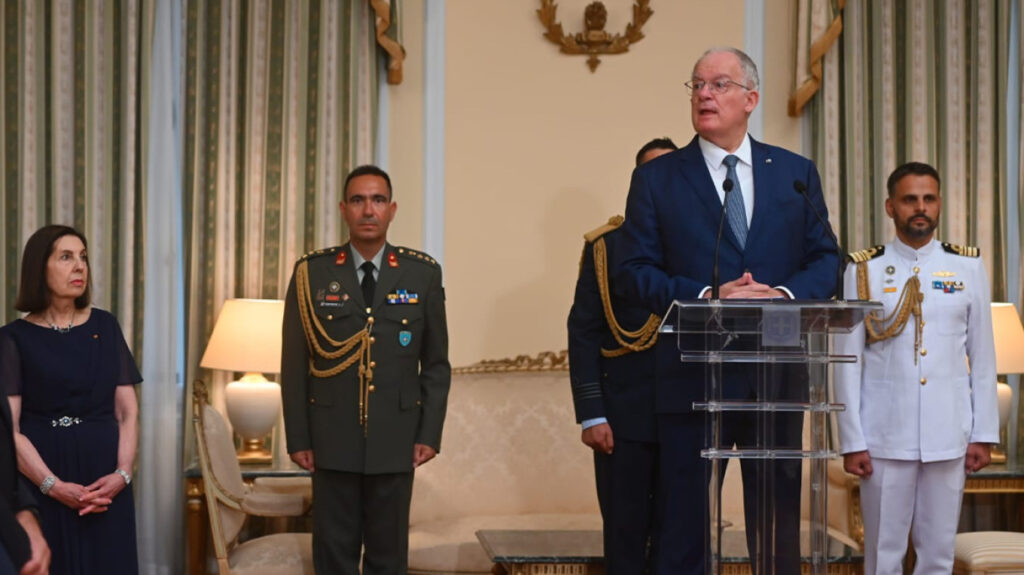
Framing the speech, Tasoulas described democracy as no easy undertaking but the highest expression of human civilisation at state and institutional level, government not in the hands of the few but of the many. He said democracy is a constant contest against its own inherent weaknesses, demagoguery, misinformation, indifference and slander, everything that makes the weaker argument appear the stronger, the trick the ancient sophists called “ton hissona logon kreitto poiein”.
The President noted that the best democracy Greece has ever known, established by Konstantinos Karamanlis and his associates, was turning 52 and, despite its trials, looks younger than its years. Reflecting on 18 months touring almost the whole of Greece as President, he returned to the frontier arc from Evros to Cyprus, home to the country’s most resilient Greek communities, and set out regional development, tackling demographic decline, protecting the vulnerable, strengthening social cohesion and ensuring quality education for all as goals that unite rather than divide.
Ask me anything
Explore related questions




