





A tiny island covering just 3.1 square kilometers, better known as the “Caribbean of Halkidiki,” an “eco-friendly” narrative surrounding a five-star “strategic” investment, and a wave of opposition from local organizations and environmental groups that have already begun preparing appeals before Greece’s Council of State in an effort to block the €41.7 million project.
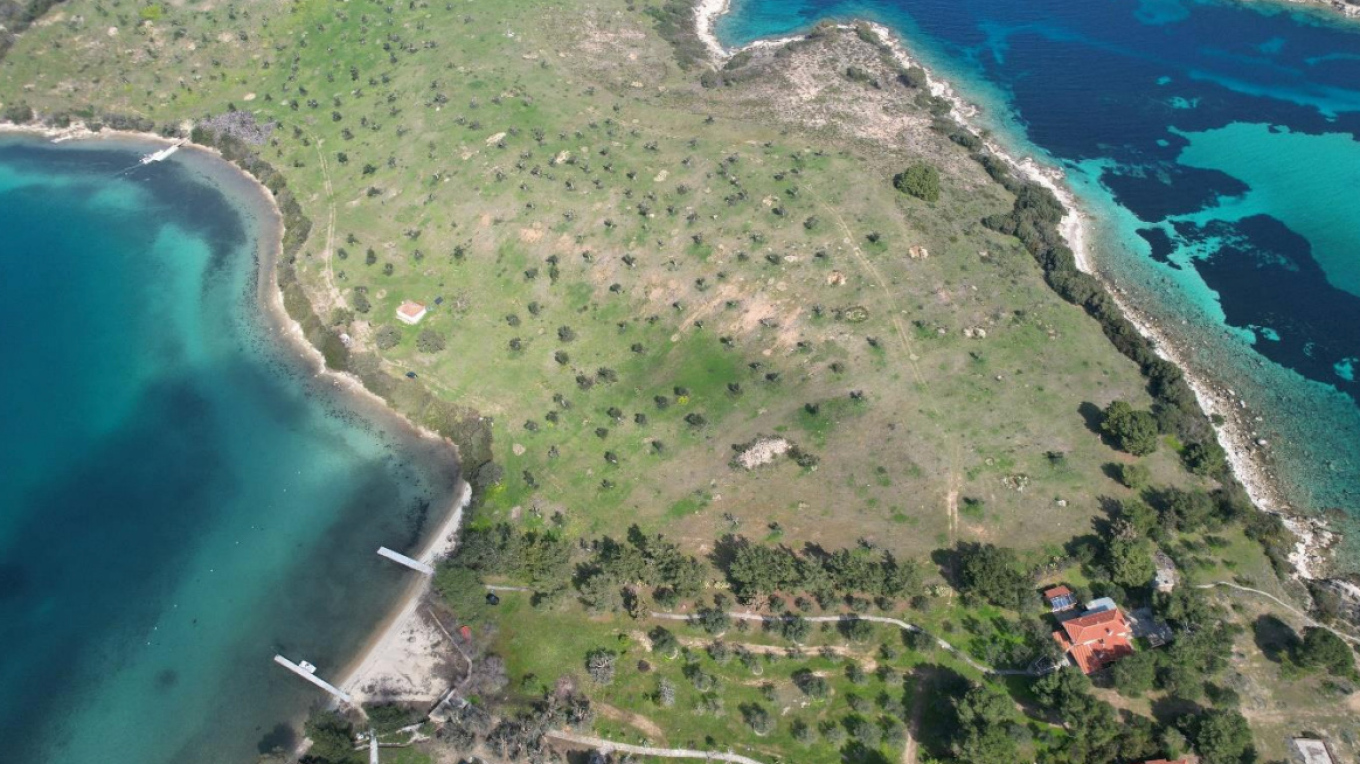
This is the current picture on Diaporos, the island with its crystal-clear waters opposite Vourvourou in Sithonia, where STANTA S.A., the company linked through ownership to businessman Stavros Andreadis, is moving forward with the licensing process for the strategic investment “Diaporos Green Retreat.” The company completed last spring the public consultation process for the Strategic Environmental Impact Assessment (SEIA) submitted for the project, which covers an 85,000-square-meter site.
It is precisely the project’s “green” character that numerous local organizations are challenging, with the Association for the Protection and Sustainable Development of Diaporos Island now preparing to seek an injunction before the Council of State. The central point of contention is what they describe as the disproportionate environmental burden and degradation of an area which, “contrary to what is often claimed, contains very few houses—around 20 in total—of which only one is currently available for rent,” according to Christos Papas, an architect-engineer and member of the association. “It should also be noted that two additional hotel developments, each with 99 beds, are also planned, which will further aggravate the situation.”
Objections during the consultation process have also been submitted by the Sithonia Ecological Environmental Association and the Hellenic Society for the Environment and Cultural Heritage. In a letter to the Ministry of Development, the latter stresses that sustainability is not simply a matter of technical “green” measures, arguing that on such a small and sensitive island, “the very scale of the investment undermines any notion of sustainability.”
Furthermore, the opinion issued by the Region of Central Macedonia last spring, while ultimately positive, notes that several critical issues require further documentation and clarification, particularly regarding the adequacy and safety of water supply through brackish groundwater and desalination, the disposal of desalination brine and its potential impact on the marine environment, the effects of port infrastructure, underwater pipelines and increased maritime traffic, the indirect and cumulative impacts on habitats and species, the actual ecological value of the site and landscape regardless of the administrative classification of certain sections, and the proposed environmental monitoring program.
Among other observations, the Region states that “the characterization of the project as environmentally neutral has not been sufficiently substantiated,” adding that the project requires “further specification regarding fuel management, storage conditions, noise emissions, maintenance requirements, pollution prevention and response measures, as well as fire protection measures.” The proposed energy system relies on a photovoltaic installation, a 4 MWh energy storage system, and two backup power generators, aiming to maximize renewable energy while operating the generators only when stored energy is insufficient. Although this is viewed positively in terms of reducing dependence on conventional fuels, it “does not negate the fact that the generators constitute a real source of noise, emissions, fuel management requirements, hazardous waste, and additional fire risk.”

Stavros Andreadis
Carrying capacity
The 85,000-square-meter property where STANTA S.A.’s investment is planned is located on the northeastern part of the island. The Diaporos Green Retreat was included last year under Greece’s Strategic Investments Law (Law 4864/2021), following the relevant decision of the Interministerial Committee on Strategic Investments.
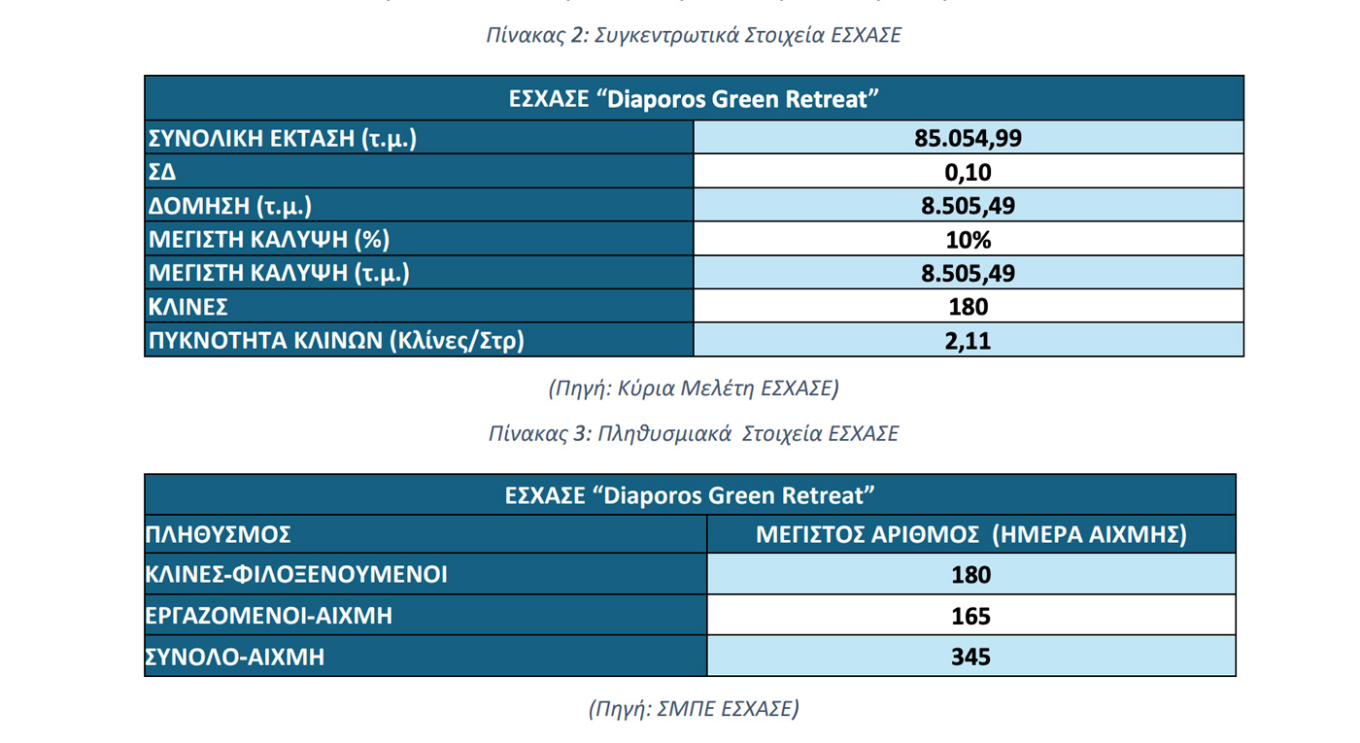
According to the SEIA, the proposal includes the construction of a five-star hotel complex with a capacity of 180 beds, comprising accommodation buildings such as bungalows and villas, reception facilities and restaurants, as well as leisure amenities including a gym, spa, sports facilities, and children’s activity areas. Total built space, based on a building coefficient of 0.10, amounts to 8,505 square meters. Particular emphasis is placed on the resort’s energy autonomy through modern energy production and storage systems, a feature that, according to the developers, is expected to make it the first project of its kind in Greece.
The SEIA estimates that the maximum population on a peak day would reach 345 people, consisting of 180 guests and 165 employees.
This is where critics raise one of their main objections. According to the carrying-capacity study accompanying the investment, Diaporos has no permanent population, based on Greece’s 2021 census, but it does contain a number of habitable buildings, particularly occupied on weekends and mainly between April and October, when there is a significant number of seasonal residents. The study estimates that the existing peak seasonal population reaches 352 holidaymakers. However, it adds that an additional 30%, or approximately 106 day visitors arriving by recreational boats and excursions, should also be taken into account, bringing the island’s estimated peak daily population to 458 people.
“Our concern is that an island characterized until now by low-intensity development and operation—which is already heavily burdened by around 800 rental boats operating in the area—will suddenly have to accommodate the resort’s guests and employees,” says Papas. He also notes that the island “is extremely vulnerable to wildfires and is protected only by a firefighting water network installed by the island’s residents.”
The organizations also argue that the environmental consequences of constructing the project have been largely overlooked and “are by no means negligible for the wider ecosystem.” They cite, among other examples, the impact of vessels transporting construction materials to the island—many of which, they argue, would pass through a Natura 2000 protected area—the issue of sourcing water for construction despite the available borehole producing brackish water unsuitable for building works, protection of the ecosystem from air, noise and light pollution during construction, and the management of stormwater and construction materials during heavy rainfall on the island’s sloping terrain.
Although the project site itself does not fall within a Natura 2000 protected area or any other designated protected zone, it lies in close proximity to several such areas. It is located 450 meters from the Natura Special Area of Conservation “Mount Itamos – Sithonia,” approximately 3 kilometers from the Natura Special Protection Area “Sithonia Peninsula,” about 3.5 kilometers from the Dragoudeli and Karras Wildlife Refuge, and close to the Important Bird Area of Mount Itamos.
Infrastructure
Regarding the operational phase, local organizations argue that the investment file contains significant shortcomings concerning electricity supply, water management, waste management, and fire protection—issues also highlighted by the Region in its otherwise favorable opinion.
Papas points out that “because the island is not connected to Greece’s national electricity grid, all existing homes are supplied through photovoltaic systems. The new development, with desalination, wastewater treatment and the operational demands of a luxury five-star hotel, is also expected to rely on photovoltaic systems. However, as our objection demonstrates, these will not be sufficient, meaning diesel generators will need to operate daily. Beyond all other concerns, diesel fuel will have to be transported every day into a bay already experiencing heavy traffic from hundreds of rental boats operated by tourists without boating licenses.”
The issue of maritime traffic is likewise raised by the Region, which states that “the environmental impacts resulting from the increased maritime traffic expected during the summer tourist season, combined with the operation of the proposed port facilities and the arrival of private vessels and day visitors, have not been sufficiently documented.” For this reason, it considers a more comprehensive cumulative assessment of maritime traffic and the resulting pressures on the marine and coastal environment to be necessary.
Regarding the port infrastructure and marine accessibility, both the SEIA and the preliminary port study provide for the construction of two piers, serving both the construction and operational phases of the resort. The port study envisages accommodating a ferry approximately 39.9 meters long, 11.4 meters wide, with a 1.7-meter draft, “demonstrating that this is a substantial intervention rather than merely ancillary infrastructure,” according to the Region. “The port works therefore constitute a core component of the project, with potential impacts on the seabed, coastal morphology, maritime traffic, marine connectivity and the landscape. Consequently, more detailed benthic, morphodynamic, hydrodynamic and cumulative assessments are required already at the strategic planning stage, rather than only during subsequent licensing procedures.”
Regarding desalination and brine disposal, the desalination technical report specifies that the installation will process 21 cubic meters of raw water per hour, producing 8.5 cubic meters of freshwater, discharging 12.2 cubic meters of brine, achieving a 42% recovery rate, and operating up to 14 hours per day to produce 120 cubic meters of freshwater daily. “These figures confirm that brine disposal is an inherent and permanent operational characteristic of the investment, rather than a secondary technical issue,” the Region argues. Although the SEIA provides for the disposal of brine through an underwater pipeline and diffuser, it postpones determining the optimal solution until a future dispersion study to be submitted during the Environmental Impact Assessment stage. The SEIA also acknowledges that underwater surveys will be required before final routing of the submarine pipelines to determine whether Posidonia oceanica seagrass meadows are present. The Region concludes that the issue of brine disposal has not yet been sufficiently developed at the strategic level, given the absence of a dedicated dispersion study, hydrodynamic documentation, and seabed mapping.
Ask me anything
Explore related questions




