





Orthodox Christians listen to it with devotion, reverence, love and dedication. So do Catholics, in those Western churches where it is sung, of course, as it does not form part of their liturgical tradition. Even non-Christian believers of other faiths admire the beauty of the melodic expression of its words and its immense depth of meaning. Even atheists are impressed when they hear it.
The subject is the Akathist Hymn, a masterpiece of Orthodox hymnography and one of the deepest expressions of honour towards the Most Holy Theotokos. It is not simply a hymn; it constitutes an experience of faith that brings together theology, history and popular devotion, particularly during the period of Great Lent.
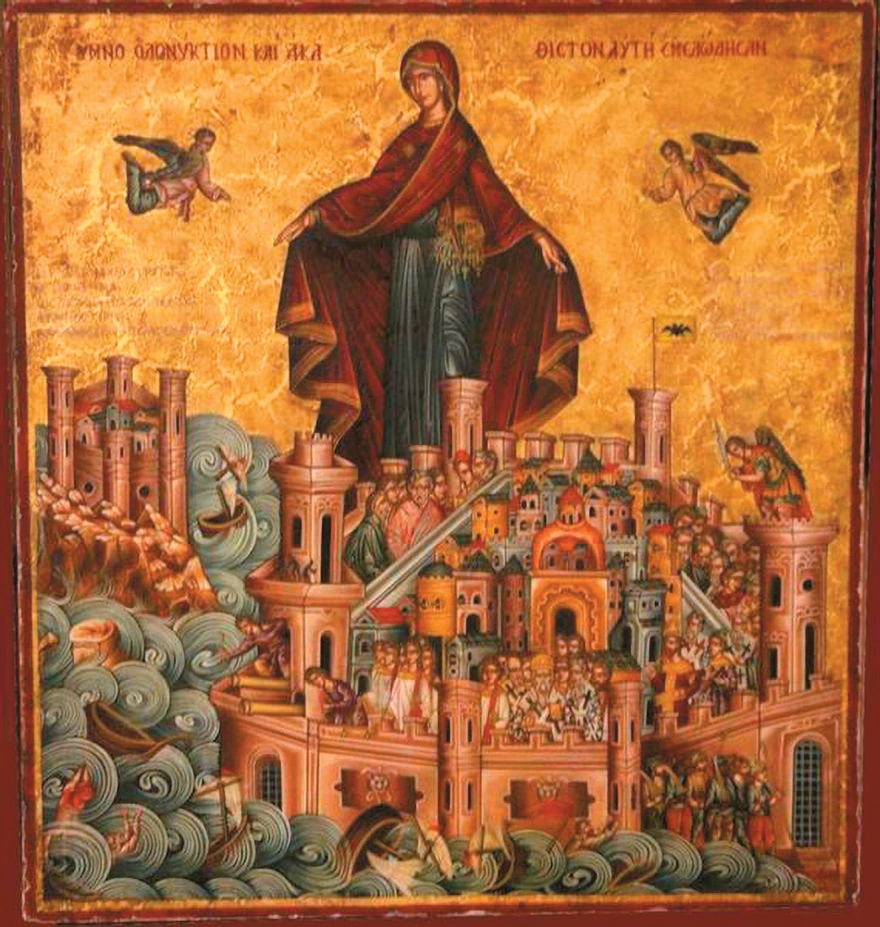
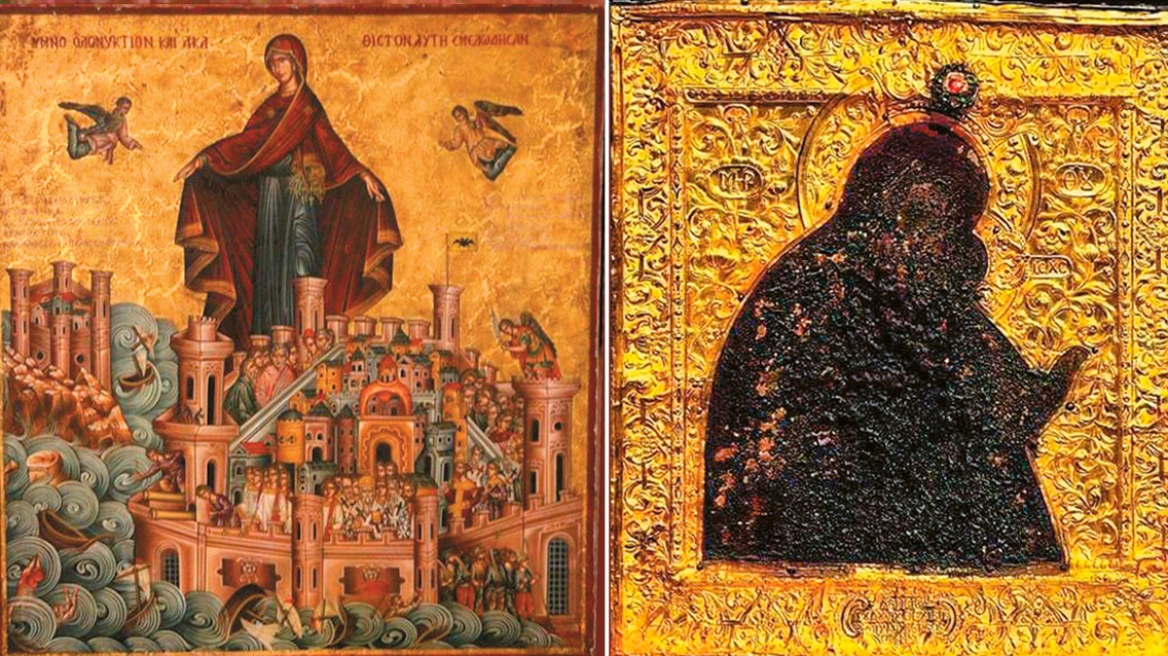
(An icon depicting the Akathist Hymn, in which the Panagia, as the Champion General, protects Constantinople from the siege by the Avars)
What is remarkable is that although it is sung on all five Friday evenings of the Salutations service, throughout Great Lent, it was nevertheless first heard from the lips of the faithful on an August night in the distant year 626 AD, at the Church of the Virgin of Blachernae in Constantinople.
It was the night of 7–8 August, exactly 1,400 years ago, when the Queen of Cities overcame the first major threat in its history. For, according to tradition, with divine assistance, the siege by the vastly more numerous Avars and their many allies – Persians, Slavic and Bulgarian tribes and others – was lifted.
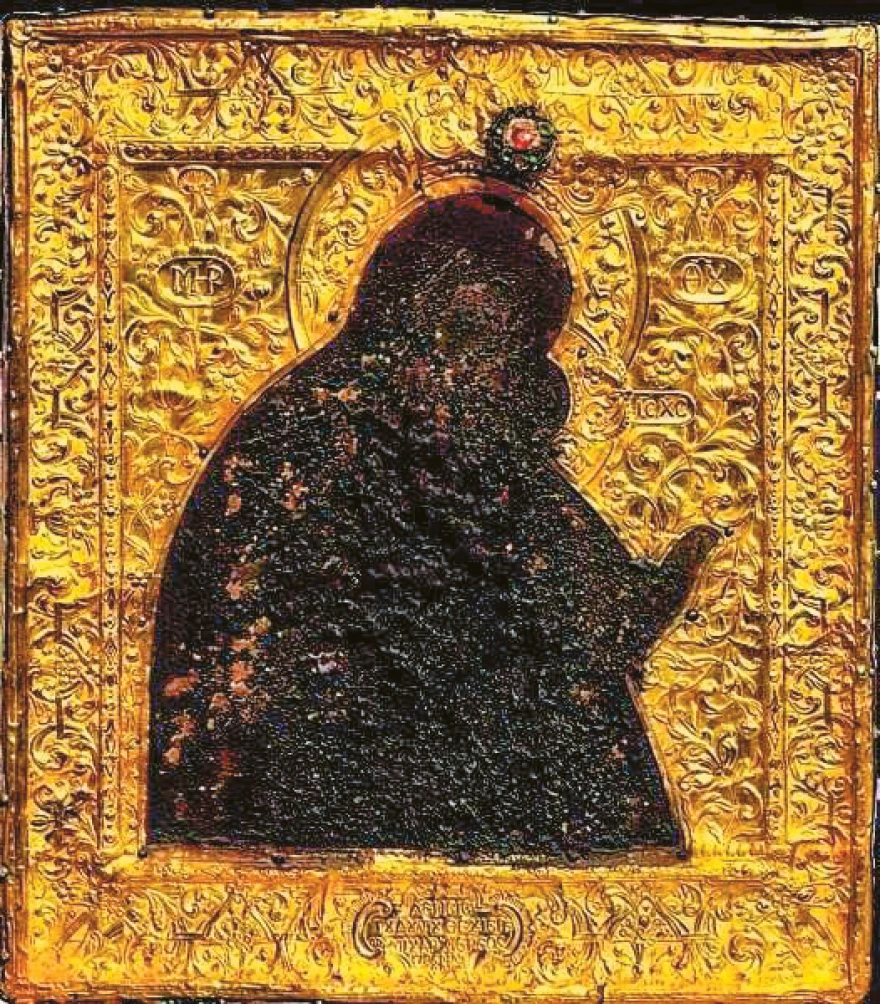
(The icon of the Panagia which Patriarch Sergius carried along the walls of the City to encourage its defenders)
The fact that of all the kontakia, only this one remains in use today in the worship of the Church demonstrates the power of its influence and the profound impression it made, and continues to make, on the faithful.
Bartholomew’s message
In Constantinople, during the Third Stasis of the Salutations, that is, on the third Friday of Lent, it is customary for the Ecumenical Patriarch to go to the Church of the Virgin of Blachernae and recite the oikoi (stanzas) of the Akathist there. This tradition is an act of honouring the memory of the events of 626 AD, namely the salvation of the City and the first singing of the Hymn. This historical symbolism lends splendour and emotional intensity to the service, which is attended every year by many Christians from the City, as well as visitors.
On this year’s third Friday of the Salutations, on 13 March, at the Church of the Virgin of Blachernae, Ecumenical Patriarch Bartholomew’s message to the faithful present was unmistakable: “If in all the churches of the Orthodox world the service of the Salutations to the Champion General of the City of Constantine moves the hearts of all Christians, hearing this sublime hymn to the Virgin Mary, our mother, here in this sacred shrine of Blachernae, where it was first sung exactly 1,400 years ago, leads us into other worlds and makes us reflect more deeply and experience more profoundly this miracle of our survival in this blessed land of our Fathers, despite the destruction wrought by the times and the changing circumstances.”
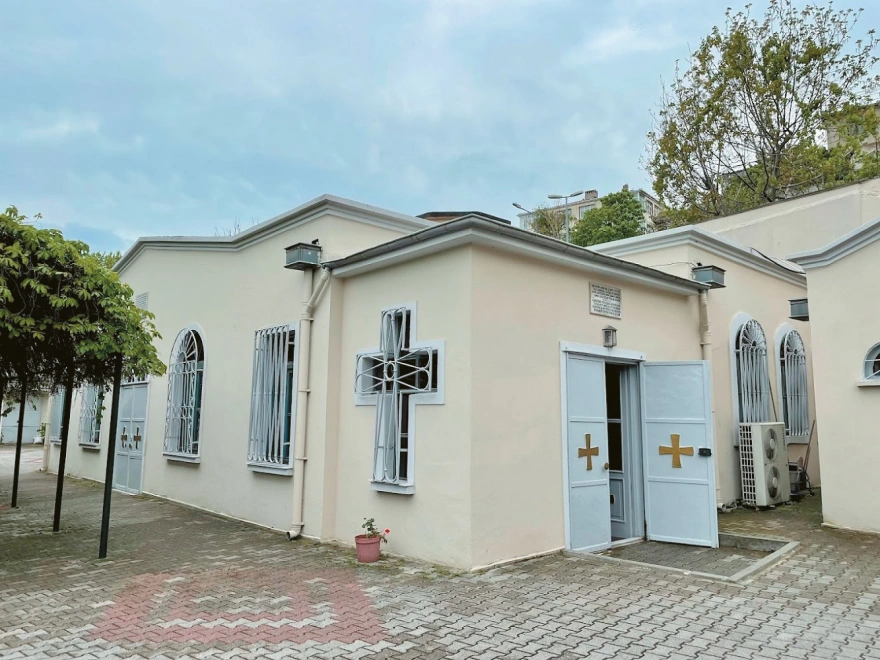
(The Church of the Panagia of Blachernae in Constantinople, where the Akathist Hymn was sung for the first time following the victory over the Avars)
Its Structure
Drawing on the Holy Scriptures and the Fathers of the Church as its sources, the Akathist Hymn describes historical events, but it also proceeds to a theological and doctrinal analysis of them. It consists of the prooemium, “To the Champion General, the victorious,” and 24 stanzas, with an alphabetical acrostic from A to Ω, while among the 72 verses we encounter 144 salutations to the Theotokos. Its first part (A–M) refers to events from the life of the Panagia (the Annunciation, the pregnant Virgin’s visit to Elizabeth, Joseph’s doubts, the adoration of the shepherds and the Magi, the Presentation, and the Flight into Egypt), following the account of the Evangelist Luke. The second part (N–Ω) refers to theological subjects, in which the poet analyzes the deeper doctrinal implications of the Lord’s Incarnation and its purpose, which is the salvation of the faithful, while the contribution of the Panagia is exalted.
The odd-numbered stanzas (A–Γ–E, etc.) are more extensive and consist of 18 verses. The first 5 verses contain the narrative; the next 12 constitute the salutations, which are addressed to the Theotokos; and the eighteenth is the refrain, “Hail, Bride Unwedded.” The even-numbered stanzas (B–Δ–Z, etc.) consist only of 5 narrative verses and the refrain “Alleluia.”
The History
According to the Synaxarion, the Akathist Hymn was created in AD 626, following the salvation of Constantinople from the siege by the Avars, and was sung for the first time on that occasion.
At the beginning of the 7th century, the Byzantine Empire extended across a large part of Europe and Western Asia, including the Holy Land. The Persians overran the eastern territories of the Empire, invaded Jerusalem, and seized the Holy Cross, which had been there since the time when Saint Helena had discovered it. The Persians transferred the Cross to their capital, Ctesiphon. Following these events, the emperor Heraclius, one of the most effective and successful leaders of Byzantium, campaigned with a large army toward the East against the Persians. He reached Ctesiphon, attacked the Persians, crushed them, and recovered the Holy Cross on September 14, AD 628.
Earlier, however, in the midst of this campaign, and while only a small army remained in Constantinople, the Byzantine capital was besieged by the Avars, the Persians, and their allies, who sought to take advantage of Heraclius’s absence and capture the City.
The emperor was then in Sebasteia and decided not to return to Constantinople. He entrusted its defense to the magister (prime minister) Bonus, Patriarch Sergius, and the young Caesar Heraclius-Constantine. He sent them instructions as well as reinforcements of 12,000 cavalrymen under his highly capable military commander and brother, Theodore, who, however, was approximately 1,000 kilometers away from Constantinople.
The Avars, in late April or early May of AD 626, reached Thessaloniki. After besieging it unsuccessfully for a month, they moved against Constantinople.
On June 29, a very powerful advance force of 30,000 Avar troops arrived before the walls of the City. On July 8, they attacked the garrison and began the siege. On July 29, the main body of the Avar forces arrived. They were estimated at between 110,000 and 150,000 men. In the besieged Queen of Cities, Bonus inspected the army and the fortifications.
The following day, the khagan (note: the leader of the Avars) set up the siege engines, and on July 31 the attack against the City began. Bonus then proposed to the khagan the payment of an extraordinary subsidy, in addition to the annual one, but he refused. Further clashes followed, simultaneously with efforts to reach a peace agreement, without result.
On the evening of Monday, August 4, 4,000 Persians managed to land at Chalcedon in Slavic monoxyla, according to the testimony of the Armenian bishop and historian Sebeos. The Byzantines, however, annihilated the Persians and sank the monoxyla.
Patriarch Sergius did not leave the defense of Constantinople solely to the reduced and, essentially, leaderless army, owing to the emperor’s absence. He called upon the faithful to pray on their knees to the Panagia and ask for her assistance in saving the City. He himself is described as having spent all the preceding days carrying the icon of the Panagia from the Monastery of Blachernae along the walls of Constantinople, in order to encourage its defenders.
On August 6, the Avars captured the Monastery of Blachernae and fortified themselves there. At sea, the Slavic flotilla, reinforced with Bulgarian infantry, concentrated its efforts on the Golden Horn.
On the night of August 7, AD 626, a naval battle took place that determined the fate of the siege. According to religious tradition, that night a terrible whirlwind, attributed to divine assistance, caused a violent storm that destroyed the enemy fleet, enabling the defenders to launch a counterattack and inflict enormous losses on the Avars and Persians, who were forced to lift the siege and withdraw without accomplishing their objective. Everyone spoke of a “miracle.” Some of those who resisted the invaders said that, during the siege, the Panagia appeared upon the walls of Constantinople.
Other historical sources record that the complete destruction of the enemy fleet by the Byzantine fleet resulted from an ambush that the Byzantines laid for the besiegers, on the orders of Bonus.
In any case, after the catastrophe, the khagan ordered the siege to be lifted. Early in the morning of August 8, the Avars, after burning their siege engines, withdrew, while at the same time their decimated allies scattered in terror. The Byzantines subsequently pursued the Avars as far as the northern borders of the Balkan Peninsula. From then on, the Avars never again troubled Byzantium, while the Persians returned to their bases.
The entire Byzantine leadership and the people proceeded to the Church of the Panagia of Blachernae to give thanks to the Theotokos, to whom they attributed the victory. All standing, they sang for the first time the hymn thereafter known as the Akathist Hymn, offering the “victory hymns” and their gratitude to the Theotokos. (“To the Champion General, the victorious.”)
The Composer
Although the hymn was heard for the first time on that night, according to the prevailing view it could not have been composed so immediately. Logically, it had most likely been composed earlier. Indeed, it is considered to have been sung in that particular church during the vigil of August 15 every year. However, on that day it was sung “standing,” while the prooemium used until then (“Having received in knowledge what was secretly commanded”) was replaced by the prooemium still used today, “To the Champion General, the victorious,” which gave the previously narrative and doctrinal hymn its doxological and laudatory tone.
Who composed the hymn and when this occurred are, of course, interconnected questions, but throughout the entire manuscript tradition the hymn is presented as anonymous, while the Synaxarion, which connects it with the events of August AD 626, mentions neither the date of its composition nor its poet.
Its content, however, reflects the doctrinal positions of the Third Ecumenical Council; therefore, the year AD 431, when the Council was convened, constitutes a fixed point, since it is certain that the hymn was not composed earlier. On the other hand, some researchers believe that its content indicates that the hymn refers to a common celebration of the Annunciation and Christmas, feasts that were separated under Justinian (527–565). If this is the case, then, on the one hand, it means that it was written no later than the reign of Justinian, while on the other, it strengthens the view that it predated the events of AD 626.
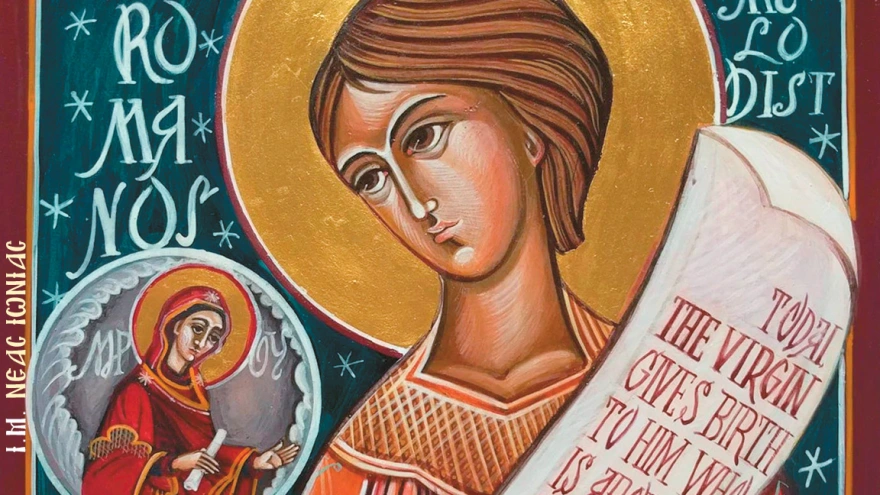
Tradition attributes the Akathist Hymn to the great Byzantine hymnographer of the 6th century, Romanos the Melodist. This view is supported by many important researchers (Krypiakiewicz, Doelger, Wellesz, Maas, Efstratiadis), who consider that the hymn’s expressions, its overall poetic excellence, and its doctrinal completeness point to Romanos. Another researcher, J. Grosdidier de Matons, considers that one of Romanos’s kontakia follows the music and meter of the first stanza of the Akathist Hymn, which, in his view, means that Romanos at least knew the Hymn, if he did not compose it himself. In addition, a later note from the 16th century, found in a 13th-century codex, identifies Romanos as the poet of the Hymn.
According to other historical sources, however, the Akathist Hymn is also connected with other similar events, such as the sieges and salvation of Constantinople under the emperors Constantine IV Pogonatus (AD 673), Leo III the Isaurian (AD 717–718), and Michael III (AD 860). Accordingly, Patriarch Germanus I, who lived through the events surrounding the deliverance of Constantinople from the Arab siege in AD 718, during the reign of Emperor Leo the Isaurian, is also recorded as a possible author of the hymn. This is based on the fact that a Latin translation of it by Christopher, Bishop of Venice, identifies him as its author.
Another version is based on an old, undated icon of the Annunciation in the chapel of Saint Nicholas at the Monastery of Saint Sabbas in Jerusalem, where a monk is also depicted holding a scroll bearing the words, “The foremost angel was sent from heaven” (the opening of the first stanza of the Akathist Hymn). Above the head of this monk is written, “Saint Cosmas.” This refers to Cosmas the Melodist, who also lived through the events of AD 718.
Other views attribute the Hymn to Patriarch Sergius, who was contemporary with the siege of AD 626; George the Pisidian; Saint Photios; Apollinarius of Alexandria; and George the Sicilian, Metropolitan of Nicomedia.
Given, therefore, the historical circumstances of the time, it is not considered unlikely that tradition may have altered the historical reality, making it very difficult to establish with absolute certainty what the historical circumstances surrounding the creation of the Akathist Hymn actually were and, naturally, to answer the question of who its composer was.
Images of the Akathist
Over the years, various icons have been painted depicting the Akathist Hymn, in which the Panagia is shown with small images around her referring to each of its stanzas. Among the portable icons, the best known today is that of the Panagia of the Salutations (or Myrovlitissa), which is kept at Dionysiou Monastery on Mount Athos. It is a small and indistinct portable icon which, according to tradition, is the one before which the hymn was sung for the first time by Patriarch Sergius. This is also stated on a silver plaque on its reverse side. Tradition relates miracles associated with it. It is kept in a chapel bearing the same name.
Also, in the Katholikon of Hilandar Monastery on Mount Athos, the icon of the Theotokos of the Akathist Hymn is kept, while at Zographou Monastery, also on Mount Athos, the Panagia of the Akathist, or the Pre-announced One, is kept.
In Everyday Language
Something that few people know is that certain expressions we use in everyday speech originate from the Akathist Hymn, having now been transferred from it verbatim. Among the best known is “I am perplexed and astonished,” which is said when someone wants to express particular surprise and bewilderment about something. It comes from the Hymn:
“…Gabriel, struck with amazement, cried out to You, O Theotokos: ‘What worthy hymn of praise can I offer to You? And what shall I call You? I am perplexed and astonished; therefore, as I was commanded, I cry out to You: Hail, O Full of Grace.’”
The same applies to the phrase “Hail, unfathomable depth,” which is said of something that is irrational, exceptionally difficult to explain, or a situation of absolute confusion and ambiguity. In its original form in the Akathist Hymn:
“Hail, depth unfathomable even to the eyes of angels…” (First Stasis).
Ask me anything
Explore related questions




