





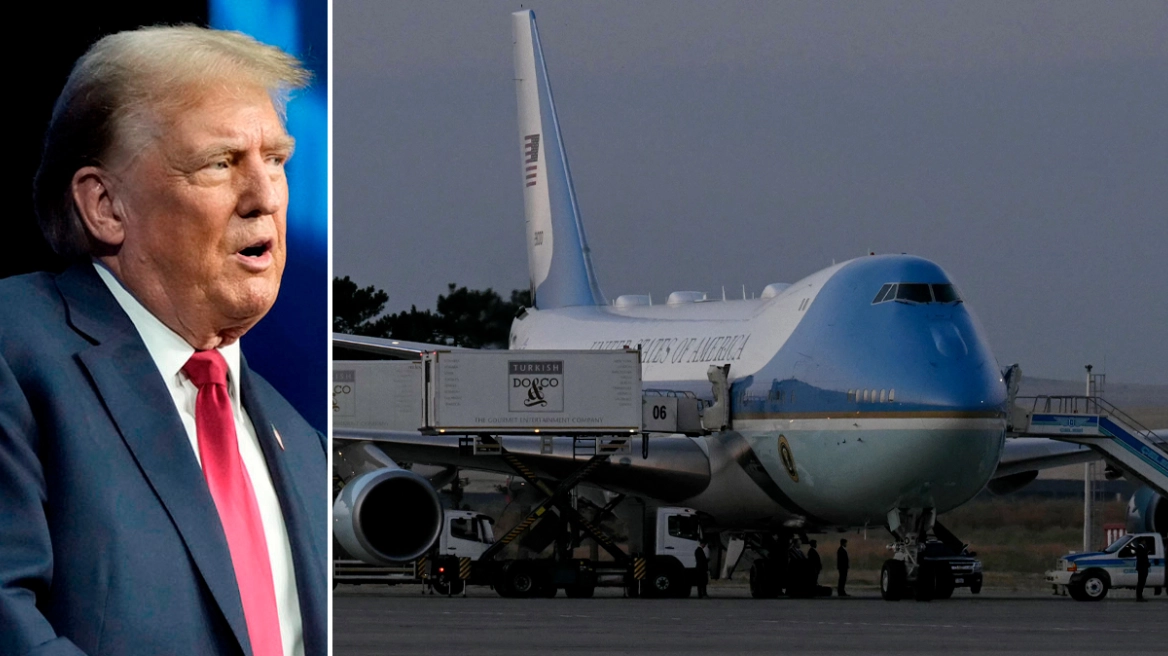
According to The New York Times, Trump boarded the older presidential Air Force One in full view of cameras, creating the impression that he would use it for the first leg of his journey home from the NATO summit. In reality, however, he was secretly removed from the aircraft inside a catering container and transferred to a third airplane, which flew him covertly to Britain.
The plan, devised within just a few hours, was disclosed only to a very small circle of senior U.S. government officials. The journalists traveling with the president, along with several White House staff members, had no idea what was happening and were effectively used as a decoy in the operation.
The “Performance” in Front of the Cameras
According to the report, Trump was scheduled to depart Turkey on July 8, after the conclusion of the NATO summit.
It had already been announced that he would not use, for the first leg of his return trip, the newer Boeing 747-8 that had been gifted to him by Qatar, but instead one of the older Air Force One aircraft. At the time, Trump attributed the change to nostalgia, telling reporters that he wanted to fly on the older aircraft “to remember the old days.”
In front of television cameras, the American president boarded the older Air Force One in the usual manner via the aircraft’s left-side stairs. The journalists accompanying him also boarded, and everything suggested that Trump would be traveling with them.
But that was not what happened.
On the opposite side of the aircraft, a catering container had been raised into position. According to a U.S. official cited by The New York Times, Trump was secretly removed through that container and escorted to a third aircraft.
How Trump Was “Made to Disappear” From the Radar
According to The Washington Post, the aircraft that secretly transported Trump to Britain was a C-32A, the military version of the Boeing 757. The aircraft flew under the callsign “Reach 18” (RCH18) instead of “Air Force One,” while the systems that normally make it easy to track the aircraft’s flight path had been turned off.
Meanwhile, the older Boeing 747 that departed Turkey carrying journalists and White House staff—but not Trump—appeared on radar using the callsign “AF1” throughout the flight. As a result, it appeared to be carrying the American president while he was actually traveling to Britain aboard the C-32A.
Traveling with Trump aboard the C-32A was Defense Secretary Pete Hegseth, who boarded separately via an external staircase so that the aircraft’s presence at the airport would resemble an ordinary government flight.
The operation took place amid heightened tensions, as only the night before U.S. forces had launched another round of strikes against Iran on Trump’s orders following the collapse of Washington–Tehran negotiations aimed at ending the war.
The Journalists Left in the Dark
The journalists aboard the older Air Force One were never informed that Trump was not traveling with them. The same was true for certain White House employees. Without realizing it, they became part of the deception operation.
Notably, during takeoff from Turkey, the journalists were instructed to keep the window shades in the press cabin closed.
The older Air Force One landed at 10:16 p.m. at RAF Mildenhall in England. Forty minutes later, Trump appeared descending from that aircraft, exactly as he would have during a routine presidential trip.
The difference was that he had actually arrived in Britain aboard a different airplane.
After the military aircraft landed, Trump was driven by road to the older Air Force One, boarded it through a different entrance, and then exited from the upper left door in front of reporters, creating the impression that he had just completed the flight from Turkey. He then walked across the tarmac to the aircraft gifted to him by Qatar and returned to Washington aboard it together with the journalists.
“If I Leave, You’re Leaving Too”
Behind the exceptionally complex operation, as mentioned earlier, was the assessment by U.S. intelligence agencies that there was a credible Iranian threat against Trump and the aircraft carrying him.
According to The New York Times, the threat was not directed solely at the new aircraft donated by Qatar. Intelligence indicated that the target was Trump himself, regardless of which airplane he used.
The American president was informed of the threat while still in Turkey, and within hours the extraction plan was organized.
According to the report, the small group of senior officials involved in planning included Defense Secretary Pete Hegseth and Chairman of the Joint Chiefs of Staff General Dan Caine.
During the return flight from Britain to the United States, reporters asked Trump why the older Air Force One had been used for the trip to England.
Among other things, the president claimed that he wanted the troops stationed at the British base to have an opportunity to see the new aircraft.
When asked why journalists had been instructed to keep the window shades closed during the flight from Turkey, Trump said he was unaware of any specific threat but maintained that he is constantly targeted by Iran.
“I’m number one on their list, ahead of you,” he told reporters, adding: “But if I leave, you’re leaving too. Right?”
The Secret Service’s History of Deception Operations
The use of decoy motorcades or flights is not an unfamiliar practice for the U.S. Secret Service, particularly when the president is visiting an area assessed to present a serious security risk.
However, the operation to secretly extract Donald Trump from Turkey stands out because of the extent of the deception involved.
According to The Washington Post, one of the most notable similar operations occurred in March 2000, during Bill Clinton’s visit to Pakistan.
Because of serious concerns for his safety, the American president traveled to Islamabad aboard an unmarked white aircraft, while another airplane bearing the official presidential markings was used as a decoy and landed first.
The newspaper notes that over the past 30 years Air Force One has been used as a decoy on several occasions, either because of specific threats or when the president was traveling to a high-risk area.
Although the presidential aircraft is equipped with highly advanced security systems, it is also extremely recognizable. Consequently, in some situations transporting the president aboard a different aircraft is considered the safest option.
The New York Times also recalls that following the terrorist attacks of September 11, 2001, George W. Bush was first taken to a military base before returning to Washington, accompanied by only a limited group of journalists.
Even during presidential trips to war zones, however, it is customary for the accompanying press to have at least a general understanding of where the president is located.
Trump himself employed similar tactics during his 2024 presidential campaign, when U.S. intelligence had information suggesting that Iran continued to seek his assassination.
In some cases, Trump was transported aboard a secret aircraft without informing the media, while his aides traveled on his private jet.
Tehran’s Threats Against Trump
Trump and several of his associates have faced threats from Iran for years, particularly after he ordered the killing of Iranian General Qassem Soleimani during his first presidential term.
As early as the 2024 presidential campaign, his advisers had been briefed on intelligence indicating that Tehran still intended to target Trump.
As mentioned above, this led his security team even then to use decoy aircraft.
The Biden administration strengthened Trump’s protection during the summer of 2024 following new intelligence concerning assassination plots against him.
This was followed by two separate assassination attempts unrelated to Iran—the first in Butler, Pennsylvania, and the second in September of the same year.
Threats against Trump have included, among other things, an alleged murder-for-hire plot involving an Iranian operative, as well as cyberattacks targeting the email and social media accounts of members of his presidential campaign.
Ask me anything
Explore related questions




