





An ordinary dive for spearfishing in the waters off Andros brought Dimosthenis Adamis face-to-face with an astonishing discovery. At first, he did not even realize that what he was seeing at a depth of 42–44 meters was a shipwreck carrying amphorae; he thought they were simply piles of stones. As he approached, however, he realized that it was a shipwreck and felt a shiver down his spine.
The spearfisherman and professional diving instructor discovered the shipwreck in 2018, at a depth of approximately 42–44 meters. The wreck was reported to the Ephorate of Underwater Antiquities in 2021, while in 2025 he returned to the site with archaeologists and showed them the exact location of the wreck, as he said on SKAI’s ONline program.
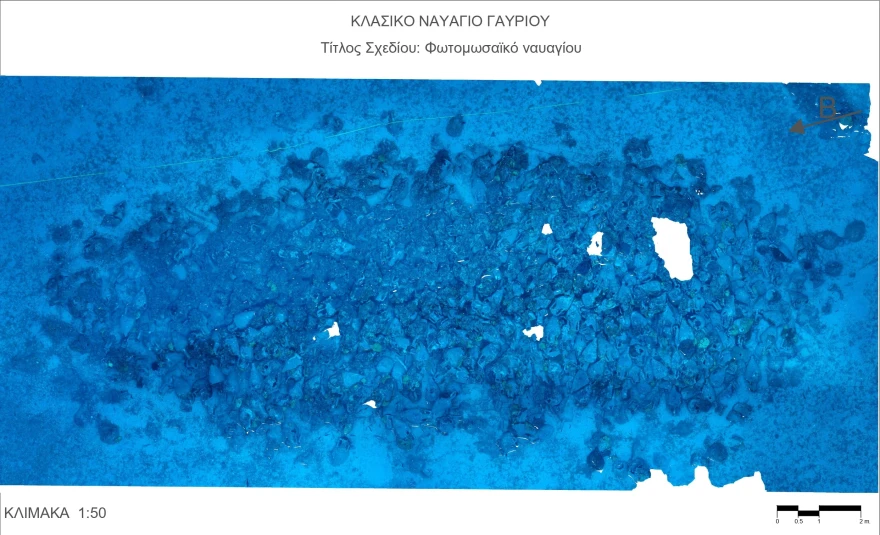
“It is the wreck of a very old ship. It is estimated to date to the 5th century BC, with 650 amphorae. I found it while fishing, and it really was perhaps the most important moment in the 30 years I have been at sea. It is something extraordinary that rarely happens, especially at such depths, because there are unexplored shipwrecks at great depths of 60 or 80 meters. But at a depth of 44 meters, it is considered relatively shallow, and it is impressive that the shipwreck is intact,” Mr. Adamis initially said, adding: “You get goosebumps at that moment. When I realized that it was not a mass of rocks but a shipwreck with amphorae, I felt very intense emotions. It is a special feeling that you do not experience when catching a fish or seeing a fish. It is something extraordinary. It is awe-inspiring. I discovered the wreck in 2018; in 2021 it was reported to the Ephorate of Underwater Antiquities, and in 2025 I led them to it and showed them the exact location of the wreck.”
Common features with the Peristera shipwreck
“As far as I have understood, this shipwreck has a great deal in common with the Peristera shipwreck, in Alonissos. They are the same types of amphorae. It is probably the same trade route. Either it was a ship heading there, or it was a ship coming from there. Due to bad weather or some other problem, it sank at this location. When it sank, its wooden hull, after 2,500 years, has decomposed, while the cargo remained stacked as it had been inside the holds,” Mr. Adamis noted, adding: “The experts recovered three amphorae, one of each type. I don’t think they contained anything inside. But there are 650 amphorae, which may reveal something.”
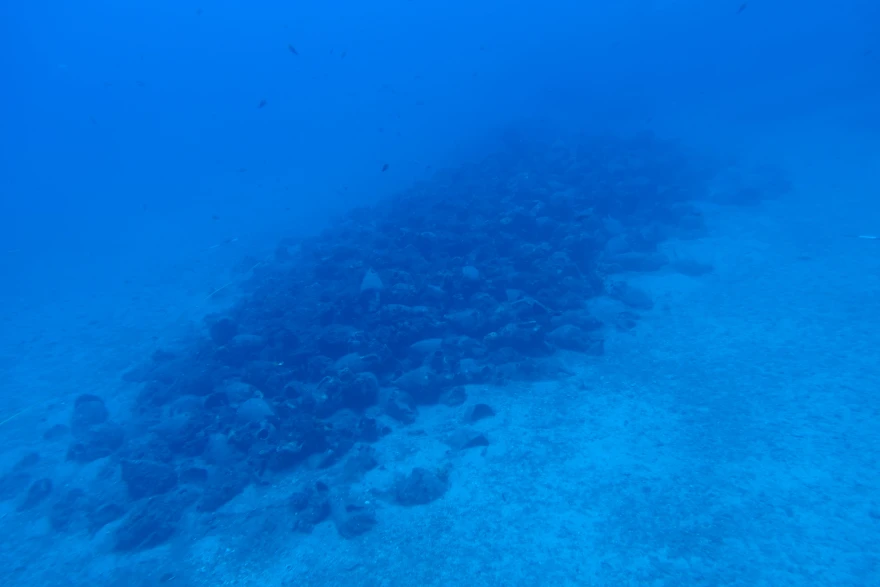
The amphorae date to the late 5th and early 4th centuries BC
The Ephorate of Underwater Antiquities of the Ministry of Culture conducted an inspection following information provided by Dimosthenis Adamis in a maritime area off the island of Andros, where it located the cargo of an ancient ship. The wreck was discovered at a depth of 39–44 meters, and its cargo consists of commercial pointed-base amphorae.
The presence of at least three different types of commercial pointed-base amphorae was established: Mende, Peparethos, and Solokha 2.
During the inspection, one amphora of each type was recovered as a sample.
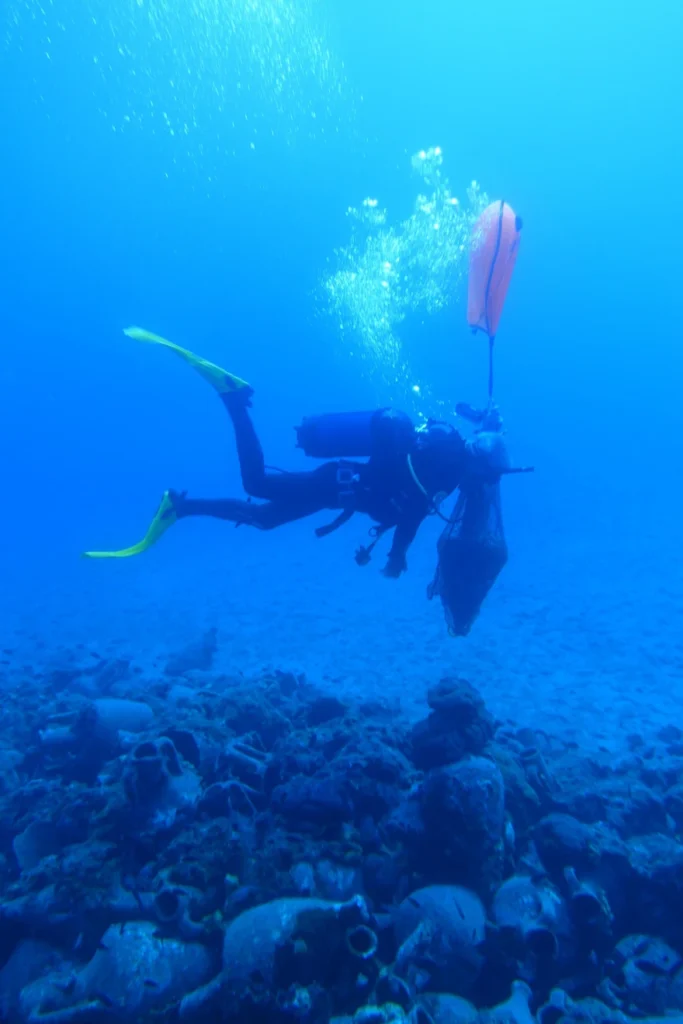
The chronological framework of these amphorae is placed in the late 5th and early 4th centuries BC. At the wreck site, a section of a lead anchor stock was also found, along with a small number of stones that may possibly have been associated with the ship’s ballast. As a preliminary estimate, approximately 600–650 amphorae were counted.
This particularly interesting find enriches our knowledge of trade and navigation during the period of the Late Classical era. Further study of the find will evidently provide additional interesting information, both about its cargo and its origin.
The team from the Ephorate of Underwater Antiquities consisted of Dionysios Evangelistis, diving archaeologist; Angelos Tsompanidis, diving conservator of antiquities; and Louis Mersenier, seabed technician.
Ask me anything
Explore related questions




