





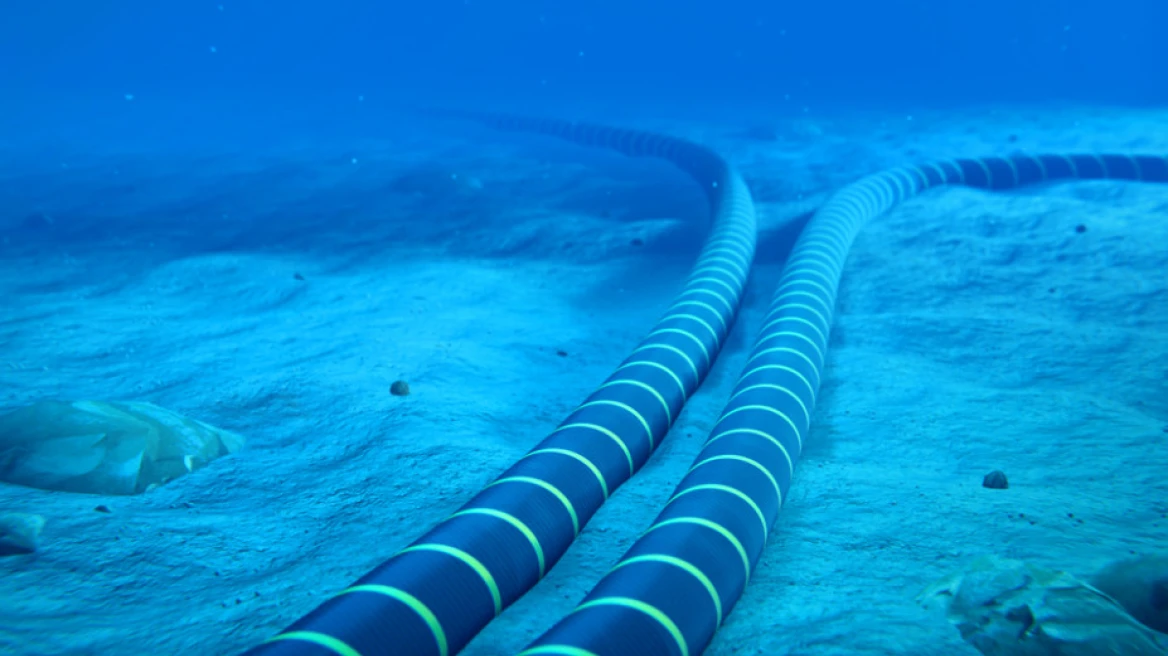
The Great Sea Interconnector (GSI) is attempting to enter a new phase toward restarting, with the strengthened presence of French company Meridiam creating a new set of circumstances surrounding the Greece–Cyprus electricity interconnection, while Athens is simultaneously sending a clear message to Ankara that the project will proceed on the basis of International Law and the Law of the Sea.
At the center of the next steps are the completion of marine surveys and bathymetric studies, the selection of the entity that will undertake the work, and subsequently the issuance of the necessary NAVTEX by the Greek authorities. These are the steps that will allow the route of the cable along the remaining section to be finalized and the project to move from the planning phase to operational implementation.
This particular phase is gaining increased geopolitical significance, as the remaining surveys also concern the maritime area south of Kasos. Ankara is reiterating its demand to be informed about surveys in areas that it considers to fall within its own continental shelf, while Athens rejects this approach and makes clear that Turkish permission is not required for projects of this nature.
Meridiam at the center of the new “formula”
A key element in the developments is Meridiam’s more active involvement. According to Kathimerini, the French company is expected to assume a central role in the next steps and to notify the countries in the region, including Greece and Turkey, by letter about the work required for the implementation of the GSI to continue.
The new reality creates a different operational as well as geopolitical basis for the project. France is gaining a stronger footprint in a project considered strategically important for the European energy architecture, as it aims to end Cyprus’s energy isolation and, when fully developed, create an energy bridge between Europe and the Eastern Mediterranean.
Within the same framework, the Independent Power Transmission Operator (IPTO/ADMIE) continues to have the technical leadership of the project and responsibility for operating the interconnection after it is energized, while the investment side is now acquiring a stronger French character.
Meridiam has experience with major electricity interconnection projects in Europe, including NeuConnect, which electrically connects the United Kingdom with Germany.
The difficult 40% of the deep sea surveys
Approximately 60% of the required bathymetric surveys have already been completed, with the remaining 40% considered the most complex part, both technically and politically.
The remaining surveys concern, among other areas, the maritime region south of Kasos, which Turkey incorporates into its unilateral conception of its continental shelf. Athens, by contrast, does not recognize Turkish rights in the specific area and considers its actions to be fully consistent with the International Law of the Sea.
Before the survey vessels return to the area, Meridiam and Nexans, which has undertaken the construction and laying of the cable, will have to finalize how the process will be completed.
Among the options under consideration is even a change in the contractor for the marine surveys. NextGeo, which participated in the previous round with IEVOLI Relume, could potentially be replaced by a French company or consortium.
If such a scenario is confirmed, the French footprint will become even stronger: Meridiam on the investment side of the GSI, Nexans in the construction and laying of the cable, and possible French participation in the final marine surveys.
The latest developments have been at the center of contacts between Kyriakos Mitsotakis, Nikos Christodoulides, and Emmanuel Macron, with Athens, Nicosia, and Paris having expressed their determination to continue the project.
A critical next step is the issuance of a NAVTEX by the Greek authorities, so that the maritime area in which the surveys will take place can be designated.
The NAVTEX, however, is expected to follow the companies’ operational decisions. First, the contractor for the surveys, the means to be used, and the timetable for the work must be determined, and then the next stage can be activated.
This process is considered particularly critical, as the return of the survey vessels to the sea will, in practice, constitute the first test of the new “formula” for the GSI.
Marinakis: The project will move forward
In response to Turkey’s demand that Ankara be notified in advance, the Greek government is categorical.
Government spokesperson Pavlos Marinakis made clear yesterday that Athens will act exclusively on the basis of what is provided for by International Law and the Law of the Sea, and that the electricity interconnection will proceed according to schedule.
“The rules of International Law and the Law of the Sea are even clearer when it comes to the survey work and the cable. Greece will not depart from these rules,” he said.
Marinakis also reiterated the shared political will to complete the interconnection, placing particular emphasis on the project’s European character.
As he stressed, “Cyprus, Greece, and France have expressed their will—I repeat it today as well—for this project, which is of European interest, to move forward. It will proceed according to schedule, and on our part we will do everything that is provided for and falls within our responsibility for its progress.”
Chatzivasileiou: No permit is required for the cable
Deputy Foreign Minister Tasos Chatzivasileiou took a similar position, stressing that the electricity interconnection is proceeding according to plan and linking the strengthened French presence to the project’s security and geopolitical protection.
“The Greece–Cyprus–Israel electricity interconnection is proceeding according to plan, while the French presence means that the project is secure. Greece does not leave any provocation unanswered and does not back down on issues relating to its national interest and sovereign rights,” he stressed.
The Deputy Foreign Minister also noted that no permit is required for peaceful infrastructure projects such as the electricity interconnection cable, while emphasizing the strategic dimension of the GSI.
As he stated, this is a European project that will contribute to ending the Republic of Cyprus’s energy isolation, while on a broader level it will strengthen Europe’s energy connection with the Middle East.
For its part, Turkey maintains that it is not fundamentally opposed to the development of international subsea infrastructure. It insists, however, that when surveys or cable-laying work are carried out in areas it considers part of its own continental shelf, communication through diplomatic channels should take place beforehand.
The Turkish side cites the Blue Raman subsea fiber-optic project as a precedent, arguing that a similar process of consultation should be followed for other projects being developed in the region.
This is precisely where one of the key differences between Athens and Ankara lies. The Greek side considers that there is no obligation to obtain Turkey’s consent or permission to carry out the specific works, while the Turkish side is attempting to link their implementation to its own claims regarding the continental shelf.
Kasos as the first major test
Attention is now turning to the resumption of the surveys. The precedent of Kasos remains decisive, as the previous attempt to carry out work in the area had led to an intense Greek-Turkish confrontation.
For precisely this reason, the new phase of the GSI is no longer viewed as a purely technical matter. The selection of the survey contractor, the issuance of the NAVTEX, and above all the presence of the vessels in the area will show whether the new business and geopolitical architecture can move the project from consultations to implementation.
The French presence is now one of the most important new variables. With Meridiam in a central role, Nexans having undertaken the cable, and Paris politically aligning itself with Athens and Nicosia in favor of completing the interconnection, the next step takes on broader significance. The critical point will be when the plans are once again transferred to the sea. The return of the survey vessels south of Kasos will constitute the first substantive test both for the restart of the GSI and for Ankara’s reaction to the new French “formula.”
Ask me anything
Explore related questions




