





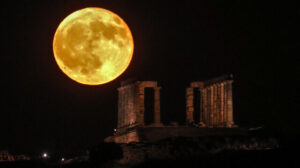
A striking astronomical spectacle is expected in the sky on Friday, August 28, as the month’s full moon, known as the “Sturgeon Moon,” is set to coincide this year with a partial lunar eclipse.
The Moon will reach its full phase, positioned directly opposite the Sun in relation to Earth, illuminating the night sky.
Interest is not confined to August’s full moon, however, as a partial lunar eclipse will also take place on the same day.
During the event, almost the entire lunar disc is expected to pass through Earth’s shadow, creating a particularly striking spectacle.
The eclipse is estimated to begin at around 4:30am, with its conclusion expected at 7:19am.
Where the name comes from
This full moon is known as the “Sturgeon Moon” in honour of Native Americans.
The Old Farmer’s Almanac, which first began publishing full moon names in the 1930s, states that August’s full moon was named the “Sturgeon Moon” after the sturgeon, a freshwater fish native to the Great Lakes and Lake Champlain that was easily caught during this period of summer. The fish was a key food source for the Native American communities living in the area.
Although sturgeon were once plentiful in the region in late summer, they are far more rarely caught there today.
The fish also has prehistoric origins, having been traced back around 136 million years, and is often referred to as a “living fossil.” Females take around 20 years to begin reproducing and can only breed once every four years. They can, however, live for up to 150 years.
Today, there are around 29 sturgeon species worldwide, including the lake sturgeon found in the Great Lakes. They have evolved to a smaller size over time, from once being enormous fish to now being roughly the size of a sea bass. In Greek, the word for sturgeon, “oxyrrynchos,” means “the one that stirs,” a reference to the way the fish moves as it searches for food.
Ask me anything
Explore related questions




