





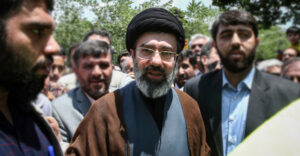
Six months after the air strikes that opened the war and left Mojtaba Khamenei, Iran’s supreme leader, severely wounded, he has still not appeared or addressed Iranians publicly.
His prolonged absence is fuelling growing questions about the state of his health and the real role he plays in decision-making, at a time when Tehran is grappling with both the fallout of the war and severe economic pressure.
Iranian officials and other senior sources cited by Reuters maintain that Khamenei continues to exercise control over the country, staying out of public view for security reasons while recovering from serious injuries that have left his face disfigured. According to the same sources, he has delegated a significant part of day-to-day management to a close circle of top officials.
However, since he took on the role a week after the war began, no photograph, video or audio recording of him has been released. The absence of any visual or audio record has deepened doubts inside the country over his position and role at the top of the Islamic Republic.
“The question is no longer whether Mojtaba is alive, but whether Iran still has a functioning supreme leader,” said Alex Vatanka of the Middle East Institute in Washington.
Only written messages from Khamenei
Khamenei’s communication with the Iranian public has been limited to a handful of written statements, read out by presenters on state media. He was also absent from the multi-day funeral ceremony for his father last month.
Senior officials and other sources inside the regime attribute his absence to fears of an assassination attempt. They insist he holds frequent meetings with top officials, is briefed on all major developments and makes the final decisions on critical issues.
Iranian President Masoud Pezeshkian said on 10 August that he had held a seven-hour meeting with Khamenei.
Despite these official assurances, questions persist even among supporters of the regime. A member of the Basij, the state’s volunteer paramilitary militia, in the city of Qom, who asked not to be named, said a public appearance by the supreme leader would boost supporters’ confidence in the Islamic Republic.
“We need to hear our leader’s voice, or see some sign that he is at the top and leading the country, so that we can have greater confidence,” he said.
He added that he believed Khamenei was still making the critical decisions, but said that the absence of even a single photograph was having a negative effect on morale.
Iranians who oppose the current political leadership, or who are calling for reform, are more blunt. “How do we know Mojtaba hasn’t been killed?” asked Shahrokh, a pro-reform businessman in Tehran who also asked not to be named. “It isn’t reasonable that there isn’t a single piece of evidence that he’s alive, let alone that he’s involved in decision-making,” he added.
Revolutionary Guards’ role strengthened
After six months of war, Iran has suffered significant blows without its political system collapsing. At the same time, its military capabilities still allow it to threaten global energy flows and strike US allies in the Gulf.
The political and religious leadership has also managed to maintain continuity of governance following the loss of the previous supreme leader and senior military commanders.
At the same time, Iran’s economy is under intense strain from the cost of the war and the months-long blockade of its oil exports.
The Revolutionary Guards, already one of the country’s most powerful institutions, have further expanded their influence since the war began. According to the sources, they are now at the core of strategic decision-making, within a reshaped power structure built around the Supreme National Security Council.
That inner circle includes senior Revolutionary Guards commanders as well as top political figures, among them Pezeshkian and parliament speaker Mohammad Bagher Ghalibaf.
“He has the final say on major decisions”
Several senior sources in Iran say Khamenei holds meetings with top officials, takes part in deliberations and retains the final say on all major issues.
A senior Iranian official said only a limited number of people have direct, personal contact with him. According to the same official, no details are made public about his condition or movements, amid fears that any information could be used by the United States to locate and target him.
A person close to Khamenei’s inner circle said his health has improved significantly, insisting he remains fully mentally alert and takes an active part in decision-making.
“Despite all the pressures, services to citizens have not stopped. Our foreign policy line is unified and our decisions are coherent. All of this shows that the supreme leader is in control,” said a second official.
Mojtaba Khamenei avoided the spotlight even before the war, when he operated mainly behind the scenes as his father’s top aide. According to senior sources, he was seriously injured in the early hours of 28 February, when Israeli and US air strikes killed his father, with the injuries leaving his face disfigured.
His prolonged absence carries particular weight given that, as supreme leader, he sits at the top of Iran’s political and religious authority during one of the most serious crises the country has faced since the 1979 Islamic Revolution.
Vatanka noted that both a possible deal with Washington and the continuation of a long and costly conflict with the United States would require clear approval from Khamenei.
In his view, the prolonged public absence creates conditions in which different factions within the system can claim to know the supreme leader’s true wishes.
Ask me anything
Explore related questions




