





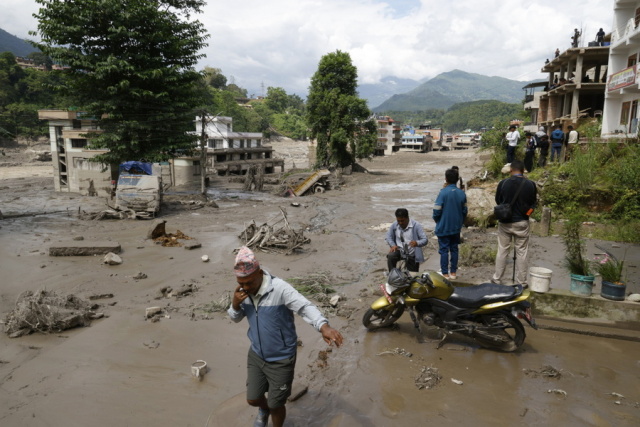
The death toll from catastrophic flash floods on the Nepal-Tibet border has climbed to 469, Nepal Police said on Friday, with more than 1,400 people still missing three days after a Himalayan glacier collapse sent a wall of ice, rock and mud through mountain communities.
New imagery from @vantortech confirms that the China-Nepal Rasuwagadhi border crossing has been completely destroyed, with the glacial flood completely scouring the valley floor.
— OSINTtechnical (@Osinttechnical) August 27, 2026
At least 359 people are dead and nearly 1,000 missing, according to local authorities. pic.twitter.com/DiBiUzJGtO
The disaster struck on Wednesday morning, when a chunk of glacier broke away in the Langtang Himal range and triggered an avalanche roughly 20 kilometres northeast of the Rasuwagadhi border crossing, according to Nepal’s National Disaster Risk Reduction and Management Authority, which based its assessment on satellite imagery. The resulting debris flow blocked the Lhende river before surging downstream into the Bhotekoshi valley. Jeffrey Kargel, a senior scientist at the Planetary Science Institute, said the flood wave covered the first 22 kilometres of its path at an average speed of 193 kilometres per hour, reaching villages in under seven minutes.
The worst disaster-struck districts are Nuwakot and Rasuwa, where police say 466 people have been injured. The Nepal Army has deployed more than 4,300 personnel and rescued over 100 people by helicopter. At Tribhuvan University Teaching Hospital in Kathmandu, walls have been lined with lists of the injured and photographs of the missing as relatives search for news of loved ones. The International Federation of Red Cross and Red Crescent Societies estimates that around 93,000 people may have been affected, and its secretary-general, Jagan Chapagain, said entire villages and market areas had been washed away.
🇳🇵 Disaster in Nepal..⚠️🚨
— sustainme.in® (@sustainme_in) August 27, 2026
New Released video, captured more than 50 km downstream from the site of the glacier collapse, shows the rapid arrival of the flood wave, obliterating everything in its wake.#Nepal #NepalFlooding #Floods #Rasuwa #flasfloods #NepalFloods… pic.twitter.com/3Ofw8n7OBA
More than 700 foreign nationals from two dozen countries are among the missing. Authorities say at least 178 are Indian nationals, most believed to have been on pilgrimage to Mount Kailash, a peak in south western Tibet held sacred by Hindus, Buddhists, Jains and followers of the Tibetan Bon tradition.
Indian spiritual leader Jaggi Vasudev, known as Sadhguru, said 77 pilgrims travelling with his Isha Foundation, including 22 Americans, were caught at an immigration centre in Gyirong, Tibet, when the flood hit. The Nepal Tourism Board says around 65 US nationals and at least 39 Australians remain unaccounted for, alongside British and Canadian citizens.
US President Donald Trump said Washington was willing to send “any help” needed. The US State Department said it was aware of around 90 Americans affected, with three rescued safely and no confirmed US deaths so far. Australian Prime Minister Anthony Albanese confirmed dozens of Australians were missing, and Foreign Minister Penny Wong said the Department of Foreign Affairs and Trade was urgently seeking updates on their welfare.
Vide warning: graphic content
This 3 min video of Nepal Flood, captures what became the last 3 mins for a many people in a small city and Trishuli Bazar.
— Abhishek Jha (@abhishekjha157) August 27, 2026
Everything disappeared in a flash. People, old and young, ran wherever they could, trying to escape the raging and imminent death.
Schoolchildren ran som… pic.twitter.com/t03O3kLXHY
Authorities in both Nepal and China are now warning of a possible second flood. Two barrier lakes have formed where debris blocked the rivers, one on each side of the border. China’s Ministry of Water Resources says around three million cubic metres of water could flow into the lake on its side within three days, threatening the already devastated Gyirong Port, a major China-Nepal crossing. Nepal’s disaster authority has issued a similar warning for the lake on its side of the border, and rescue teams have begun moving to higher ground as a precaution.
The flooding has also badly damaged the region’s infrastructure and its children. Dozens of bridges have been destroyed and around 40 kilometres of roads damaged, complicating rescue efforts. UNICEF says at least 17,000 children have been affected, with 18 schools destroyed and 20 more damaged across Rasuwa and Dhading. The agency’s Nepal representative, Alice Akunga, warned that surviving children now face heightened risks of disease, malnutrition and exploitation. The Red Cross has launched a 43 million dollar emergency appeal to fund the response and a two year recovery effort.
Ask me anything
Explore related questions




