





The situation in Ceuta remains volatile, as the unprecedented illegal immigration crisis that has affected the Spanish enclave for several weeks has triggered reactions from local residents. At the end of July, approximately 70,000 illegals crossed into the coastal city from Morocco and, although more than allegedly 90% are reportedly believed to have returned, the problems remain.
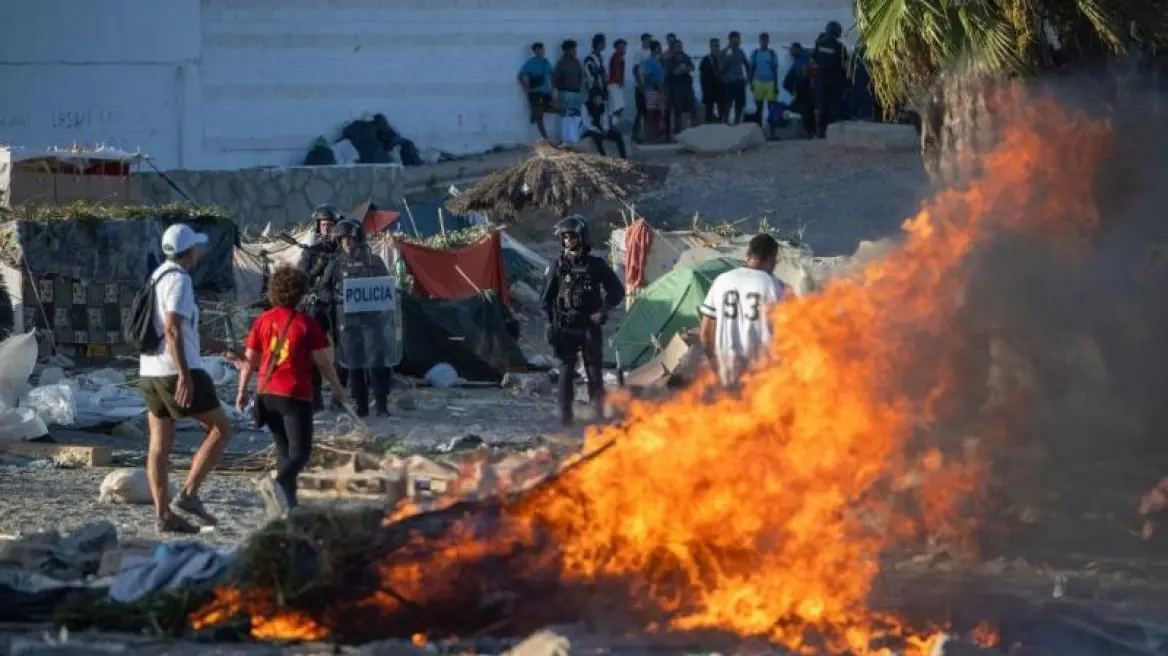
Spaniards has been attempting to prevent the daily distribution of food at El Tarabolín Beach, even setting fire to the tents that have been erected for the illegals demanding remigration. Police forces had to intervene, in unprecedented scenes broadcast live on television, in order to prevent clashes between illegal immigrants and demonstrators. At the same time, Red Cross volunteers, who until now had been distributing the food without problems, appear increasingly frightened.
Amid this climate of extreme tension, which makes managing an already extremely complicated crisis even more difficult, the government appealed to all political parties, but especially to the People’s Party (PP), which has governed and politically dominated Ceuta for the past 25 years, to contribute to condemning and curbing the violence.
Ángel Víctor Torres, head of the unified coordination mechanism for the crisis, acknowledged that he and the president of the autonomous city, Juan Jesús Vivas, had agreed on a joint message against violence, which they delivered in similar terms on Wednesday evening.
However, this did not prove sufficient. Torres therefore called from Congress on all political parties, and particularly the PP, to join in condemning the violence. “Yesterday, Vivas and I agreed on an urgent message against violence. It would be good if everyone joined in today,” he said.
His appeal, however, received little response. PP spokeswoman and senator Cristina Díaz responded to Torres that the violence that must be condemned is the attack by illegal immigrants against a group of military personnel. The minister immediately condemned that particular incident, but called for equal emphasis to be placed on attacks by some residents against migrants or Red Cross volunteers who, as he pointed out, are simply trying to provide food to people who are hungry.
“Ceuta does not need lessons in patience and coexistence. For decades, we have been the ones giving such lessons to the rest of Spain. What we need is a government that guarantees security, regains control, and restores normality for all the residents of Ceuta,” said the PP senator.
Vivas used particularly dramatic language when referring to the violence, as the situation deteriorates on a daily basis. Shortly after his statements, approximately 100 people managed to block the distribution of food for quite some time, while violent incidents followed, along with the torching of the makeshift migrant camp on the beach.
“No one can attack Muslim residents of Ceuta, just as no one can be attacked because they are a migrant,” Torres said. “Red Cross volunteers, who are themselves residents of Ceuta, cannot feel threatened because they are distributing food at El Tarabolín Beach and consider abandoning their volunteer work. Journalists cannot be attacked either. Public officials take on responsibilities, but violence against any public representative cannot be accepted,” he added.
However, the confrontational climate between the two major parties is anything but a sign of an agreement on a joint effort to de-escalate the anger of the local community.
Three ministerial hearings were held in Congress, and in all of them the confrontation between the government and the opposition was intense, as the opposition believes that this crisis could constitute a serious blow to the government, while Spain approaches the 2027 election period, a year in which municipal, regional, and national elections will be held.
The PP and Vox launched a fierce attack on the government, at a time when former Prime Minister José María Aznar was visiting Ceuta, also with harsh criticism of the executive branch and a demand for the restoration of order.
In Congress, Justice Minister Félix Bolaños reminded lawmakers that Aznar had never made an official visit to Ceuta while he was prime minister. He had traveled there only once, during his 2000 election campaign, for a party rally, without any official government activity. By contrast, Pedro Sánchez has already made four official visits to the city, the most recent being on July 31.
Nor had the King, whose presence the PP is now requesting, visited Ceuta when Aznar or Mariano Rajoy were in government. Juan Carlos I had visited the city once, when José Luis Rodríguez Zapatero was prime minister.
Aznar and the PP accuse the government of appearing weak toward Morocco. Bolaños, however, insists that there is no evidence proving that Rabat is behind the mass entry of migrants, although videos from Morocco says otherwise. On the contrary, he argues, there are clear indications that, thanks to the current good relations between Spain and Morocco, the rapid return of 90% of those who crossed into Ceuta was made possible, a claim that again does not seem to reflect the reality in Ceuta.
A significant number of people have remained and this is the group that is now causing the major difficulties in managing the crisis.
On Friday, a new meeting of the unified coordination mechanism is expected to take place, this time chaired by Pedro Sánchez from the Moncloa. According to Torres, decisions will be made there regarding new accommodation facilities, in order to accelerate the registration and identification of all illegal immigrants.
Last week, facilities for 1,800 people were sought, but many more places are required, as the government attempts to bring under control a crisis that at this point appears to have spiraled out of control.
“I am not going to deceive anyone by saying that they can be returned tomorrow when I know that this is false. Normality will be restored, but I cannot say when,” Torres said.
Concern is growing within the government. Several ministers privately admit that they, surprisingly, did not expect the efforts by some residents to prevent the distribution of food. They point out that if it proves impossible to continue feeding the illegal immigrants, the situation could become much worse.
According to government sources, the approximately 4,000 meals distributed daily since the beginning of the crisis have been instrumental in maintaining a relative calm and preventing incidents.
Government members point out that managing the crisis becomes much more difficult when a large part of the local population reacts to the situation that has being imposed on them.
Officials who had managed the 2021 crisis, when approximately 10,000 people crossed en masse into Ceuta and most remained there, recall that there were no comparable reactions from residents at the time. The city quickly made an indoor sports hall available, allowing the situation to be dealt with more discreetly and without serious clashes. The numbers now, however, that absolutely unbearable for the small enclave.
At that time, there is an attempt to transfer illegal immigrants to mainland Spain, mainly minors. Today, however, this possibility is categorically rejected by the PP and, above all, by Vox. In fact, Vox’s regional representatives did not even participate in the meeting with the Ministry of Youth and Children to prepare for possible transfers and approve €25 million in funding.
Ask me anything
Explore related questions




