





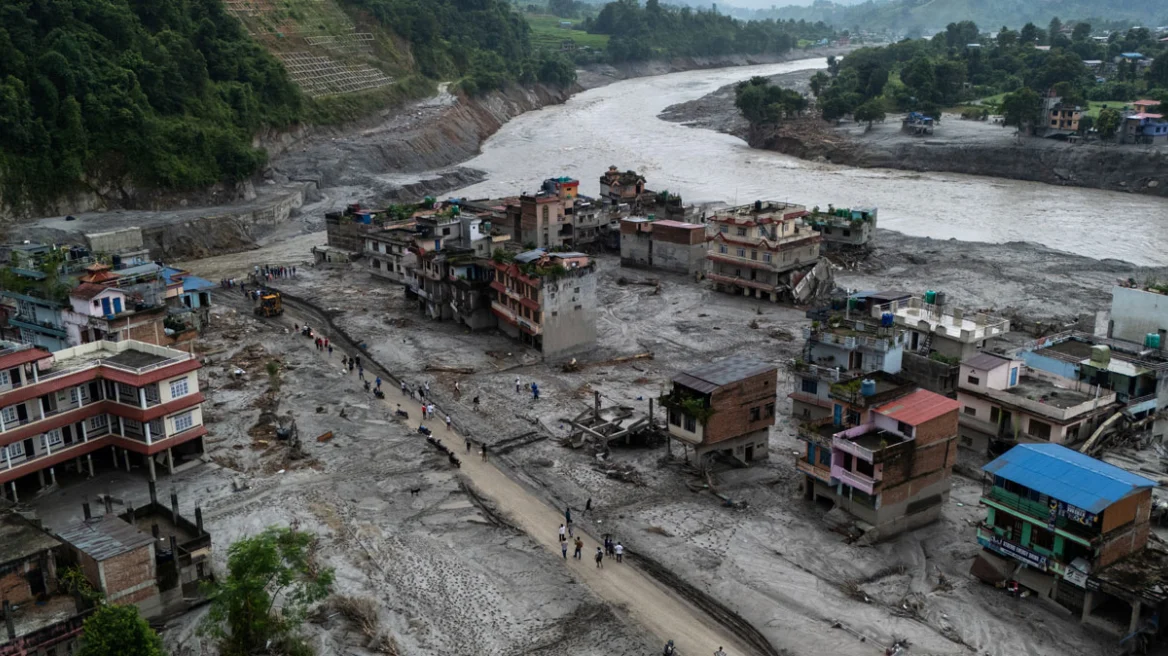
One of the largest natural disasters in recent years is devastating Nepal and the border region with Tibet, as deadly floods and landslides have left hundreds dead and thousands of people missing. The death toll continues to rise, while rescuers are battling under extremely difficult conditions to locate survivors.
According to the latest figures from Nepalese authorities, at least 734 people have lost their lives, while 2,498 remain missing. More than 8,000 people have been rescued, while nearly 20,000 members of the security forces are taking part in search-and-rescue operations.
On the Chinese side, in Tibet, authorities reported 16 deaths and 546 missing people, bringing the total number of missing people on the two sides of the border to more than 3,000.
The deadly mudslide that swept through villages and infrastructure
The disaster occurred on Wednesday, when a massive mass of ice, rocks, and mud collapsed high in the Himalayas, triggering a catastrophic torrent that moved along the Trishuli and Bhote Koshi rivers.
There were initially reports of a possible earthquake having caused the disaster, but more recent scientific analyses concluded that the phenomenon was linked to a glacier collapse and a massive debris flow that swept away entire areas in its path.
Roads, bridges, homes, and hydropower facilities were destroyed within minutes. The Nuwakot region was particularly badly affected, as were areas near the Gyirong Port border crossing, an important route for tourists and pilgrims heading toward Mount Kailash in Tibet.
Thousands missing — including tourists and workers
The tragedy has taken on international dimensions, as hundreds of foreign nationals are among those missing.
Nepalese authorities say that approximately 589 foreigners are among the missing, while people from many countries have disappeared across the affected areas.
In Tibet, Chinese authorities announced that among the 546 missing people were 261 foreign nationals from 23 countries, including citizens of Nepal, India, the United States, Latvia, and Britain.
Many of them were travelers who were in the area for trekking or religious pilgrimages, as the route to Mount Kailash is a popular destination for thousands of visitors every year.
Dozens of workers trapped in hydropower tunnels
Particular concern surrounds the fate of workers trapped in underground tunnels belonging to hydropower facilities.
Rescuers are trying to reach areas where more than 100 workers are believed to be located, but mud and debris are making access extremely difficult. In some cases, specialized pipes are being used to supply air to those trapped inside.
Rain hampers the rescue operation
Despite large-scale operations involving the army, police, and international teams, conditions remain extremely difficult.
The bad weather is continuing, while meteorological services have issued warnings of further rainfall. The United Nations has pointed out that delivering humanitarian aid is a major challenge because of the rugged terrain, with many areas accessible only by helicopter.
“Access is extremely difficult,” U.N. officials said, noting that even the use of drones to deliver supplies to isolated communities is being considered.
New danger from the Bhote Koshi River
Nepalese authorities have warned residents in areas near the Bhote Koshi River to remain on alert, as a new rise in water levels has been recorded.
Fears of a second wave of flooding remain, as landslides have created natural dams that could lead to new dangerous releases of water and mud.
Lekkas: Flash flood traveled 100 kilometers
According to Professor Efthymios Lekkas, president of the Earthquake Planning and Protection Organization (OASP), who is in the area studying the causes and development of the phenomenon firsthand:
As Mr. Lekkas explained, the disaster was not caused solely by the collapse of the glacier. High temperatures caused fractures and fissures within the glacier mass, increasing its mobility. At some point, enormous quantities of ice, together with underlying rocks and soil formations, collapsed.
The pressure generated by the volume of ice and rocks breached the lake’s natural dam, releasing enormous quantities of water and material. This was followed by a sudden flooding phenomenon — a flash flood — which traveled for approximately 100 kilometers, sweeping away mud, rocks, and infrastructure and causing widespread destruction.
Preliminary analyses place the beginning of the phenomenon in the Himalayas, at an altitude of approximately 6,200 meters. The scale of the detachment was enormous, with experts estimating that the width of the glacier that broke away reached approximately 610 meters.
Ask me anything
Explore related questions




