





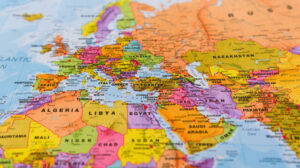
The UN General Assembly is being asked by the international community to abolish the traditional Mercator map and replace it with a depiction that accurately renders the true size of the African continent. The initiative is being led by Togo, backed by the other 54 member states of the African Union (AU), as well as other countries.
Togo’s Foreign Minister, Robert Dussey, made clear, according to the Guardian, that the proposal carries no political motive: “This is not about politics, but a scientific debate. The scientific data are indisputable, and we all have a duty to accept reality.”
Although UN resolutions are not binding, a vote in favour is expected to have a direct impact on school curricula and digital applications, given that the Mercator map is the one still used everywhere today, from schools and the internet to public services.
The “cartographic colonialism” of 1569
The map was designed in 1569 by the Flemish cartographer Gerardus Mercator (hence the term “Mercator map”) to aid maritime navigation. However, because of the geometric technique used in the projection, regions near the equator appear disproportionately small, while regions at high latitudes are hugely enlarged.
As a result of this distortion, Africa appears almost the same size as Greenland, when in reality it is 14 times larger. As the international #CorrectTheMap campaign points out, “the United States, China, India, Japan, Mexico and most of Europe could all fit within the landmass of Africa at once.”
Experts and activists describe this as “cartographic colonialism”, arguing that the map has contributed to global inequality by visually shrinking poorer countries in the Global South while enlarging wealthier nations in the Global North.
The Equal Earth proposal and the next steps
Togo is proposing the adoption of the Equal Earth map (designed in 2018), which renders the proportions of the continents accurately. Analysts note that the move is part of a wider effort by African states to gain stronger representation and control over how their continent is portrayed internationally, according to the same report.
Following the UN’s recent adoption of a resolution proposed by Ghana recognising the slave trade as a crime against humanity, Togo’s government appears optimistic. It is already planning an international conference in Lomé, in partnership with UNESCO, the African Union and technology giants such as Google Maps, to draw up a roadmap for implementing the new map.
“To those who ask, ‘why now?’, I answer, ‘why not?’ It is time for us to change the narrative and take responsibility for correcting what we can correct ourselves,” concluded Togo’s top diplomat.
Ask me anything
Explore related questions




