





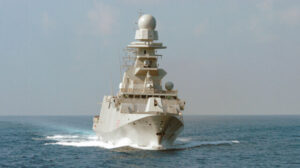
The Greek Pentagon’s plans for the country’s new naval fleet are gradually taking shape, with an implementing agreement for the acquisition of two FREMM frigates of the Bergamini class expected to be signed in Rome on Tuesday.
The agreement, to be signed by Greek Minister of National Defence Nikos Dendias and his Italian counterpart, Guido Crosetto, will also pave the way for Greece to acquire two additional frigates of the same type in the near future.
Interest in high-quality second-hand warships is currently extremely strong. In the case of the two frigates Greece is expected to acquire, Portugal had also expressed significant interest, requiring particularly delicate handling by both the political leadership and senior Hellenic Navy officers.
The acquisition of seaworthy vessels, including used ships, had become a high priority for the Hellenic Navy, given that its last purchase of new MEKO frigates took place back in 1999. In addition to the effects of aging, naval personnel have had to contend with rapid technological advances in recent years and the increasingly visible new challenges emerging in the wider southeastern Mediterranean.
Stronger rapid-response capabilities
The agreement for the acquisition of the two Bergamini-class frigates gradually reveals the Pentagon’s strategic plan for a ten-ship frontline fleet capable of immediate deployment.
In practical terms, this means Athens will have ten combat-ready surface vessels capable of responding rapidly to developments, as demonstrated by the deployment of the Kimon to Cyprus. According to information available, this ability was taken into account when assessing Greece’s military capabilities not only by NATO forces but by other powers as well.
The plan also helps make up for lost time in the modernization of Greece’s MEKO-class frigates, for which the Government Council for National Security has now given the green light.
The ten “immediate-response” vessels will comprise:
- Four new FDI Belharra frigates, built by Naval Group.
- Four MEKO-class frigates, which, despite being around 35 years old, will be equipped with state-of-the-art systems following their modernization.
- Two FREMM frigates of the Bergamini class, which, although second-hand, are considered to be only one tier below the FDI frigates.
This ten-ship core will also be supported by some of the Navy’s S-class frigates until the timeline for acquiring two additional Bergamini-class frigates is finalized.
Learning from past mistakes
The Pentagon’s planning primarily reflects the political and operational determination to avoid the mistakes of the past. For years, the Greek fleet had been left without major modernization or new-vessel acquisition programs, leaving it facing a rapidly changing strategic environment in the wider region.
However, all indications suggest that those experiences have become lessons learned. Pentagon planners are keeping their options open and moving aggressively toward the continuous strengthening of Greece’s deterrent capabilities.
At the same time, the Navy’s ten-ship combat-ready fleet is not simply about maintaining a double-digit number of surface vessels available at any given time. It is also linked to the Navy’s broader effort to instill a new operational philosophy among its personnel, reflecting modern requirements and the increasingly complex nature of warfare.
Beyond acquiring new ships and modernizing older ones, the effort to integrate advanced weapons and unmanned systems into the fleet is also well underway. The ten frontline surface units will be supported by A900 unmanned helicopters, S100 unmanned systems and Category 2 unmanned systems, including the new V-Bat systems approved by the Government Council for National Security.
The two frigates
Greece is acquiring from Italy one general-purpose frigate and one anti-submarine warfare frigate.
Although the two ships are visually almost identical in terms of their hulls, they can perform complementary roles during a crisis. One can contribute to air-defense missions, while the other is designed to detect and track underwater activity.
Both vessels are equipped with naval guns. The Bergamini-class frigates also have a range of 6,000 nautical miles, allowing them to remain at sea for up to 45 days.
They require relatively little fuel to operate, generate limited underwater noise and could significantly strengthen Greece’s deterrent capabilities in the Aegean. Their extended endurance means they do not require constant resupply and can remain stationed in designated areas for weeks at a time.
The Bergamini-class frigates can also undergo upgrades even decades after entering service. Maintenance and modernization work has already been planned by the Hellenic Navy following their acquisition.
The timeline
For the general-purpose frigate Carlo Bergamini (F-590), the transfer from the Italian side is expected to take place during the first half of 2028, along with a flag-raising ceremony.
For the anti-submarine warfare frigate Virginio Fasan (F-591), the corresponding procedures are expected to take place during the first half of 2029.
The agreement between Greece and Italy also includes both initial and follow-on support to ensure the vessels’ operational availability, as well as Greek industrial participation.
Greek shipyards are expected to be involved in maintenance work and in the integration and adaptation of new systems aboard the frigates.
Ask me anything
Explore related questions




