





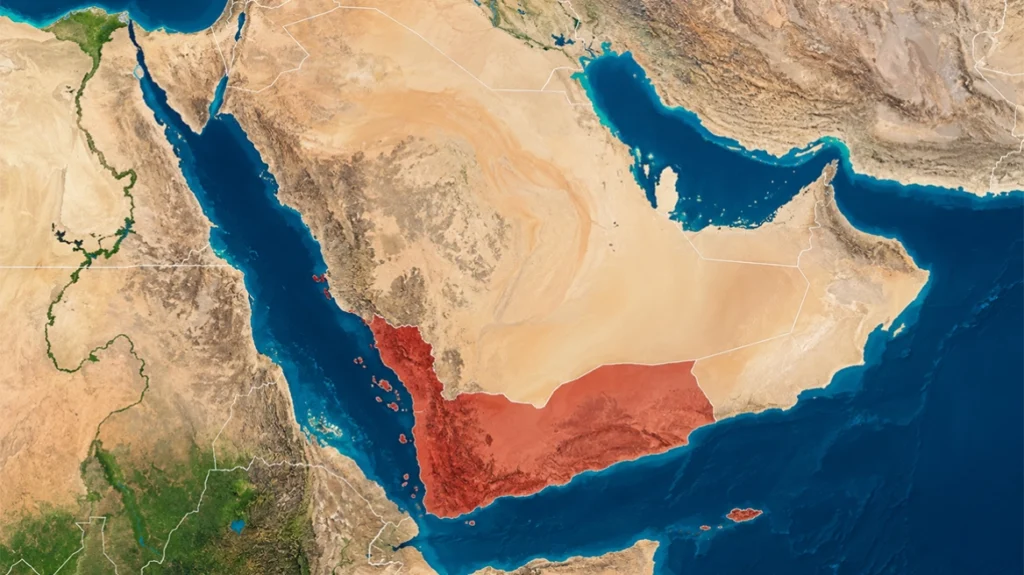
The crisis in the Red Sea is entering a new and clearly more dangerous phase, as the Houthis have now gained effective control of almost the entire western coast of Yemen, strengthening their presence along a zone leading to the maritime approaches to Bab el-Mandeb, one of the world’s most important passages for global shipping and energy flows.
The development takes on particular significance as it coincides with a new wave of attacks against Saudi Arabia and growing pressure on alternative routes for Saudi oil exports to the Red Sea.
According to a Reuters report published today, officials from Yemen’s internationally recognised government said that, despite the intensification of airstrikes by Saudi and Yemeni forces, the Houthis retain effective control of almost the entire western coastline of the country along the Red Sea. The development significantly expands the Houthis’ footprint following their latest territorial advances, which include the strategically important area of Mokha and Perim/Mayun, the island at the entrance to the Red Sea. Consolidation of these positions increases the geopolitical risk around Bab el-Mandeb, through which commercial vessels travel between the Indian Ocean, the Red Sea and the Suez Canal.
At the same time, the Houthis have reopened the front against Saudi Arabia. They announced that they had launched dozens of missiles and unmanned aircraft at the military airbase in Khamis Mushait, in southern Saudi Arabia. According to their statements, the targets included aircraft hangars, radar systems, runways and ammunition depots. Saudi authorities issued emergency warnings in the area and in three other cities in the south, while the Saudi-led coalition announced that 13 civilians had been injured. For shipping and energy markets, however, the crucial point is that the security situation has begun to affect Red Sea infrastructure through which Riyadh is seeking to bypass the Strait of Hormuz. An alert was issued even in Yanbu, Saudi Arabia’s main oil hub on the Red Sea coast, before authorities later announced that the danger had passed.
The timing is extremely critical. Saudi Arabia’s approximately 1,200-kilometre East-West Pipeline remains out of service following last week’s airstrike. The pipeline was built specifically to enable Saudi Arabia to transport oil from its eastern regions to the Red Sea, bypassing the Strait of Hormuz. This means that Riyadh is facing pressure on both sides of its energy supply chain: in the east, Hormuz remains largely blocked, while in the west, the Houthis are consolidating their positions opposite Bab el-Mandeb and missile threats are approaching the Yanbu area. The equation has immediate global implications. Traders cited by Reuters estimate that a prolonged shutdown of the East-West Pipeline, while Hormuz remains largely closed, could cut off quantities equivalent to as much as 4% of global oil supply from the market.
Riyadh has so far not announced when the pipeline will resume operations. The new reality is therefore turning the Yemen front from a regional military conflict into a direct risk factor for international shipping and energy security. With Hormuz under severe restrictions and the Houthis consolidating their positions around the approaches to Bab el-Mandeb, two of the most important maritime passages for global energy trade are now simultaneously at the centre of the same crisis.
Ask me anything
Explore related questions




