





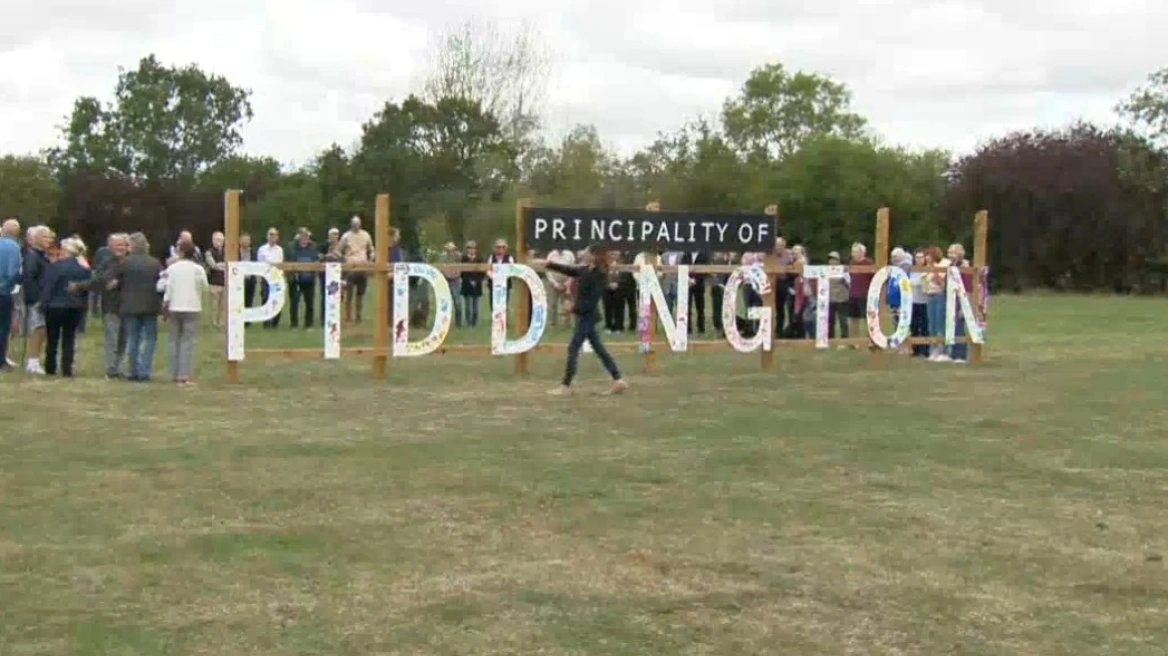
A 14th-century church, a small community hall, picturesque thatched roofs and paths winding through the green hills of the English countryside. These are the features that make up the village of Piddington in Oxfordshire, south-east England, which is so small that it does not even have one of the most characteristic establishments of British culture: a pub.
This summer, the British government announced a plan that completely changed the daily lives of its approximately 350 residents: to accommodate 1,250 male illegal immigrants at an abandoned military site near the village and keep them there for as long as their applications are being assessed.
If the plan goes ahead, the illegal immigrants will outnumber the village’s residents by almost four to one.
The decision has sparked strong reactions and concern in the area, turning this small corner of England into a characteristic example of the growing social tension surrounding the way Britain is managing the tens of thousands of illegal immigrants arriving in the country.
Residents even went as far as organising a referendum asking whether the village should symbolically “declare independence” from the United Kingdom, in a move with no legal force but intended to draw the government’s attention.
According to the results announced on Wednesday morning, a total of 285 people, out of the 312 who voted, backed independence from the United Kingdom, while 26 voted against. One ballot was invalid.
Self-defence classes and security cameras
Some women in the village, saying they feel unsafe at the prospect of such a large number of unfamiliar men settling next to their community, have begun taking self-defence classes.
Other residents are considering installing wireless security cameras. A new sign has even been put up at the entrance to the village reading: “I am Spartacus. You are Spartacus. We are all Spartacus.”
Elon Musk also came out in support of the residents on X, arguing that what is happening in Piddington is a warning of what could happen in other small English villages if immigration is not controlled.
The head of the community council, Tim McNally, even went so far as to send a letter to US President Donald Trump, believing that the British government is not listening to residents’ concerns. “I have to look at every measure I can, every tool I can use to put pressure on this government, so that either it backs down or finally does what it should and listens to people’s concerns,” he said.
The British government, for its part, is not changing its position, with Prime Minister Andy Burnham saying that all areas of the country must do their share in accommodating asylum seekers.
A camp 15 minutes from the village
If the project is completed, the former military site, enclosed by barbed wire and located approximately a 15-minute walk from the village, will be converted into an accommodation center, with asylum seekers able to enter and leave the premises freely.
Residents fear that the village will come under disproportionate pressure, that property prices will fall and that crime could increase. Some have even talked about putting up fences or walls around their homes to feel safer.
Others have adopted a different tactic: volunteers are searching the surrounding woods for rare species of bats, hoping that any findings could create environmental obstacles to the implementation of the project.
Around 200,000 small-boat arrivals since 2018!
Over the past decade, the number of illegal immigrants arriving in Britain has increased significantly, as smuggling networks began using small inflatable boats to transport people across the Channel from France.
Since 2018, around 200,000 people have arrived in the country via this route. Those seeking asylum in Britain may wait months or even years for their applications to be considered. Many do not have identification documents or a passport, making it difficult for the British authorities to confirm their identity and country of origin.
While their applications are being considered, they are not permitted to work and are housed in accommodation funded by the state.
At the same time, criminal cases involving illegal immigrants often receive extensive coverage in the British press, further fueling the political debate.
Earlier this month, an asylum seeker from South Sudan was sentenced to 29 years in prison for the murder of a 27-year-old woman, while in August a Syrian illegal immigrant was sentenced to four years in prison for sexually assaulting two women.
Over the summer, the British government also began distributing information leaflets to illegal immigrants about sexual consent, explaining that in Britain both parties must give consent and that sexual contact without consent constitutes rape and a serious criminal offence.
From hotels to former military camps
Following the pandemic, a huge backlog of outstanding asylum applications built up. The government then began using hotels to house asylum seekers, provoking a backlash because of the high cost at a time of rising taxes and intense pressure on public services.
Last year, the British state spent £1.7 billion – approximately $2.3 billion – on accommodating asylum seekers. In an effort to reduce costs while also responding to criticism that hotel accommodation was excessively expensive, the government decided to turn to former military sites.
Three such sites, including the one near Piddington, are intended to accommodate a total of around 4,000 people.
The Home Office argues that housing asylum seekers in former barracks could both act as a deterrent to those considering making an irregular Channel crossing and make it easier for the authorities to know where asylum seekers are.
Opposition in other areas too
The plans have also sparked controversy elsewhere in Britain.
A proposal to convert a barracks in Inverness, Scotland, into an asylum seeker accommodation center was abandoned earlier this year following opposition from residents.
In January, hundreds of people carrying English flags marched in a small town in Sussex when a similar plan was announced.
Over the summer, far-right protesters temporarily blocked access to the port of Dover, where those arriving across the Channel are initially processed. One of the leaders of that protest has already warned that he will organise demonstrations in Piddington if the military site opens.
Residents of Piddington, however, say they do not want their own protest to take such a form.
Many moved there from larger cities in search of a quieter life. It is also an area that voted for the Liberal Democrats, a party that has generally adopted a more positive stance towards refugees, while several residents describe themselves as liberals.
British state tried again in 2002
This is not the first time the British state has attempted to create an accommodation center in the area.
In 2002, a plan was launched to house migrants at a Ministry of Defence facility, with £28 million spent on designing the project. Three years later, the plan was abandoned as asylum applications fell and costs had increased significantly.
The government argues that it has now made progress in tackling the backlog of outstanding applications. In June 2026, there were 32,400 cases awaiting an initial decision, while approximately a quarter of them had been pending for more than a year.
Ask me anything
Explore related questions




