





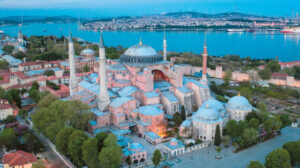
Legend has it that, when Emperor Justinian was building Hagia Sophia, Satan tried to sabotage the project. With the help of the Saints’ prayers, Justinian managed to trap Satan and chain him in the deepest, flooded underground chambers of the church. Now imagine the shiver running through the divers when, diving into the labyrinthine flooded underground chambers of Hagia Sophia, at a depth of 12 meters, they came across gigantic iron chains and human bones…
The research
Ultimately, the chains were not used to restrain the imprisoned demon, but by the Byzantines to raise the large chandeliers or to secure the underground passages. It therefore turns out that the magnificent Christian church that has stood proudly for around 1,500 years still has many secrets hidden within it.
Researchers have discovered an extensive network of tunnels stretching for more than 9 kilometers, remarkable solutions – even by today’s standards – for ventilating and draining the foundations of the church, flexible foundations designed to absorb the vibrations of earthquakes, hidden rooms, the tombs of patriarchs, a saint and children who were descendants of prominent families, pieces of its chandeliers, and underground connections with other landmarks of the City, such as the Great Palace. The latter is also evidence that there is an entire city beneath the City, with underground routes centered on Hagia Sophia. How many more secrets could be hidden beneath its ground? Researchers have good reason to hope that they may discover hidden underground avenues, untouched burial chambers of emperors, as well as Byzantine treasures protected from invaders.
The “dust of time”
In one of the many flooded cisterns and near the bottom of the church, at a depth of 12 meters, a diver saw two large wooden objects that looked like a shovel and a bucket. He approached and, as soon as he touched them, something happened that seemed to have come straight out of a fairy tale. The objects immediately disintegrated and turned to dust, which disappeared into the dark water of the cistern. This was later called the “dust of time”, as the objects seen by the diver had rotted after centuries in the water.
“They still haven’t found the Marble King beneath Hagia Sophia,” a Greek man jokes as he watches an interview with Turkey’s Minister of Culture and Tourism, Mehmet Nuri Ersoy, who confirms the legend that Hagia Sophia is connected underground with the entire city. It was officially announced that a vast network of underground tunnels with a total length of 9 kilometers extends beneath the church. Scientists have identified at least seven different tunnels dating back around 1,600 years, to the early Byzantine period. During recent cleaning works, more than 1,000 tonnes of soil and mud were removed, revealing narrow passages and vaulted rooms, with the Turkish minister explaining that access is prohibited at several points because of collapses. “Once the work is completed, we can assess opening the appropriate and safe sections to visitors,” he stressed.
The underground system of Hagia Sophia is not a single, level space, but a genuine labyrinth. As for the flooded cisterns, beneath the church there are large, deep water-storage chambers, comparable to the famous Basilica Cistern, which remain filled with water. Divers were needed there, as in the renowned research by director Göksel Gülensoy in 1998 and 2009, to dive into the dark waters, find old objects such as lamps, shoes and even chains, and locate the bases bearing the Medusas.
The underground network is not a simple straight line, but extends across different levels (layers) beneath the marble floor of the church: at the first level, at a depth of 2–4 meters, are the dry ventilation passageways, cells, crypts and scriptoria (writing rooms). At this depth, the “underground chamber”, the tomb with three rooms, was also discovered. At the second level, at a depth of 4–8 meters, the large conduits that carried rainwater away from the church so that it would not flood begin. At the third level, at a depth of 8–12 meters, there are the deep wells and gigantic flooded cisterns. At this depth, divers descended into the two central wells/cisterns and encountered impressive finds, such as submerged tombs. Several meters beneath the water, divers discovered tombs dating back to the 13th century. Among them were the bones of children considered “sainted” or belonging to prominent families of the Byzantine period who died during times of famine or sieges and were buried in this place of honour. At the same site, in the so-called “underground chamber”, other burial rooms were also found, which scientists have established belonged to Patriarchs. So far, they have identified the tombs of Saint Antigonus and Patriarch Athanasius.
At the bottom of the cisterns, dozens of glass fragments from the gigantic chandeliers that once illuminated Hagia Sophia were discovered, along with Byzantine lamps and coloured pieces of stained glass. The divers discovered gates and narrow passages leading deeper towards the center of the building, as well as in the direction of Topkapı. These passageways remained untouched for reasons of the monument’s structural safety.
The Byzantine anti-earthquake secret
There are hundreds of meters of passageways designed by Justinian himself to allow air to circulate, so that the foundations would not rot from damp, and to carry away rainwater. These tunnels were filled with tonnes of mud, soil and rubbish that accumulated there over the centuries.
Hagia Sophia has stood for almost 1,500 years in one of the most earthquake-prone regions in the world. The secret of its survival lies, in part, beneath its floor, leaving scientists scratching their heads over the mysterious and sophisticated architectural methods – even by today’s standards – used by the Byzantines for the church.
Thus, the vast network of voids, tunnels and cisterns beneath the church acts as a cushion. When an earthquake occurs, the underground cavities absorb and disperse the seismic waves, preventing the energy from being transferred directly to the enormous columns and dome. In the underground vaults, an exceptionally elastic mortar mixture containing crushed brick was used, allowing the stones to bend during tremors without breaking.
The Byzantine architects Anthemius and Isidore designed the dry tunnels to function as an air-conditioning system. The air circulating through them regulates the humidity in the foundations. Without them, ground moisture would have eroded the foundations within a few decades, causing the church to collapse.
The emperor’s hidden passages
The legends of secret escape routes used by Byzantine emperors have proved, in part, to be true. Archaeological research has confirmed the existence of passageways leading towards the Great Palace. These underground corridors once served the discreet and safe movement of the clergy and the imperial court away from the eyes of the crowds. In the seven different tunnels, which date precisely from the time of Justinian (1,600 years ago), have a total length of more than 9 kilometers, and were uncovered by archaeological teams after more than 1,100 tonnes of mud and rubble were removed from them, the mapping is now almost complete. Because many of the tunnels are too narrow and dangerous for people, scientists are now using robotic cameras, LiDAR scans and thermal cameras to see where the tunnels lead without risking structural damage.
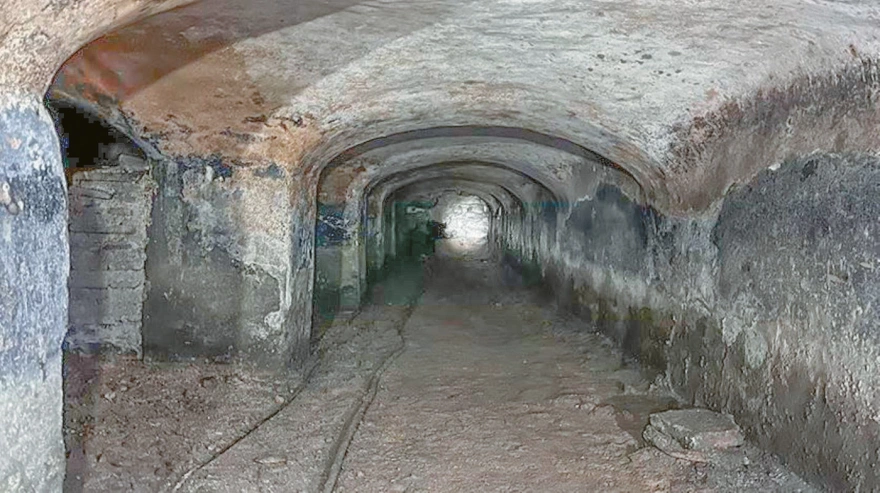
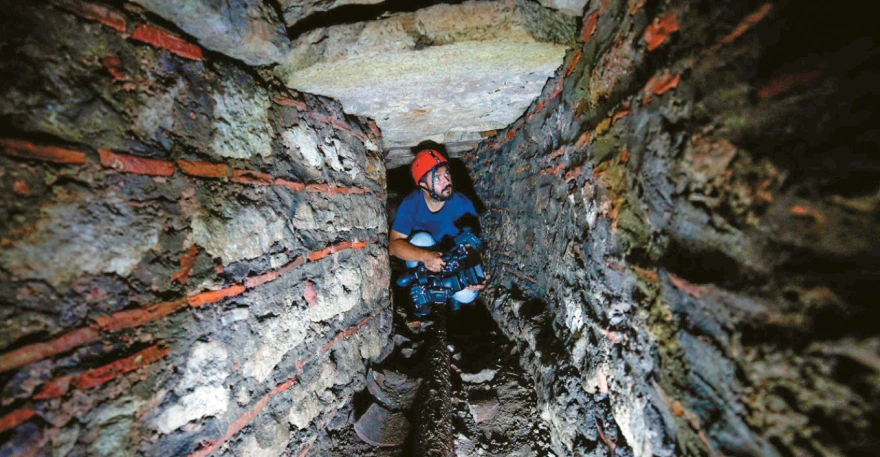
(Images of the underground passages linking Hagia Sophia with other landmarks of Constantinople, including the Imperial Palace)
In addition to the underground communication system with the rest of the City, small underground chambers were discovered that are believed to have been used by Byzantine clergy as secret writing rooms or storage spaces for sacred texts, away from public view, and above all as crypts to prevent them from falling into enemy hands.
The 9-kilometer network does not remain confined beneath the church. The passageways open in two main directions: towards the Great Palace, after tunnels leading to the old Byzantine administrative center were confirmed, allowing the emperor to travel to the church during times of unrest without going out onto the street. But also towards Topkapı: during the Ottoman period, the same tunnels were partially cleared to transport water to the gardens of the sultans’ palace.
Researchers have also found carvings on the underground walls made by the workers who built the church in AD 532, bearing their names or small prayers.
City beneath the City
The underground network of Hagia Sophia is connected to and forms part of the wider underground labyrinth of Constantinople. However, the nature of this connection differs significantly from popular legends. The reality behind this vast network, as also confirmed by official archaeological research, concerns the City’s extensive hydraulic network, with Hagia Sophia organically connected to the enormous water-supply and drainage network that extended beneath Constantinople, as well as to the cisterns: the church’s passageways and conduits are connected underground to the system that supplied the nearby Basilica Cistern. Water traveled from the aqueducts in the north of the city, passed through the central cisterns and ended up in the wells beneath the church. Archaeologists have confirmed that Hagia Sophia’s underground drainage conduits (the rainwater channels) connect with the corresponding large conduits that ran beneath the Hippodrome (today Sultanahmet Square), forming a common underground avenue for the waters.
The 285 underground structures
An extensive three-year study by Turkish scientists, completed on the historic peninsula, brought to light 285 ancient underground structures. These are scattered beneath Hagia Sophia, Hagia Irene and Topkapı Palace. They include hidden holy springs, submerged gardens and cisterns, and escape tunnels that connected Hagia Sophia with the Great Palace of the Byzantine emperors.
Researchers are constantly encountering new evidence proving that Hagia Sophia is the centre of an underground city beneath the City, with hidden passages, secret rooms and other secrets buried in time and oblivion that remain hidden beneath the feet of the millions of people who live in Constantinople today. A characteristic example is the City’s second-largest surviving Byzantine religious building. In the Fatih district, overlooking the Golden Horn, where the Molla Zeyrek Mosque now stands, the Pantokrator monastery complex was originally built.
The complex was erected in the 12th century by Empress Irene, wife of Emperor John II Komnenos, who dedicated the foundation to Christ Pantokrator, Christ Almighty. Designed as a multifunctional religious institution, the complex combined places of worship with social services. It operated not only as a church, but also as a hospital, medical school and public kitchen. The institution served both the spiritual and practical needs of the Byzantine capital.
What makes the site particularly remarkable lies beneath its foundations. Labyrinthine corridors beginning in its underground chambers form a chaotic, unexplored labyrinth to this day, which appears to have been part of a wider system of cisterns and underground, hidden corridors.
Scientists believe that these underground spaces served for water storage, but also as communication routes, storage facilities and, at certain periods, detention areas. Researchers have established that the narrow passages branch off in various directions, raising the possibility that they once connected different parts of the city. Although they have not been fully mapped, these routes are widely believed to have formed part of a broader underground network used for logistical and administrative functions. The labyrinth-like layout reinforces descriptions portraying Constantinople as a city where movement and survival often depended on hidden infrastructure operating away from public view.
This gives scientists the incentive to continue their research intensively using LiDAR, ground-penetrating radar (GPR) and robotic cameras. Archaeologists estimate that they will manage to find remains of the Theodosian Church, as they search for deeper foundations and architectural elements from the second Hagia Sophia, that of Theodosius II, which was completely destroyed by fire during the Nika Riots in AD 532. They also hope that intact crypts and relics will come to light: there are sections of the network that are completely sealed by compacted sediment or stone walls. Scientists hope that intact ecclesiastical vessels or sealed tombs of Byzantine emperors and patriarchs that were never looted are hidden behind these walls.
The aim, however, in the first phase, is to determine the exact route of the central imperial escape passage and establish whether its future restoration is possible, so that it can become partially accessible to the public.
To some extent, archaeological research confirms the myths and legends about underground passages through which, for example, the priest descended with the sacred vessels when the Ottomans entered the City and has been waiting for the liberators ever since, or rooms beneath Hagia Sophia where the “Marble King” is said to be.
The legends
The underground world of Hagia Sophia fueled the popular imagination for centuries, creating some of the darkest, most fascinating and frightening legends of the Christian and Islamic traditions. These stories survived by word of mouth, and many of them acquired a new dimension when divers began exploring the dark tunnels. So, what are the most famous legends hidden in the depths of the church?
■ The Secret Room of Justinian: For centuries, there was a rumour that Justinian had built a golden room deep beneath the sanctuary, where he had hidden the empire’s greatest treasures, as well as sacred relics that had survived from Jerusalem, such as the Ark of the Covenant or pieces of the True Cross. When divers and archaeologists opened the sealed passages, they found no gold. They did, however, find the scriptoria (writing rooms) and storage areas. It was there that the Byzantines really did hide valuable religious manuscripts and sacred vessels during sieges so that they would not fall into enemy hands.
■ The Hidden Patriarch and the Divine Liturgy: One of the most moving Greek legends states that on 29 May 1453, at the moment when the Ottomans were breaking down the doors of Hagia Sophia, the Patriarch (or, according to other versions, a priest) was celebrating the Divine Liturgy. As the invaders entered the church, the priest took the Holy Chalices and entered the southern wall of the sanctuary, which closed behind him as if by a miracle. The legend says that the priest has remained ever since in a secret, hidden crypt beneath the church, waiting in a state of deep sleep. He will emerge from his hiding place only when the church once again functions as a Christian church, in order to continue and complete the liturgy from the point at which it was interrupted.
■ The Imprisoned Satan: One of the City’s best-known legends, widely circulated during the Ottoman period as well. According to tradition, when Emperor Justinian was building Hagia Sophia, Satan tried to sabotage the project, misleading the workers and destroying the walls at night. With the help of the Saints, Justinian managed to trap Satan and chain him in the deepest, flooded underground chambers of the church. The legend said that if someone approached the wells on quiet nights, they could hear the sound of the chains and the breathing of the imprisoned demon.
■ The Virgin Mary’s Tear and the Weeping Column: Although it is located on the ground floor of the church, the Weeping Column (or Column of Wishes) is connected to the underground chambers. It is a column clad in copper that is always wet. Christian legend held that the column weeps for the fall of the empire or that the Virgin Mary touched it. The Ottoman legend held that Saint George of Islamic tradition placed his finger there to turn the church towards Mecca. The column is in fact connected to the underground network of cisterns. Because of the enormous humidity coming from the tunnels and the porous marble, water rises upwards, causing the column to “sweat” continuously for centuries.
The underground network of Hagia Sophia is therefore the heart of a wider, remarkable system that has kept Constantinople alive and standing for 16 centuries. But what other secrets could it still conceal? What precious or astonishing discovery might be waiting in the underground labyrinths beneath Hagia Sophia, placed there by the Byzantines so that it would remain hidden from the eyes of Mehmed the Conqueror and the Ottomans who conquered the City?
Ask me anything
Explore related questions




