





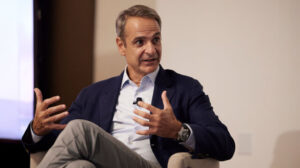
Kyriakos Mitsotakis highlighted the need for greater fiscal flexibility from the European Union so that member states can support households facing pressure from higher energy costs, in an interview with Bloomberg.
The Greek Prime Minister argued that Greece is currently in a stronger fiscal position than several other European countries, having achieved its fiscal targets, recorded a surplus and reduced public debt at a high rate.
As he noted, this fiscal position creates room to support incomes, although the scope for action is not unlimited. For this reason, he said, a European initiative may be needed to allow greater flexibility, particularly ahead of a difficult winter.
“At some point, Europe may also need to take a step forward and give us greater fiscal flexibility so that we can support households,” the Prime Minister said.
Mr Mitsotakis made particular reference to freedom of navigation, against the backdrop of the situation in the Red Sea and attacks by the Houthis.
As Prime Minister of a country with a strong shipping presence, he stressed that Greece has a “major interest” in safeguarding freedom of navigation and reminded that the country is already participating in the European operation in the Red Sea.
Kyriakos Mitsotakis stressed that a return to freedom of navigation must happen quickly and opposed any form of charge for passage through open sea routes. “We can never accept tolls. We can never accept any kind of charges for passage through open sea routes,” he said.
As he explained, such a development would increase the cost of international trade and have an impact on inflation. At the same time, he said that Europe could play a more active role in the Gulf region, provided there is agreement among the parties involved.
“No one is going to send military assets into an area while hostile fire is taking place there,” he said, adding that a similar European presence has already existed in the Red Sea.
Asked about comments by Greek shipowners that they could accept the relevant charges, the Prime Minister said that the government was “categorically opposed” to such a prospect. As he explained, the ability of shipping companies to pass the cost on to the end consumer is one of the reasons why the government does not want such a precedent to be created, particularly in an environment of high inflation.
Mr Mitsotakis linked the energy pressure to the need to support households during the winter. He said that a subsidy for heating oil had already been announced, pointing out that heating needs are particularly high in northern Greece.
“I cannot accept that people in northern Greece […] will not have heating oil to heat their homes,” he said. At the same time, he referred to fuel taxation, acknowledging that Greece has relatively high taxation in this sector.
As he explained, a substantial reduction in fuel taxes could only take place if a European exemption were granted, so that the loss of revenue would not be included in the fiscal expenditure indicator that the country is required to comply with.
“The only way for me to significantly reduce taxes on fuel is for this to become a European initiative,” he said. The Prime Minister stressed that the need for temporary support for households does not mean abandoning the green transition. As he noted, more than 55% of electricity in Greece already comes from renewable energy sources.
At the same time, he described maintaining refining capacity as a strategic advantage for Europe, noting that the energy transition does not mean that fossil fuels can be abandoned immediately. In this context, he made specific reference to Greek refineries, noting that they export significant quantities of petroleum products.
‘We will not put our fiscal success at risk’
Referring to the course of the Greek economy from the 2010 crisis to the present day, Mr Mitsotakis stressed that the country’s fiscal picture has changed significantly.
As he said, few would have expected a few years ago that Greece would be able to borrow at a lower cost than four G7 countries.
At the same time, he made clear that the government does not intend to put the fiscal performance that has been achieved at risk. “I am not going to put this success at risk,” he said, stressing that Greece will remain committed to European fiscal rules.
“We will never again go through a crisis like the one we had to deal with a decade ago. Therefore, we cannot move away from our fiscal targets,” he said.
Investment and attracting capital from abroad
The interview also touched on efforts to attract wealthy individuals, investors and businesses to Greece.
The Prime Minister said that the government had held meetings in London and New York with major wealth creators and hedge fund managers in order to establish what would be required for them to relocate to Greece. As he said, the regulatory framework was subsequently adjusted, and there have now been moves by investors and companies to establish themselves in the country.
Among other things, he referred to Chris Rokos and Millennium, arguing that their presence in Greece contributes to the economy as well as to the creation of jobs for Greek workers.
“Greece is not just a place to visit. It is also a place to do business,” he said. Among the country’s advantages, he cited the tax regime, quality of life and access to skilled human resources.
He made particular reference to engineers and the technology sector, noting that several companies are choosing Greece to establish offices because they can find specialised personnel at a cost that remains competitive compared with other European countries.
At the end of the interview, Kyriakos Mitsotakis was also asked about the next leadership of the European Central Bank. The Prime Minister did not refer to any specific candidate, stressing that Greece already has an important institutional role through the presidency of the Eurogroup by a Greek official and that several important European positions are opening up.
As he noted, Greece should remain neutral, as it is involved in managing part of the relevant process. “I am sure that good choices will be made,” he said.
In closing, the Prime Minister returned to the issue of attracting human resources and capital to Greece, linking it to the return of people who had previously left the country in search of better professional opportunities.
As he noted, the creation of jobs and the establishment of businesses in Greece can provide an answer to the phenomenon of the flight of talent that characterised previous periods.
Ask me anything
Explore related questions




