





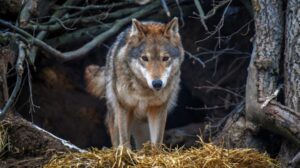
The Lamia Hunting Association is expressing strong concern over wolf attacks on hunting dogs and sightings of wolves in areas near villages in Phthiotis, with its representative, Ioannis Tsiknis, claiming that incidents have increased significantly.
Speaking to Lamia Polis 87.7, Mr. Tsiknis claimed that hunters are now losing “five every day” hunting dogs, describing a situation which, as he said, is becoming increasingly difficult. The discussion was prompted by a complaint from a hunter from Spercheiada, who said that wolves attacked his dogs in Gardiki, killing one and seriously injuring another. He said this was the third time his dogs had been attacked.
Ioannis Tsiknis described the situation as particularly worrying, claiming that wolves have increased in number and have moved to lower altitudes compared with the past.
Mr. Tsiknis claimed that the attack reported in Gardiki “is not the only incident.” As he said, the Hunting Association has sent messages to hunters asking them to report every encounter with wolves and every related attack. Asked how often dogs are lost, he replied, “five every day,” and clarified, following a question from Anna Bampeta, that he was referring to hunting dogs. “At some point, we will reach the point where we give it up altogether,” he said, explaining that a dog is a hunter’s companion and requires years of care and training. When asked whether the attacks have now become an almost daily occurrence, he insisted: “Daily, five at a time.”
[Phthiotis: Hunters Report Surge in Wolf Attacks – “Attacks on Hunting Dogs Every Day”]
Pavliani, Neochori, Sklithro and Apostolia: “These Are Red Zones”
Asked which areas hunters avoid, Mr. Tsiknis first mentioned Pavliani and Neochori. He also referred to Sklithro and Apostolia, saying characteristically: “These are red.” As he explained, the possibility of encountering wolves now affects where they choose to go hunting. “It is a risk, and we avoid going to areas where there are wolves,” he said, adding: “We no longer go to our villages for this purpose.”
“They Are Members of Our Family Now”
The association’s representative placed particular emphasis on the bond between hunters and their dogs. “They are members of our family now,” he said of animals that grow up alongside them for seven, eight or even ten years. Beyond the emotional loss, he also spoke about the time and cost required to care for and train a hunting dog.
According to him, the dog is particularly vulnerable when searching for prey: its attention is focused on scents, with its head down, and it may not notice a wolf in time. He described it as “a very easy target.”
Mr. Tsiknis also said that hunters cannot deal with a wolf that attacks their dog themselves, citing the legal consequences of killing the animal.
Concern About Villages and Livestock Farming
The discussion expanded to reports of wolves near villages and the fear that, as the journalist noted, has been expressed by residents of mountainous areas. Mr. Tsiknis argued that the presence of wolves also affects livestock farming, as the loss of animals is difficult to attribute to and prove as a wolf attack when the necessary evidence is not found.
He also described a personal experience during an outing with friends and horses in the mountains. As he said, dusk caught up with them while they had stopped and they realized there were wolves around them. “The question is one: What were they seeing as prey? Us or the horses?” he wondered.
He also expressed concern for the safety of people who travel through the mountains at night.
“There Should Be an Official Census and a Bounty”
As a first step toward addressing the issue, Mr. Tsiknis called for “an official census” of the wolves. As he said, hunters have an idea of the areas where they move, but an official assessment of the population is needed.
Mr. Tsiknis initially called for an official census of the wolves and then proposed that “a bounty should be placed on them.” “Not to hunt them, not to classify them as game, but to put a bounty on them,” he said, calling on the state to take measures to reduce their population. As he noted, this is a proposal by the Lamia Hunting Association, which, he said, they intend to raise in meetings with authorities and MPs.
Ask me anything
Explore related questions




