





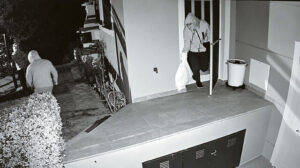
Modern burglary does not always begin at the front door. Police case files, along with information gathered by Proto Thema from people with inside knowledge of how organised rings operate, suggest it often starts days or even weeks earlier, with a single piece of information.
On one side of the chain are people who move unnoticed among the professionals households deal with every day, sometimes inside the home itself. On the other are career burglars who specialise in locks or in climbing, and a phenomenon investigators call “crime tourism”.
Gangs travel from country to country, rent houses and cars, and target luxury homes. They work for a few days, then disappear, often having crossed a border with their haul.
The informant needs to know who lives in the house, when they leave and return, and whether an elderly person is at home. They need to know whether the family has money or jewellery, which room holds the safe, whether there is an alarm or cameras, and whether the flat stands empty at set hours. The informant may never take part in the burglary. They may not even be near the property when it happens. But they have already supplied the most valuable tool of all, the target.
Changes in the way people live in recent years have raised demand for domestic workers and carers for the elderly. Working parents, older people living alone and families with no spare time hire help every day, and hand over far more than a key. They hand over their daily routine. Case files from recent years repeatedly record organised groups using people working inside homes to gather information.
Domestic workers
The most recent case is typical. On 19 September 2026, the Hellenic Police’s Organised Crime Directorate announced it had dismantled a criminal organisation and solved 23 burglaries. The case involved an organised network for identifying suitable homes, and in some instances a member of the group worked as a housekeeper to collect the necessary details.
The pattern is not new. In 2020, in another major burglary case in Attica, the region around Athens, officers found that information on target houses was being obtained from domestic workers. In April 2024, the authorities dismantled an organisation linked to 16 burglaries and loot worth more than €690,000. They said one woman had used her job as a housekeeper to feed information to the other members.
Georgian criminal networks feature prominently in case files of recent years. Officers who have handled such cases describe them as highly skilled technically, especially at opening doors and defeating different types of lock. This is the expertise of particular criminal organisations, not a trait of an entire nationality. The files show these burglars knowing many types of key and lock in depth, and able to open a door without leaving visible signs of forced entry.
The skills come with the equipment to match. Police operations have turned up hundreds of keys, skeleton keys, key-cutting machines, magnetic opening tools and specialist break-in gear. In a single case in June 2026, officers seized 253 keys, seven skeleton keys, a magnetic tool for opening drawers and other break-in equipment. Sources with knowledge of similar investigations also cite the use of corrosive substances that attack the mechanical parts of a lock, one of the newest weapons to appear in the burglary world. It is not found in every case, but police tracking the development of organised groups’ expertise are now watching for it.
Cleaning crews
In some case files, the Greek authorities have also linked criminal organisations to a Eurasian organised crime structure known as vor v zakone, or “thieves in law”. It is a historically formed system of post-Soviet organised crime, with a strict hierarchy, internal rules and figures who hold a special place at the top of the pyramid. In such cases, what matters is not only the burglar’s technical skill but his link to the person who can secure the information. And information can come from almost anywhere.
Cleaning and building-maintenance crews, for example, often hold a key to a block’s main entrance. A worker can enter without arousing suspicion, spend long periods in the communal areas and, over time, learn who lives where. He does not need to know the combination to a safe. It is enough to know that the third-floor tenant leaves every morning, that the couple on the fifth floor go to their country home every weekend, that the elderly woman on the second floor lives alone, or that a particular car disappears from the garage every August. It amounts to building a dossier on daily life, without files or computers.
Professions that have boomed since the pandemic have joined the same category in recent years. When officers find that the perpetrators of a burglary had an unusually detailed picture of a victim’s routine, they now examine every possible route by which the information could have leaked.
The case files show different “schools” of burglary. Some groups rely mainly on technical knowledge of locks, others on climbing up balconies and light wells, and others on force and speed, breaking doors or windows.
Experienced officers describe an almost informal division by floor. In some cases involving Roma perpetrators, the choice more often falls on detached houses, ground floors and first floors, where entry can be gained quickly by forcing a way in, climbing or going through a window. From the first floor upwards, organised groups with greater technical expertise in locks appear more often, including certain Georgian networks.
Nationalities
According to the Hellenic Police’s latest report on organised crime, based on 2024 data, three in four organised groups of thieves and burglars are made up of Greeks (76.26 per cent). Foreign nationals account for 18.71 per cent, and mixed groups for 5.04 per cent.
Roma dominate the Greek groups, making up 76.69 per cent of domestic groups. Among foreign groups, one in two is Albanian (48.15 per cent), followed by Georgian groups (22.22 per cent), whose defining feature is that they include no one of another nationality. Romanian groups, whether pure or mixed, come next, then Algerian groups (7.41 per cent) and others with smaller shares.
Most groups (84.89 per cent) operate within a single prefecture or region, while 13.67 per cent of the gangs dismantled were found to be active nationwide.
Crime tourism
If crime had an estate agent, some burglars would ask for a “ground floor with easy access” and others “first floor to penthouse”. Then the Chileans arrived and moved the business upmarket. The organised groups from Chile that have appeared in Europe in recent years have no interest in an ordinary flat in an apartment block. They target luxury homes, mansions and properties thought to hold expensive watches, jewellery, cash and safes.
Behind their activity lies a serious phenomenon that is increasingly concerning European law enforcement, known as “crime tourism”.
For about the past two years, the Organised Crime Directorate, and its burglary section in particular, has been dealing with Chilean gangs working to a different operating model. They do not settle in Greece or build permanent infrastructure. They arrive for a few days or weeks, stay temporarily, choose luxury homes, carry out their raids and leave for the next destination.
According to police sources, at least three or four separate Chilean cells, as well as lone offenders, have come to the authorities’ attention in the wider Athens area. The method resembles a travel package, except that the purpose of the trip is criminal: a flight, an Airbnb, a hire car, a few days of reconnaissance, then burglaries at chosen luxury properties. Once the round of raids is over, the members leave for another European country, often before the Greek authorities can link the separate cases.
A team can spend about two weeks in Athens, staying in a short-term rental flat and carrying out daily surveillance of targets. The targets are not random. They include the northern and southern suburbs, luxury detached houses, the homes of very wealthy people, and properties believed to hold watches, jewellery, safes and cash.
The case that best illustrates the scale of the problem is the burglary of a well-known shipowner’s luxury home in Vari, south-east of Athens, on 13 December 2025. The thieves took 45 handmade luxury watches worth more than €1.5 million, one of the most spectacular raids of recent years. The Organised Crime Directorate solved the case months later, identifying four people. The investigation established that members of the group had reached Greece through other Schengen countries and were staying temporarily. One left the day after the burglary and another nine days later, both bound for Barcelona.
Glyfada and Kifisia
Earlier, in summer 2025, police dismantled a criminal organisation that had hit luxury homes in Voula, Glyfada, Kifisia and Palaio Psychiko. Officers solved 10 cases, with illicit proceeds exceeding €400,000. Members used forged documents, rented accommodation and hire cars, carried specialist burglary tools and carried out systematic reconnaissance of high-value homes. The investigation revealed movements and links across Europe and Latin America, and the items seized even included documents for money transfers to Chile.
The two cases show how so-called crime tourism works: arrival in the country, temporary lodging, choice of targets, burglaries netting hundreds of thousands or even millions of euros, and departure for the next destination. Barcelona appears repeatedly on these groups’ routes. Police sources say Spain serves as an important hub for the perpetrators’ movements and possibly for channelling stolen goods. Investigations have recorded part of the loot of certain criminal organisations going abroad, including to Spain and Latin American countries. A burglary in a luxury home in the northern or southern suburbs may therefore be just one stop on the route of an international criminal network.
The picture that emerges from the case files is far more complex than the classic stereotype of the burglar. Organised crime now works as a chain. One person knows the target. Another confirms the information. Another keeps watch. Another opens the door. Another waits in the car. Another takes the stolen goods, and someone thousands of miles away arranges their sale.
Ask me anything
Explore related questions




