





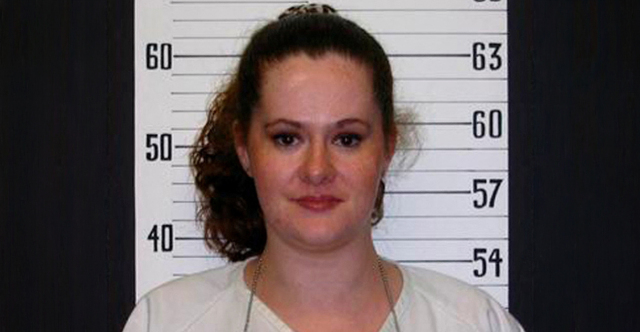
Christa Pike, the convicted murderer who survived Tennessee’s failed attempt to execute her, remains unconscious, intubated and reliant on a ventilator to breathe, her lawyers said on Friday. Their account gives the first detailed picture of the damage she suffered during the lethal injection procedure.
Medical staff at a Nashville-area hospital are fighting to save her life and clear the pentobarbital, the drug used in the execution attempt, from her system, her legal team said in an emergency court filing. They are asking the court to order the Tennessee Department of Correction to preserve all evidence relating to the failed execution on Wednesday evening.
Pike is in a critical condition two days after the authorities gave her two doses of pentobarbital, which did not kill her. According to her lawyers, she also sustained serious injuries to both arms, which were swollen, burned and blistered when she arrived at hospital. Her experts compare the drug to bleach, describing it as caustic and highly alkaline, meaning it burns on contact with skin, tissue and veins.
“At no stage did any member of the execution team realise that the intravenous lines had not been placed correctly or that the veins had been damaged, and that the pentobarbital, wholly or in part, was being channelled into Ms Pike’s body outside the intended intravenous route,” her lawyers wrote in a document filed with the Chancery Court of the 20th Judicial District of Tennessee.
The filing states that at least seven needles were used in the attempt to gain intravenous access, one of which was bent at a 90-degree angle when removed. It adds that Pike could be heard crying, whimpering and breathing loudly, and at one point said her arm felt as though it was about to burst open. A backup set of syringes was then administered.
Her lawyers also allege that the state may have prepared the injections at 8am, the originally scheduled time of the execution, but that court delays meant they were not administered until almost 12 hours later.
The filing offers the fullest account so far of the medical consequences of the failed attempt. Tennessee Governor Bill Lee has maintained that it was carried out according to the state’s established protocol, and the Department of Correction has said it followed every step of that protocol. The department has declined to comment on the pending litigation.
The court has granted Pike’s lawyers an expedited hearing on the evidence request, although no date has been set. The office of Tennessee Attorney General Jonathan Skrmetti said the governor had appropriately called for an investigation.
This was Tennessee’s second failed execution in 2026. In May, officials abandoned the execution of another prisoner, Tony Carruthers, after failing to find a suitable vein. Following the latest incident, Lee suspended all remaining executions in the state for the rest of the year and ordered an independent review to establish exactly what happened.
Pike’s lawyers have argued that the difficulties the execution team encountered were linked to intravenous access, an issue they say they had warned both the state and the courts about before the execution.
Reaction from the victim’s family has been bitter. Colleen Slemmer’s mother, May Martinez, who witnessed the procedure, said she had not received justice for her daughter. A representative of the family has said the administration has not told them what happens next, while Republican Senator Marsha Blackburn has called for Tennessee to return to the electric chair.
Pike, 50, was convicted of the murder of her 19-year-old fellow student Colleen Slemmer in 1995, when she was 18. She was due to become the first woman executed in Tennessee in more than two centuries.
Ask me anything
Explore related questions




