





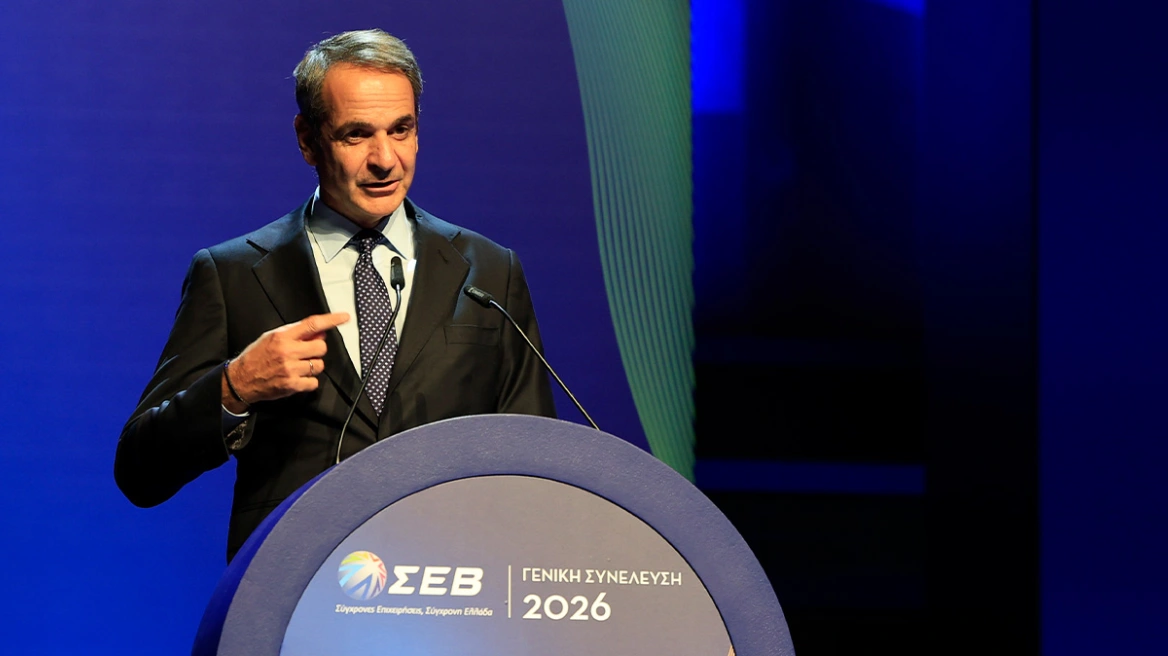
Prime Minister Kyriakos Mitsotakis has announced a direct electricity subsidy for energy-intensive industry, costing €95m, as the government moves to shield businesses from rising energy and fuel costs.
Speaking on Tuesday at the annual general meeting of the Hellenic Federation of Enterprises (SEV), the country’s main business lobby, Mitsotakis said extraordinary circumstances call for extraordinary measures. The subsidy will draw on the European framework, with the details to be set out in the coming days.
It will cover energy-intensive sectors such as cement, food, paper and plastics, with additional support for companies making green investments. Mitsotakis said the government stands alongside those who create wealth in Greece.
He said transport costs remain a heavy burden, with diesel continuing to weigh on businesses despite measures taken by the government and the refineries. On Sunday, he said the diesel subsidy would be raised for the next 15 days, as the prolonged disruption around the Strait of Hormuz keeps putting pressure on energy prices.
Turning to the economy, Mitsotakis said Greece is recording the fastest reduction in public debt among members of the Organisation for Economic Co-operation and Development (OECD). He said it was the first time since 1980 that the country had achieved a significant fall, easing the burden passed on to future generations, and described this as a key national asset.
He said the budget reflects the €2.2bn of measures he announced at the Thessaloniki International Fair (TIF) in September. Despite global turbulence, he added, Greece is among the few countries producing genuine surpluses.
According to Mitsotakis, this fiscal strength allows Greece to build buffers against fuel price rises, keeping prices at or even below the EU average.
The credibility regained by the Greek economy also means the country can now borrow more cheaply than the powerful economies of the Group of Seven (G7), something few could have predicted a few years ago, he said.
Mitsotakis said he would stand by fiscal discipline, noting that Greece had won back, at great cost, the credibility it lost in the previous decade. The government’s main aim, he added, is to meet its fiscal targets within the limits of the new EU fiscal rules.
He also said he had asked European Commission President Ursula von der Leyen to explore a joint European response to the energy challenge facing the continent. Under the proposal, surplus revenue in the EU budget would be used to fund measures protecting society from the effects of the current energy crisis.
Ask me anything
Explore related questions




