





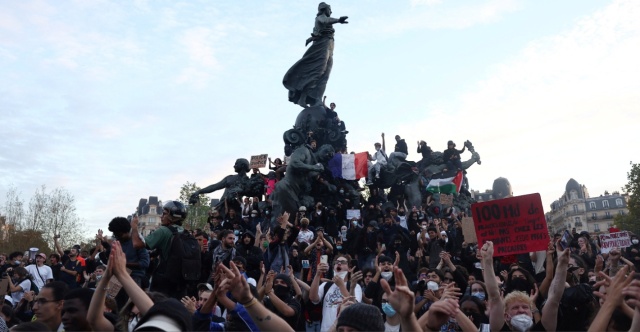
Schools in France that remained closed because of the so-called “student protests” will gradually begin reopening today, following another day of mass demonstrations across the country, with hundreds of mainly thousands of second and third-generation immigrants and leftists taking to the streets among the students.
The Education Ministry issued instructions for the gradual reopening of the most heavily affected high schools, beginning with final-year classes, while student organizations -whose demonstrations were taken over to a great extend by the immigrants and the left-wing parties- warn that the protests will intensify if the government does not respond to their demands for better conditions in schools.
Gradual return to classrooms
According to the instructions sent to school principals, in institutions most affected by the protests, students will return to classrooms in stages, with priority given to final-year students.
The ministry also asked each school to set aside half a day specifically for dialogue with students, so that they can present their proposals concerning the problems they face.
At other schools, classes are expected to take place normally, as part of the “internal democracy” measures announced by the government.
Hundreds of thousands take to the streets
Tuesday’s demonstrations were one of the largest days of mobilization since the wave of protests began in mid-September.
According to the government, 891 high schools experienced problems or suspended classes, representing nearly one quarter of the approximately 3,700 high schools in the country.
Authorities estimated the number of protesters at more than 250,000, while student organizations put the figure at 450,000 and said that around 1,800 schools had been blockaded or affected by the protests.
Students are protesting mainly over overcrowded classrooms, teacher shortages and the poor condition of school buildings.
32 arrests and 14 injured in Paris
In Paris, demonstrators began blockading schools early in the morning, while later thousands gathered at Place de la République and marched toward Place de la Nation.
Police used tear gas, while groups of protesters set fire to objects during clashes.
Paris police chief Patrice Faure announced that 32 arrests were made during the demonstration at Place de la Nation, while 14 injuries were recorded.
He said that police forces had acted “with proportionality and discernment,” noting that most of the gathering took place peacefully.
Clashes were also reported in other cities. In Marseille, police used tear gas, while in Rennes water cannon trucks were used to disperse protesters.
“The protests will intensify”
The co-general secretary of France’s largest student trade union organization, Marius Mesnil, warned that the movement would continue to intensify as long as students felt that the government was not listening to them.
“We shouldn’t have to be the students who blockade high schools and demonstrate by the hundreds of thousands in the streets just to be able to study in normal facilities,” he said.
He also argued that in recent days the government had been trying to portray the protests as weakening, adding that the latest mass turnout showed the opposite.
Prime Minister Sébastien Lecornu, for his part, said that the government “must now listen,” expressing relief that most of the organized demonstrations had taken place without serious incidents.
From Seine-Saint-Denis to across France
The movement began in mid-September at schools in the Seine-Saint-Denis area, in the northern suburbs of Paris, with key demands including reducing the number of students per class, filling vacant teaching positions and improving school facilities.
The protests gradually spread across France and took a different turn with second and third-generation immigrants mainly from Islamic origin taking over.
Education Minister Édouard Zéphyr has said that from the beginning of the crisis he sought dialogue rather than blockades, while also denouncing the presence of “extremely violent elements” within the student protests.
The government is now under pressure to provide specific responses to the students’ demands, as so far initiatives for online recording of complaints and internal dialogue in schools have not led to a de-escalation.
The major trade union confederation CGT has already announced that new mobilizations are being planned for Thursday.
Ask me anything
Explore related questions




