





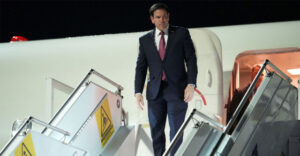
Marco Rubio is activating a center of two clear messages from Athens today. The first is aimed at the Eastern Mediterranean and Southeastern Europe, where defense, energy routes and American interests are gaining increasing weight. The second looks much farther afield: from the Pnyx, the U.S. Secretary of State is expected to call on the United States and Europe to rediscover the “Western spirit” and jointly confront the new era of great-power competition.
Greece already has a place in key elements of this planning. The F-35s have been set in motion, the F-16s are being upgraded to Viper configuration, American LNG is flowing through Greek infrastructure toward the Balkans and Eastern Europe, Chevron and ExxonMobil are involved in Greek exploration activities, while the 3+1 format with Cyprus and Israel is returning to the agenda and today’s visit concerns the next step.
The curtain rises shortly at the Foreign Ministry. After the embraces and warm atmosphere at the airport, Giorgos Gerapetritis will welcome Marco Rubio, followed by a bilateral meeting and joint statements, after which the two ministers will officially launch the 6th Greece-U.S. Strategic Dialogue. Following the plenary session, the individual working groups will continue their work on defense, energy, investment, technology, shipping and regional issues.
The composition of the American delegation also indicates the breadth of the issues on the table. Alongside Rubio is Ambassador Kimberly Guilfoyle, whom he has publicly credited with promoting U.S. energy interests in Greece and Southeastern Europe, with particular reference to the Vertical Corridor. Also traveling with him are Kate Dillon, responsible for Educational and Cultural Affairs, and Dylan Johnson, responsible for Global Public Affairs. The groundwork had earlier been laid by Allison Hooker, head of the State Department’s Political Affairs Bureau, who had visited Athens to prepare for the trip.
The Pnyx
After the inauguration of the new wing of the U.S. Embassy, Rubio will head to the Pnyx for the most politically charged stop on his program. According to information, he will not limit himself to the traditional reference to Greece as the birthplace of democracy. With the Acropolis in the background, he is expected to call on Americans and Europeans for a major “renewal of the Western spirit,” linking Athens and Rome, the Christian tradition and the founding of the American Republic in a single historical trajectory.
In ancient Greece, he will look for what he believes later gave the West its impetus: curiosity, courage, ambition and the boldness to explore the unknown. The political thrust will concern the present. Rubio is expected to warn that much of the Western world has forgotten these qualities and to call on the United States and Europe to reject decline, defend their common heritage and jointly confront the new era of great-power competition.
The F-35 weapons
In defense, the discussion has already moved beyond the acquisition of the F-35s. The next chapter is what capabilities the new fighter jets will have and how they will operate alongside the upgraded F-16 Vipers. Athens has already opened discussions with Washington on additional advanced weapons and systems. The idea is not simply to add new missiles to a shopping list, but to build around the F-35s and Vipers a complete mission package for the Hellenic Air Force of the next decade.
The aircraft are the foundation. The real change will be determined by the weapons they will be able to carry, the systems they will operate with and the missions they will be able to undertake. The Strategic Dialogue will also include a Letter of Intent for cooperation between the Hellenic Armed Forces and the Florida National Guard.
LNG
The Vertical Corridor is the route through which Greece is seeking to channel larger quantities of American LNG toward the Balkans and Eastern Europe. For Athens, this means a greater role in the region’s energy flows. For the United States, it means greater access for American natural gas to markets that continue to reduce their dependence on Russia.
Chevron and ExxonMobil add a second dimension. The presence of two American energy giants in Greek offshore exploration puts specific business interests in an area where energy planning is accompanied by geopolitical and legal disputes.
South of Crete, where the Libyan side has raised claims linked to the Turkish-Libyan memorandum, Chevron’s presence adds a factor that did not exist a few years ago. This does not mean that an American company turns Greek positions into Washington’s positions. It does, however, mean that there are now specific American economic interests in the same area.
The next steps in the 3+1
Marco Rubio knows the Greece-Cyprus-Israel-U.S. framework well. As a senator, he played an active role in the legislative effort that strengthened American involvement in the security and energy cooperation of the Eastern Mediterranean.
The 3+1 is now returning with specific substance: energy, electricity and digital interconnections, and regional security. That is why Athens will pay particular attention to Rubio’s wording on the Eastern Mediterranean. A dramatic American intervention in Greek-Turkish affairs is not expected. What will matter, however, is how Washington connects Greece with the region’s energy routes, regional partnerships and security.
Rubio’s tour does not include a stop in Ankara. This does not mean a change in American policy toward Turkey, but it breaks with the previous, almost automatic logic of a parallel stop in the Turkish capital.
The meeting at the Maximos Mansion
In the afternoon, Rubio will meet with Kyriakos Mitsotakis, following the prime minister’s return from Croatia, after which a dinner will be held in honor of the U.S. Secretary of State. The discussion will cover, beyond bilateral issues, the Middle East, Ukraine and the Eastern Mediterranean.
By then, the Strategic Dialogue will also have produced three specific signatures: the cooperation agreement with the Florida National Guard, the renewal of the memorandum on the protection of archaeological and ethnological material, and the memorandum on the mutual recognition of certificates of competency for seafarers.
Ask me anything
Explore related questions




